Hall of Mirrors: The Baroque Masterpiece of the Palace of Versailles
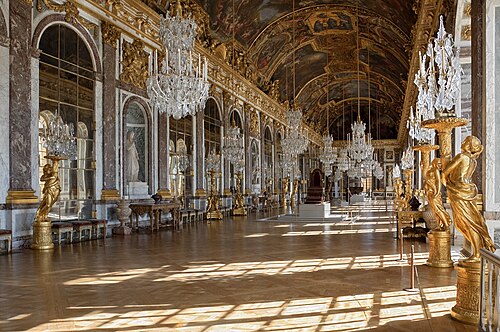
The Hall of Mirrors (known in French as the Grande Galerie or Galerie des Glaces) stands as one of the most iconic rooms in the royal Palace of Versailles. A triumph of Baroque style, this grand gallery was designed not merely as a passageway, but as a powerful symbol of the absolute authority of King Louis XIV. Located on the piano nobile (the first floor) of the palace's central body, the hall faces west, offering a breathtaking view of the palace gardens.
Throughout history, the Hall of Mirrors has served as a stage for events that reshaped the world, from the proclamation of the German Empire to the signing of the Treaty of Versailles.
Key Facts
- Dimensions: 73 meters long, 10.5 meters deep, and 12.3 meters high.
- Architects: Designed by Jules Hardouin-Mansart with interior decorations by Charles Le Brun.
- Key Feature: 17 mirrored arches reflecting 17 garden-facing windows, composed of over 350 individual mirror surfaces.
- Purpose: Built to illustrate the power of the absolutist monarch Louis XIV and serve as a venue for state ceremonies.
- Historic Events: Site of the 1871 Proclamation of the German Empire and the 1919 Treaty of Versailles.
The Evolution of Versailles
The journey of Versailles began in 1623 when King Louis XIII built a modest two-story hunting lodge. Between 1631 and 1634, this was expanded into a château. However, it was his son, Louis XIV, who transformed the site into a permanent residence in 1661, envisioning a seat of government that would be the center of European culture, art, and political authority.
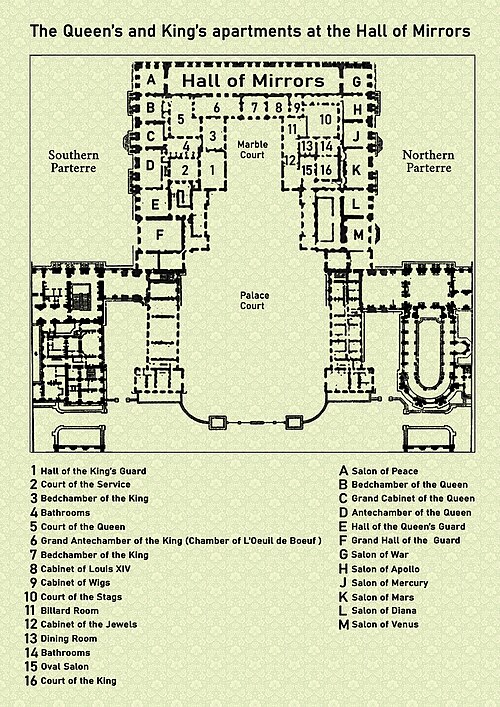
Early expansions by architect Louis Le Vau included the Forecourt and the "Le Vau Envelope," which added north and south wings housing the king's and queen's apartments. Between these wings lay a terrace supported by arcades, which eventually proved impractical due to exposure to the elements.
Construction of the Gallery
Between 1678 and 1684, the Hall of Mirrors was constructed to replace the aforementioned terrace and several smaller salons. Architect Jules Hardouin-Mansart led the design, while the artist Charles Le Brun created the lavish interior decorations. The hall is one of the largest rooms in the palace, reaching up to the Attic floor of the Corps de Logis (the main central block). Interestingly, the upper-floor square windows visible from the exterior are purely aesthetic, as there are no rooms behind them. Due to its immense size, the hall was never equipped with fireplaces, as it was considered too large to heat effectively.
Artistry and Decoration
The hall's most striking feature is the interplay between its 17 windows and 17 corresponding mirrors. These mirrors served a dual purpose: they brought the light and imagery of the gardens inside and reflected candlelight during evening events. Beyond aesthetics, the mirrors were a subtle display of French economic strength and the king's immense wealth.
The original furnishings were crafted from solid silver, including famous guéridons (small tables). However, in 1689, Louis XIV ordered these to be melted down to fund the War of the League of Augsburg. Most of the current furniture dates to the 19th century, replacing pieces lost during the French Revolution.
Sculptures and Ceiling Masterpieces
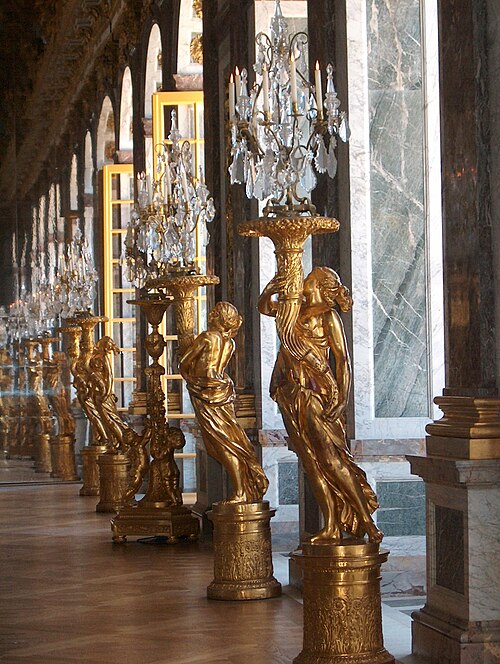
The room is adorned with marble and porphyry busts of eight Roman emperors, alongside sculptures of Greek and Roman deities and Muses, including Bacchus, Venus, and Hermes. The original Diana of Versailles was moved to the Louvre in 1798 and was replaced by a copy during the 2004–2007 restoration.
The ceiling is a narrative masterpiece. The central scene, The King rules by Himself, asserts Louis XIV's absolute power. Surrounding panels depict the Franco-Dutch War (1672–1678), the War of Devolution (1667–1668), and various domestic achievements. These scenes were designed as propaganda, with titles provided by the regime's official historians, the poets Boileau and Racine.

A Venue for Power and Pageantry
The Hall of Mirrors was the heart of court life, hosting royal weddings—including that of Louis XVI and Marie Antoinette in 1770—and opulent embassies. One of the most famous events was the 1745 Yew Tree Ball, where Louis XV met his future mistress, Madame de Pompadour.
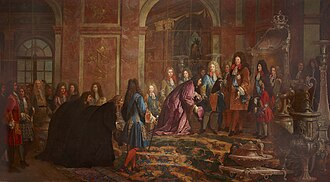
The hall also received foreign dignitaries, such as the Doge of Genoa in 1685 and the Siamese Embassy, which is noted as one of the most opulent events of Louis XIV's reign. At its peak, the hall was illuminated by over 3,000 candles.
Modern Historical Significance
The gallery's role shifted from royal pageantry to global politics in the 19th and 20th centuries. On January 18, 1871, following the Franco-Prussian War, the Second German Empire was proclaimed here by Otto von Bismarck and William I. Later, on June 28, 1919, the hall witnessed the signing of the Treaty of Versailles, ending World War I.
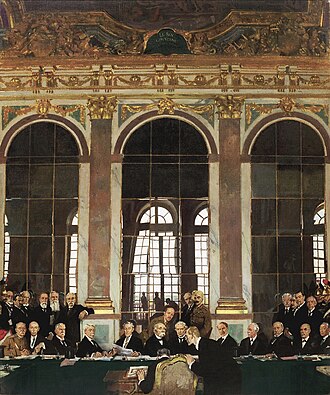
Today, the Hall of Mirrors remains a site for official French Republic ceremonies, having hosted leaders such as U.S. President John F. Kennedy and the G7 summit representatives.
Summary of the Hall of Mirrors
| Feature | Details |
|---|---|
| Construction Period | 1678–1684 |
| Primary Architects | Jules Hardouin-Mansart & Charles Le Brun |
| Dimensions | 73m (L) x 10.5m (W) x 12.3m (H) |
| Key Architectural Elements | 17 mirrored arches, 17 garden windows |
| Major Historical Events | Proclamation of German Empire (1871), Treaty of Versailles (1919) |
Frequently Asked Questions
Why are there so many mirrors in the hall?
The mirrors were designed to reflect the gardens, bringing the outdoors inside, and to amplify candlelight. They also served as a symbol of the French economy's efficiency and the King's wealth.
What happened to the original silver furniture?
The original silver guéridons and other furniture were melted down in 1689 by order of Louis XIV to provide funding for the War of the League of Augsburg.
What is the meaning of the ceiling paintings?
The paintings serve as royal propaganda, depicting the military victories of Louis XIV, his domestic achievements, and his claim to absolute power, specifically in the central panel The King rules by Himself.
Why was the Hall of Mirrors built where it is?
It replaced a terrace that was considered architecturally misplaced and too exposed to the weather, providing a more functional and grand space between the King's and Queen's apartments.
Is the Hall of Mirrors still used today?
Yes, it is reserved for official ceremonies of the French Republic and has hosted various heads of state and international summits.