Baroque Art and Architecture: A Legacy of Grandeur and Drama
The Baroque period, spanning the 17th and 18th centuries, represents one of the most opulent and emotionally charged eras in human creativity. Emerging in Europe and eventually spreading to the Americas and Asia, the Baroque style is characterized by its dramatic intensity, lavish ornamentation, and a desire to awe the viewer. From the sweeping curves of Roman cathedrals to the intricate compositions of Bach and Vivaldi, the movement sought to break away from the rigid balance of the Renaissance in favor of movement and grandeur.
Key Facts
- Timeframe: Active primarily during the 17th and 18th centuries.
- Geographic Reach: Originated in Europe and expanded to the Americas and Asia via colonial influence.
- Etymology: The term originally referred to irregular, imperfectly round pearls.
- Core Characteristics: Emphasis on drama, contrast, ornate detail, and emotional appeal.
- Evolution: Transitioned into the more flamboyant and asymmetric Rococo style before being replaced by Classicism.
The Origin of the Word "Baroque"
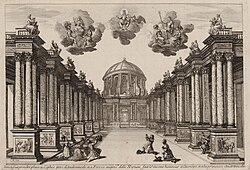
Long before it described an artistic movement, the word baroque (and the Portuguese barroco) was a term used in jewelry. In the 16th and 17th centuries, it described pearls that were irregular or imperfectly round. For instance, a 1531 inventory of the treasures of Charles V of France used the term in this context, and a 1694 edition of Le Dictionnaire de l'Académie Française defined it specifically as applying to pearls that lacked a perfect circle.
It was not until the mid-19th century that art historians adopted the term to describe post-Renaissance art. Initially, this usage was derogatory; critics like Jacob Burckhardt in 1855 used "baroque" to ridicule artists who he believed lacked respect for tradition and abused detail.
Baroque Architecture Across the Globe
Baroque architecture is defined by its scale and theatricality. While it began in Italy, it evolved into distinct regional variations as it spread.
Italian and Spanish Baroque
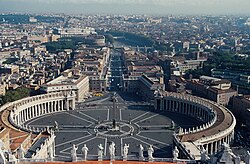
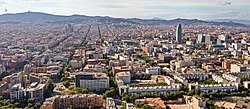
In Italy, the style reached its zenith with works like St. Peter's Square in Rome, designed by Gian Lorenzo Bernini. Spanish Baroque also flourished, seen in the Palacio de la Merced in Córdoba and the Virreina Palace in Barcelona. In Granada, the Baroque interior of the Granada Cathedral, designed by Alonso Cano, is noted for its dramatic contrast between massive white columns and gold decor.
French and Central European Influence
French Baroque is perhaps best exemplified by the Palace of Versailles, featuring the Hall of Mirrors and the garden façade designed by Jules Hardouin-Mansart. Architects like François Mansart introduced heavy rustication and the frequently used mansard roof to the French vocabulary. In Central Europe, particularly Austria, Bohemia, and Poland, the period saw the construction of highly ornate abbeys and pilgrimage churches, such as the Karlskirche in Vienna.
![Quadratura or trompe-l'œil ceiling of the Church of the Gesù, Rome, by Giovanni Battista Gaulli, 1673–1678[20]](/images/55/98/5598f26e7207c53ca91add4a43b8debb41a2f29e2acd210aa4cc9a31480a285e.jpg)
Colonial Expansion: The Americas and Asia
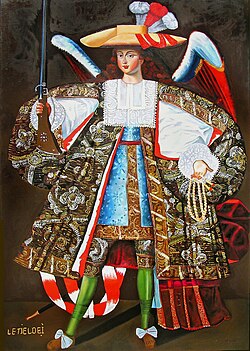
Through Spanish and Portuguese colonization, the Baroque style reached the Americas and Asia. Notable examples include the Quito Metropolitan Cathedral in Ecuador and the Church of San Francisco Acatepec in Mexico. In Asia, the style is preserved in structures like São Paulo in Macau and Diu, India.
Painting, Sculpture, and Decorative Arts
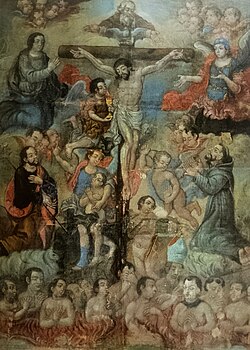
Baroque art focused on capturing a moment of high tension or deep emotion. Painters used chiaroscuro (the strong contrast between light and dark) to create three-dimensional depth and drama.
Masterworks of Painting
Some of the most enduring images of the era include Rembrandt's The Night Watch, Diego Velázquez's Las Meninas, and Artemisia Gentileschi's Judith Slaying Holofernes. These works emphasize movement and psychological intensity.
Sculpture and Furniture
Sculptors like Bernini and Francesco Mochi brought stone to life, as seen in the 5-meter tall Saint Veronica in St. Peter's Basilica. In the decorative arts, the period favored gilded wood and upholstery, with masters like Andrea Brustolon creating elaborate armchairs and thrones.
The Sound of the Baroque: Music and Theatre
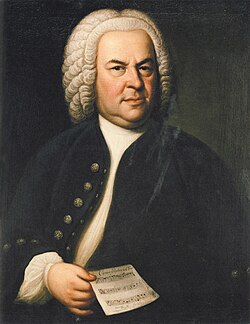
Baroque music introduced complex harmonies and the birth of opera. The era produced some of the most influential composers in history, including Johann Sebastian Bach, Antonio Vivaldi, and George Frideric Handel.
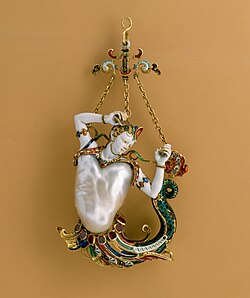
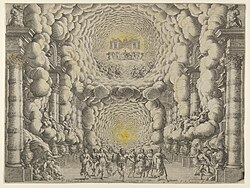
Theatrical design also evolved, with Giacomo Torelli and others creating elaborate set designs and machinery to enhance the spectacle of ballets and plays, such as the 1650 set for Pierre Corneille's Andromedé.
Transition to Rococo and Later Revivals
By the first half of the 18th century, the Baroque style evolved into Rococo, a more asymmetric, light, and flamboyant style. This is evident in the Amalienburg in Munich and the Chinoiserie elements of the Chinese House in Potsdam.
In the 19th century, a wave of revivalism brought Baroque elements back into fashion, particularly during the reign of Napoleon III. This led to eclecticism, where architects mixed elements from various periods. Features like the giant order and coupled columns became staples of this eclectic approach, influencing buildings well into the early 20th century.
| Region | Key Characteristics | Notable Example |
|---|---|---|
| Italy | Theatricality, grand scale, curved lines | St. Peter's Square |
| France | Symmetry, luxury, mansard roofs | Palace of Versailles |
| Spain/Americas | Heavy ornamentation, gold decor | Quito Metropolitan Cathedral |
| Central Europe | Ornate cathedrals, transition to Rococo | Karlskirche, Vienna |
Frequently Asked Questions
What does the word "Baroque" actually mean?
Originally, the term was used to describe pearls that were irregular or imperfectly round. It was only later adopted by art historians to describe the ornate and dramatic style of the 17th and 18th centuries.
How does Baroque differ from Rococo?
While Rococo emerged from the Baroque, it is generally more asymmetric, lighter in color, and more flamboyant, whereas Baroque is characterized by grandeur, deep contrast, and heavy ornamentation.
Who were the most influential Baroque composers?
Key figures include Johann Sebastian Bach, Antonio Vivaldi, George Frideric Handel, and Claudio Monteverdi, who contributed to the development of the concerto, the fugue, and opera.
Where can Baroque architecture be found outside of Europe?
Due to colonial expansion, Baroque architecture is prominent in the Americas (such as Mexico and Ecuador) and parts of Asia (such as Macau, India, and the Philippines).
What is eclecticism in the context of Baroque art?
Eclecticism refers to the 19th and early 20th-century practice of mixing elements from different historical styles. Baroque features, such as the giant order and coupled columns, were frequently used in these eclectic designs.