Rococo Art and Architecture: The Era of Elegance and Asymmetry
Emerging in the early 18th century, Rococo represents one of the most ornamental and theatrical periods in Western art history. Originating in Paris during the reign of Louis XV, this style evolved from the heavy grandeur of the Baroque into a lighter, more playful aesthetic characterized by curves, asymmetry, and a fascination with nature. From the intimate salons of France to the extravagant abbeys of Southern Germany, Rococo transformed architecture, painting, and the decorative arts into a celebration of leisure and luxury.
Key Facts
- Time Period: Active approximately from the 1730s to the 1780s.
- Core Aesthetic: Defined by rocaille (rock-work), asymmetry, and C-shaped or S-shaped curves.
- Origins: Started in Paris, France, before spreading to Italy, Central Europe, and South America.
- Key Themes: Pastoral scenes, mythology, romance, and the Fête galante (courtship parties).
- Successor: Eventually replaced by the more symmetrical and sober Neoclassicism.
Etymology and the Concept of Rocaille
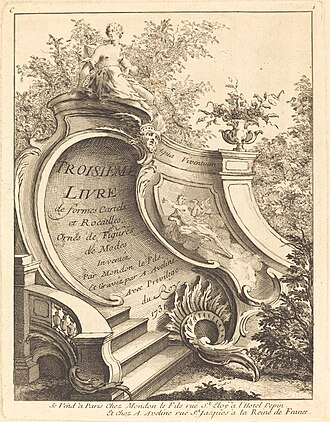
The term "Rococo" was not used during the era's peak; it first appeared in print in 1825 as a pejorative term for decoration that critics considered old-fashioned. By 1829, the author Stendhal linked it to rocaille, a French term meaning "rock-work" or "pebble-work." Rocaille originally referred to the use of shells, pebbles, and vegetal forms—such as vines and leaves—intertwined in complex, organic designs.
Regional Variations of the Rococo Style
French Rococo: The Art of the Salon
In France, the style flourished between 1723 and 1759. It was most prominent in salons—specialized rooms designed for entertaining guests and impressing visitors. A prime example is the Salon de la Princesse at the Hôtel de Soubise in Paris, designed by Germain Boffrand and Charles-Joseph Natoire. While French Rococo was highly artistic, it remained more restrained than the versions found in Central Europe.
Southern Germany and Austria: Theatrical Extravagance
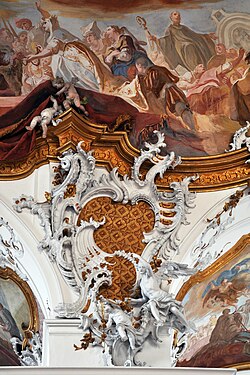
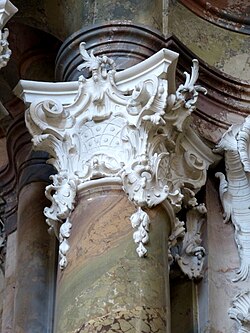
In Bavaria and Austria, Rococo reached its most exuberant heights, often blending with religious architecture. Architects like Balthasar Neumann created "theatres of light," where gilded stucco, illusionistic frescoes, and sculpture merged seamlessly. The Würzburg Residence and the Augustusburg Castle in Brühl showcase this synthesis, where the interior spaces often contrast sharply with more sober Baroque exteriors.
England and Russia
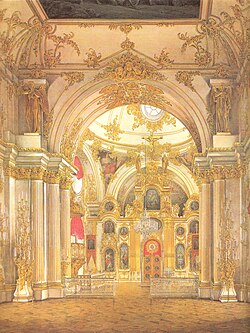
Rococo arrived later in England, appearing in the 1730s via Huguenot refugees and immigrant artists. While English furniture initially followed the neoclassical Palladian model, designers like Thomas Chippendale eventually integrated Rococo elements. In Russia, the style was adopted for imperial grandeur, as seen in the original decorations of the Winter Palace's Grand Church.
Mastery in Painting and Sculpture
The Fête Galante
Rococo painting shifted away from the heavy drama of the Baroque toward the Fête galante—a genre depicting young nobles celebrating in idyllic, pastoral settings. Antoine Watteau pioneered this style with works like The Embarkation for Cythera. He was followed by François Boucher, the favorite of Madame de Pompadour, and Jean-Honoré Fragonard, who captured the era's sensuality and wit.
Integrated Sculpture
Rococo sculpture was often inseparable from the architecture it adorned. In Spain and Austria, marble and stucco were carved into fluid, organic shapes that blurred the line between structural support and decoration. Notable examples include the portal of the Palace of the Marqués de Dos Aguas in Valencia and the Atlantes at the Belvedere Palace in Vienna.
Furniture, Fashion, and Decorative Arts
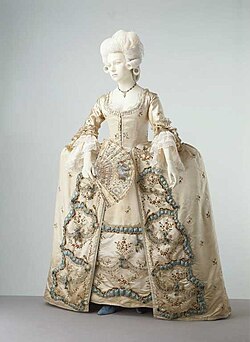
The Rococo era redefined interior luxury. Furniture featured chinoiserie (Chinese-inspired motifs), lacquered finishes, and the signature "curves and counter-curves." This aesthetic extended to fashion, where the sack-back gown and elaborate petticoats mirrored the flowing, asymmetrical lines of the architecture.
| Region | Primary Focus | Key Characteristic | Notable Example |
|---|---|---|---|
| France | Salons & Interiors | Vegetal forms, elegance | Hôtel de Soubise |
| Germany/Austria | Churches & Palaces | Theatrical exuberance, light | Würzburg Residence |
| England | Furniture & Silver | Blend of Palladian & Rococo | Chippendale Furniture |
| Russia | Imperial Architecture | Grandeur mixed with tradition | Winter Palace |
Frequently Asked Questions
What is the difference between Baroque and Rococo?
While Baroque is characterized by grandeur, heavy drama, and symmetry, Rococo is lighter, more playful, and emphasizes asymmetry and organic, curving lines.
What does the term "rocaille" actually mean?
Rocaille literally means "rock-work" or "pebble-work," referring to the decorative use of shells, stones, and natural vegetal forms in interior design.
Who were the most influential Rococo painters?
Antoine Watteau, François Boucher, and Jean-Honoré Fragonard are the most prominent figures, particularly known for the Fête galante genre.
Why did the Rococo style eventually decline?
The discovery of Roman antiquities at Herculaneum and Pompeii in the mid-18th century sparked a renewed interest in the symmetry and order of classical antiquity, leading to the rise of Neoclassicism.
Where can I see Rococo architecture today?
Significant examples remain in the Hôtel de Soubise in Paris, the Würzburg Residence in Germany, and various abbeys across Austria and Bavaria.