Fulda: A Journey Through Germany's Baroque Heart and Spiritual History
Nestled along the banks of the river Fulda in the state of Hesse, Fulda is a city where spiritual heritage and architectural grandeur converge. From its origins as a pivotal center of early Christianity in Germany to its strategic importance during the Cold War, Fulda offers a rich tapestry of history. Today, it serves as the administrative seat of the Fulda district and is celebrated for its stunning Baroque cityscape.
Whether you are drawn by the legacy of Saint Boniface or the elegance of its palaces, Fulda remains a cornerstone of Hessian culture and a vital transport hub in central Germany.
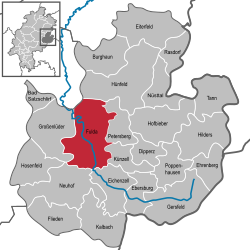
Key Facts
- Founded: 744 AD by Saint Sturm.
- Population: 65,434 (as of December 31, 2024).
- State: Hesse, Germany.
- Key Landmark: Fulda Cathedral and the City Palace (Stadtschloss).
- Strategic Significance: Home to the "Fulda Gap," a critical Cold War invasion route.
- Administrative Status: A city with special status (Stadt mit Sonderstatus).
The Spiritual Foundations of the Middle Ages
The story of Fulda begins in 744, when Saint Sturm, a disciple of Saint Boniface, founded a Benedictine monastery. This establishment was a key outpost in the reorganization of the German church, receiving critical support from Carloman (Mayor of the Palace in Austrasia) and the Carolingian rulers.
In 751, the monastery achieved a rare status of exemption, placing it directly under the Papal See and granting it independence from local bishops and worldly princes. This autonomy, combined with the arrival of the relics of Saint Boniface after his martyrdom in 754, transformed Fulda into a renowned center of learning and a major pilgrimage site.
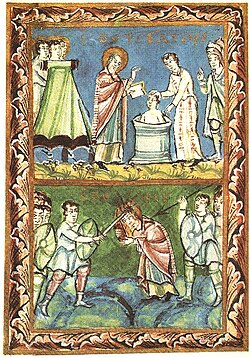
Between 790 and 819, the community constructed a grand basilica modeled after the original 4th-century Old St. Peter's Basilica in Rome. While the church later underwent Baroque renovations, the original crypt still houses the relics of Saint Boniface, the "Apostle of the Germans." Under the leadership of Abbot Rabanus Maurus (822–842), the abbey became a scholarly powerhouse, preserving works by Cicero, Bede, and the Roman historian Ammianus Marcellinus.
Counter-Reformation and the Baroque Era
The city's trajectory shifted during the Counter-Reformation under Prince-abbot Balthasar von Dernbach. In 1571, he invited the Jesuits to establish a school and college, enforcing a return to Catholic faith. This period was marked by strict religious mandates and the tragic Fulda witch trials, which targeted both suspected witches and crypto-Protestants.
By the 18th century, Fulda entered a golden age of construction. The city underwent a massive Baroque building campaign, earning it the status of a "Baroque City." Key contributions by architect Johann Dientzenhofer include the remodeling of the Fulda Cathedral (1704–1712) and the Stadtschloss (City Palace, 1707–1712).
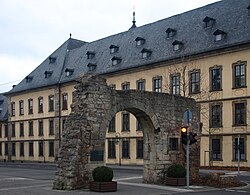
The 18th century also saw the rise of local industry, including a porcelain factory established in 1764 by Prince-Bishop Heinrich von Bibra, though it was closed in 1789.
Modern History and Strategic Importance
The 19th and 20th centuries brought significant political shifts. After the dissolution of the bishopric by Napoleon I in 1802, the city passed through various hands, including the Principality of Nassau-Orange-Fulda and the Electorate of Hesse, before being annexed by Prussia in 1866.
A darker chapter occurred between 1938 and 1943, when Fulda housed a Nazi forced labor camp for Romani people. Following World War II, the city gained global strategic notoriety due to the Fulda Gap. This east-west route was viewed as a primary invasion path for Soviet forces into West Germany, leading to a heavy U.S. military presence, including the 11th Armored Cavalry Regiment at Downs Barracks until 1993.
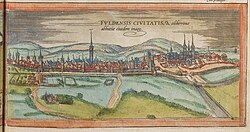
City Profile and Infrastructure
Politically, Fulda is a conservative Catholic stronghold, with the CDU (Christian Democratic Union) maintaining a dominant presence in local and federal elections since 1946.
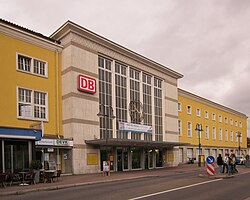
Today, the city is a vital transport hub. The Fulda station is a Category 2 hub on the Hanover–Würzburg high-speed railway, connecting the city to major German centers. It is also conveniently located on the Bundesautobahn 7 and 66, providing easy access to Frankfurt, which is the nearest airport (114 km away).
| Attribute | Details |
|---|---|
| Total Area | 104.05 km² |
| Elevation | 261 m |
| Population (2024) | 65,434 |
| Lord Mayor | Dr. Heiko Wingenfeld (CDU) |
| Main Industries/Hubs | Transport, Administration, Tourism |
Notable Figures from Fulda
Fulda has been the birthplace or home to many influential figures across various fields:
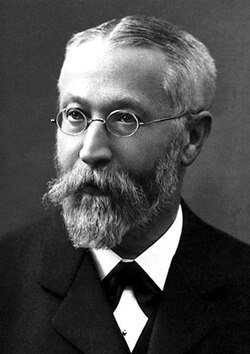
- Ferdinand Braun: Nobel laureate in physics and electrical engineer.
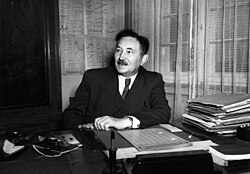
- Wilm Hosenfeld: Officer recognized as Righteous Among the Nations.
- Jamal Musiala: Professional football player.
- Anton Storch: Prominent politician.
Frequently Asked Questions
What is the Fulda Gap?
The Fulda Gap is a traditional east-west invasion route. During the Cold War, it was considered a likely path for a conventional military invasion by Soviet forces into West Germany, resulting in a significant NATO and U.S. military presence in the region.
Who was Saint Boniface?
Saint Boniface was a missionary known as the "Apostle of the Germans." His relics are housed in the crypt of the Fulda Cathedral, and his legacy is central to the city's identity as a spiritual center.
Why is Fulda called a "Baroque City"?
Fulda earned this title due to an extensive building campaign in the 18th century, which produced iconic structures like the Fulda Cathedral and the Stadtschloss, characterized by the ornate Baroque architectural style.
How do I get to Fulda?
Fulda is highly accessible via the German railway network, specifically the Hanover–Würzburg high-speed line. By car, it is located on the Bundesautobahn 7 and 66. The nearest major airport is Frankfurt Airport, located 114 km to the southwest.
What is the status of a "Stadt mit Sonderstatus"?
A city with special status is a distinction in Hesse where the city takes on administrative tasks that are typically performed by the surrounding district (Kreis).