Hadean Eon: The Violent Birth of Early Earth
The Hadean is the first and oldest of Earth's four geologic eons. Spanning from the planet's formation approximately 4.567 billion years ago to 4.031 billion years ago, this era represents the chaotic infancy of our world. Named for its hellish conditions, the Hadean was a time of extreme heat, massive interplanetary collisions, and the gradual cooling that allowed the first oceans and perhaps the first sparks of life to emerge.
Key Facts
- Time Span: 4567.3 ± 0.16 Ma to 4031 ± 3 Ma.
- Defining Event: The interplanetary collision that created the Moon occurred early in this eon.
- Oldest Material: Zircon crystals from Western Australia date back to 4.404 ± 0.008 Ga.
- Atmosphere: Initially a heavy CO2 atmosphere with hydrogen and water vapor.
- Water: Evidence suggests liquid water oceans may have existed as early as 4.4 Ga.
Chronology and Definition
The Hadean eon is formally defined by the International Commission on Stratigraphy. Its lower boundary is set by the age of the oldest solid material in the Solar System's protoplanetary disk—specifically chondrules and calcium–aluminium-rich inclusions found in meteorites—dating to 4567.30 ± 0.16 million years ago (Ma). The eon concludes at 4.031 Ga, marked by the age of the oldest known intact rock formations on Earth.
The Hadean was succeeded by the Archean eon, with the hypothesized Late Heavy Bombardment occurring around the transition between the two.
| Attribute | Details |
|---|---|
| Duration | ~4.567 Ga to 4.031 Ga |
| Proposed By | Preston Cloud (1972) |
| Oldest Dated Zircons | 4.404 ± 0.008 Ga (Jack Hills, Australia) |
| Initial Surface Temp | ~230 °C (446 °F) |
| Initial Pressure | Above 27 standard atmospheres |
The Geological Record: Zircons and Rocks
Because the Hadean was so violent, very few intact rocks survive. However, geologists have identified fragments in northwestern Canada, western Greenland, and Western Australia. The most critical evidence comes from zircons—extremely durable mineral crystals that can survive intense heat and pressure.
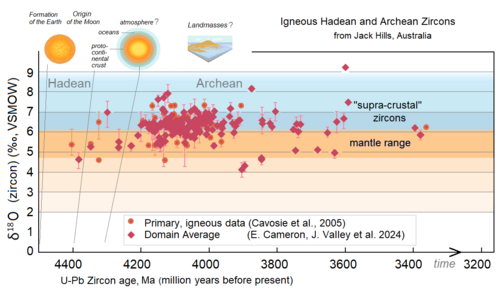
In the Jack Hills of the Narryer Gneiss terrane in Western Australia, detrital zircons have been dated to 4.404 ± 0.008 Ga. While this is a slight outlier, most consistently dated zircons from this region fall around 4.35 Ga, roughly 200 million years after Earth's formation.
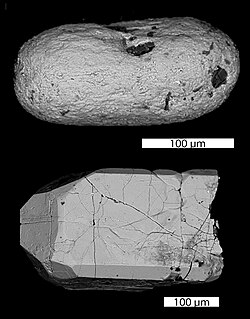
These crystals provide a window into the early crust. Some studies of Hadean zircons have even revealed traces of carbon minerals interpreted as remains of biotic life in 4.1-billion-year-old samples.
Atmosphere, Oceans, and the Magma Ocean
Early Earth was likely a molten wasteland. A massive impact that created the Moon is theorized to have vaporized a significant portion of the planet's material and melted large regions. This initial magma ocean solidified within 5 million years, releasing hot volatiles that formed a dense atmosphere of carbon dioxide, hydrogen, and water vapor.
Despite surface temperatures of 230 °C, liquid water oceans likely existed between 4.0 and 4.4 Ga. This was possible because the atmospheric pressure (over 27 atmospheres) prevented water from boiling away at those temperatures.
However, this stability was periodically interrupted. Asteroid impacts, some involving objects up to 100 kilometers in diameter, could boil off 100 meters of the global ocean and temporarily spike atmospheric temperatures to 500 °C.
Plate Tectonics and Continental Growth
The existence of plate tectonics—the movement of Earth's lithospheric plates—during the Hadean is a subject of ongoing debate. A 2008 study of Australian zircons suggests plate tectonics may have begun as early as 4 Ga. Conversely, some geologists argue these zircons were created by meteorite impacts rather than tectonic activity.
If plate tectonics were active, they would have driven the formation of continental crust. Models vary on the scale of this growth: some predict the continental crust reached only 25% of its current area by the end of the Hadean, while others suggest it reached present-day volumes between 4.2 and 4.0 Ga.
![Evolution of continental crust and ocean depths (from Korenaga, 2021)[8]](/images/11/14/1114780ecf64454ff28bb90ec41d8dec2b601992abdc3c560262b6d4eef5934f.gif)
The Origins of Life
The Hadean may have been more hospitable to life than previously thought. Research indicates that geothermal microenvironments—specifically porous rock systems with heated air-water interfaces—could have supported the synthesis and replication of RNA. These environments may have allowed ribozymes to catalyze the replication of sense and antisense strands.
Recent research published in 2024 suggests that the last common ancestor of all current life may have emerged during the Hadean, specifically between 4.09 and 4.33 Ga.
Frequently Asked Questions
What does the name "Hadean" mean?
The name is derived from Hades, the Greek god of the underworld, referring to the hellish, high-temperature conditions of the early Earth.
How do scientists date the Hadean if no intact rocks exist?
Scientists use zircon crystals. Zircons are incredibly resilient minerals that can survive billions of years of geological upheaval, allowing researchers to use U-Pb (uranium-lead) dating to determine their age.
Could liquid water exist on a planet with a surface temperature of 230 °C?
Yes. Because the Hadean atmosphere was extremely dense (over 27 times current atmospheric pressure), the boiling point of water was significantly raised, allowing oceans to remain liquid despite the heat.
When did the Moon form?
The Moon was created early in the Hadean eon following a massive interplanetary collision with the early Earth.
Is there evidence of life in the Hadean?
While not definitive, traces of carbon minerals in 4.1-billion-year-old rocks and models of RNA replication in geothermal vents suggest that primitive life or its precursors may have existed during this eon.