Triassic Period: Life and Earth After the Great Dying
The Triassic Period represents a pivotal chapter in Earth's history. Spanning approximately 50.5 million years—from 251.902 Ma to 201.4 Ma—it serves as the first and shortest geologic period of the Mesozoic Era. Emerging from the shadow of the devastating Permian-Triassic extinction event, the Triassic was a time of profound biological recovery, dramatic climatic shifts, and the foundational rise of many lineages that would eventually dominate the planet.
Key Facts
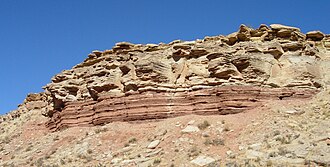
![Sydney, Australia lies on Triassic shales and sandstones. Almost all of the exposed rocks around Sydney belong to the Triassic Sydney sandstone.[31]](/images/84/9d/849d0468d4bc46dde2eb5e2e262d5de8bd867d6d678dcafb91ad4da20b2da96e.jpg)
- Duration: Approximately 50.5 million years.
- Era: The first period of the Mesozoic Era.
- Boundaries: Begins with the first appearance of the conodont Hindeodus parvus and ends with the ammonite Psiloceras spelae tirolicum.
- Climate: Characterized by extreme heat in the Early Triassic due to greenhouse gas discharges.
- Major Events: Includes the Carnian pluvial episode and the Triassic-Jurassic extinction event.
Chronology and Subdivisions
Geologists divide the Triassic into three distinct epochs, each containing specific stages that help track the evolution of life and environmental changes over time.
| Epoch | Stages/Ages | Approximate Start (Ma) |
|---|---|---|
| Upper (Late) Triassic | Rhaetian, Norian, Carnian | 237 Ma |
| Middle Triassic | Ladinian, Anisian | 246.7 Ma |
| Lower (Early) Triassic | Olenekian, Induan | 251.902 Ma |
Paleogeography and Climate
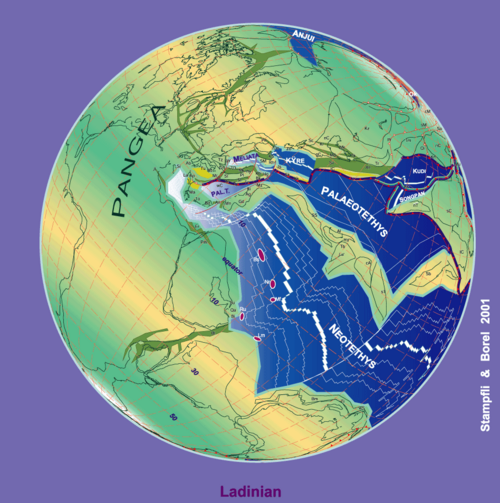
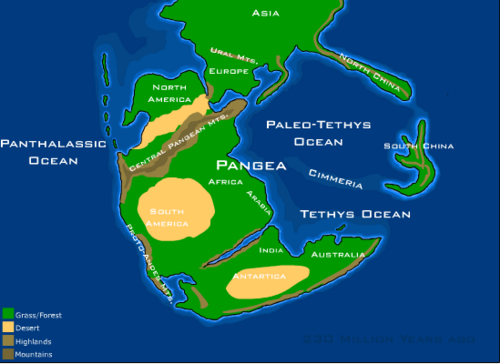
During the Triassic, the Earth's landmasses were largely unified into the supercontinent Pangea. This massive landmass consisted of two major components: Laurussia (Northern Pangea) and Gondwana (Southern Pangea). Surrounding this supercontinent was the vast Panthalassic Ocean, while the Tethys Ocean carved a significant wedge into the eastern side of the landmass.
Extreme Climatic Fluctuations
The Early Triassic was arguably the hottest period of the entire Phanerozoic Eon. This intense warmth was driven by massive discharges of greenhouse gases from the Siberian Traps. The period saw several dramatic temperature swings, including the Permian-Triassic Thermal Maximum (PTTM) and the subsequent Dienerian Cooling. Later, during the Latest Olenekian Cooling, temperatures dropped by approximately 6 °C.
The Evolution of Life
The Triassic was a period of intense biological experimentation. Following the mass extinction at the start of the period, life had to rebuild from the ground up.
Flora: From Glossopteris to Conifers
The landscape of the Triassic saw a major shift in vegetation. In regions like Australia, the Glossopteris flora that dominated the Permian was suddenly displaced by an Australia-wide coniferous flora. This transition marked a significant change in the terrestrial biosphere.
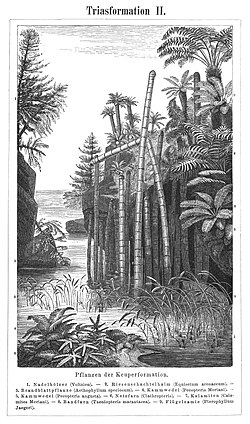
![Immediately above the Permian–Triassic boundary the glossopteris flora was suddenly largely displaced by an Australia-wide coniferous flora[51]](/images/26/1e/261e24552a2b953adb6c903cc13ad01095d8574bef70c3c0a2bd53dcfaedf690.jpg)
Fauna: The Rise of New Lineages
On land, the Triassic witnessed the emergence of some of the most iconic groups in history. While early archosaurs (crocodile-like reptiles) were prominent, this era also saw the rise of some of the earliest dinosaurs, such as Staurikosaurus and Coelophysis. Large sauropodomorphs like Plateosaurus also began to appear toward the end of the period.
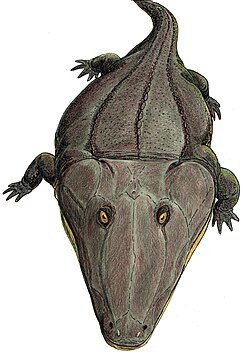
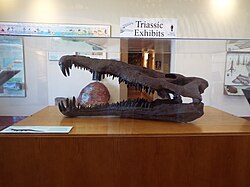
In the oceans, marine life underwent significant reorganization. Marine invertebrates, fish, and various marine reptiles began to fill the ecological niches left vacant by previous extinctions. Apex predators emerged in the seas, including various marine vertebrates that navigated the Tethyan and Panthalassic waters.
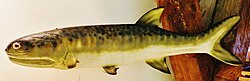
![Marine vertebrate apex predators of the Early Triassic and Anisian (Middle Triassic)[74]](/images/9f/e3/9fe3370cdcb6d4cb9cc7cd13d0890ef23a9f6508473265f4e8421ffb63c45bd3.png)
The End of an Era
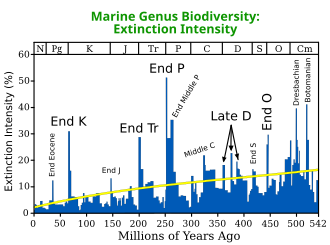
The Triassic Period did not fade away quietly. It concluded with the Triassic-Jurassic extinction event, a major biotic crisis that paved the way for the dominance of the dinosaurs in the subsequent Jurassic Period. This event is often linked to volcanic activity in the Central Atlantic Magmatic Province (CAMP).
Frequently Asked Questions
How long did the Triassic Period last?
The Triassic Period lasted for approximately 50.5 million years, beginning roughly 251.9 million years ago and ending about 201.4 million years ago.
What was the climate like during the Early Triassic?
The Early Triassic was exceptionally hot, representing one of the hottest intervals in the Phanerozoic Eon due to massive greenhouse gas releases from the Siberian Traps.
Did dinosaurs exist during the Triassic?
Yes, some of the earliest dinosaurs, such as Staurikosaurus and Coelophysis, appeared during the Triassic Period.
What major landmass existed during this time?
Most of Earth's landmasses were joined together in a single supercontinent known as Pangea.
What caused the end of the Triassic Period?
The period ended with a major mass extinction event, often associated with the volcanic activity of the Central Atlantic Magmatic Province.