Precambrian Earth: The Dawn of Our Planet and the Origins of Life
The Precambrian represents the vast, foundational stretch of Earth's history, spanning from the planet's formation to the emergence of complex life. Covering nearly 90% of geologic time, this supereon encompasses the chaotic beginnings of a molten world, the stabilization of the first crusts, and the slow, transformative rise of biological complexity.
Spanning approximately 4,567.3 to 538.8 million years ago (Ma), the Precambrian is not a single continuous era but a collection of three distinct eons: the Hadean, the Archean, and the Proterozoic. Together, they tell the story of a planet evolving from a celestial collision to a world capable of supporting diverse ecosystems.
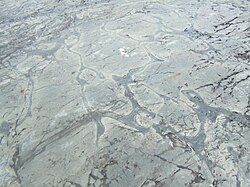
Key Facts
- Time Span: Approximately 4,567.3 Ma to 538.8 Ma.
- Major Eons: Hadean, Archean, and Proterozoic.
- Earliest Crust: Evidence of stable crust exists as early as 4,404 Ma via zircon crystals.
- Supercontinents: Includes Vaalbara, Kenorland, Columbia (Nuna), and Rodinia.
- Life Milestones: Bacterial life recorded in the Archean; complex multicellular organisms appearing in the Ediacaran.
The Three Eons of the Precambrian
To understand the immense scale of the Precambrian, geologists divide it into three primary eons, each defined by the changing state of the Earth's surface and atmosphere.
The Hadean Eon (4567.3 – 4031 Ma)
The Hadean represents the earliest stages of Earth. It is thought the planet coalesced from material orbiting the Sun roughly 4,543 Ma. Shortly after formation, a massive impact by a planet named Theia may have occurred, ejecting material that eventually formed the Moon. While once thought to be a period without preserved rocks, the discovery of 4,404-million-year-old zircon crystals in Western Australia suggests a stable crust was already forming.
The Archean Eon (4031 – 2500 Ma)
During the Archean, the Earth's crust stabilized further, and the first signs of life began to emerge. While the exact date of the origin of life remains unknown, evidence of organic carbon has been found in 3.8 billion-year-old rocks in Greenland, and microscopic bacterial fossils dating back 3.46 billion years have been identified in Western Australia.
The Proterozoic Eon (2500 – 538.8 Ma)
The Proterozoic was a period of profound change, characterized by the rise of oxygen and the development of more complex life forms. This eon saw the formation and breakup of major supercontinents and extreme climatic shifts, including the "Snowball Earth" periods—massive glaciations that may have reached the equator.
The Evolution of Life and the Ediacaran Biota
The transition from simple single-celled organisms to complex life is one of the most significant narratives of the Precambrian. While bacterial life was a mainstay throughout the Proterozoic, the emergence of multicellularity is a subject of ongoing scientific debate.
Potential early multicellular organisms include red algae from the Kola Peninsula (2450 Ma) and the Bangiomorpha red alga from the Canadian Arctic (1047 Ma). However, the most widely accepted complex multicellular organisms are the Ediacaran biota. These soft-bodied forms flourished between 635 and 542 Ma, representing a diverse collection of life that preceded the "Cambrian explosion" of hard-shelled creatures.
Planetary Dynamics: Supercontinents and Glaciation
The Precambrian was a time of intense tectonic activity. The movement of Earth's plates led to the assembly and breakup of several massive landmasses, known as supercontinents.
- Vaalbara: The earliest known supercontinent, existing roughly 3.6 billion years ago.
- Kenorland: Formed around 2.7 billion years ago.
- Columbia (Nuna): Formed between 2.1 and 1.8 billion years ago.
- Rodinia: A massive supercontinent that formed between 1300 and 900 Ma and broke up around 750–600 Ma.
In addition to shifting continents, the Earth experienced significant climatic events. The Sturtian-Varangian glaciation (850–635 Ma) is a notable example of a period that may have plunged the entire planet into a glacial state.
Summary of Precambrian Eons
| Eon | Approximate Time Span (Ma) | Key Characteristics |
|---|---|---|
| Hadean | 4567.3 – 4031 | Earth formation, Moon impact, early crust formation. |
| Archean | 4031 – 2500 | Emergence of early bacterial life and stable crust. |
| Proterozoic | 2500 – 538.8 | Oxygenation, supercontinents, and complex multicellular life. |
Frequently Asked Questions
When did the Earth form?
Earth is thought to have coalesced from material in orbit around the Sun at approximately 4,543 million years ago.
What is the difference between the Archean and Proterozoic eons?
The Archean eon is characterized by the earliest forms of life (mostly bacteria) and the stabilization of the crust, while the Proterozoic eon saw the rise of oxygen, the formation of supercontinents like Rodinia, and the appearance of complex multicellular organisms.
What was "Snowball Earth"?
Snowball Earth refers to periods of intense global glaciation, such as the Sturtian-Varangian glaciation (850–635 Ma), where ice may have extended all the way to the Earth's equator.
What are the Ediacaran biota?
The Ediacaran biota are a diverse collection of soft-bodied, complex multicellular organisms that lived between 635 and 542 million years ago, marking the final stage of the Precambrian.
How do scientists know about the Hadean eon if rocks are scarce?
Scientists use evidence from zircon crystals, which can survive for billions of years, as well as data from the Moon and meteorites to reconstruct the conditions of the Hadean eon.