Carboniferous Period: The Age of Coal and Giant Forests
The Carboniferous is a pivotal geologic period and system of the Paleozoic era that spanned approximately 60 million years. Beginning 358.86 million years ago (Ma) and ending 298.9 Ma, it serves as the fifth period of the Phanerozoic eon. Known colloquially as the "Age of Amphibians or Reptiles," this era is most famous for the vast swamp forests that eventually became the world's primary coal deposits.
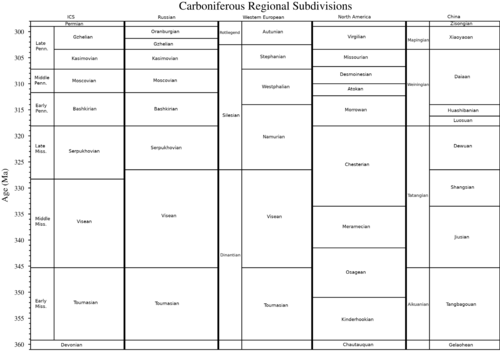
In North America, geologists typically divide this period into two distinct subsystems: the earlier Mississippian and the later Pennsylvanian. This distinction reflects a shift in the Earth's environment from carbonate-rich marine sequences to siliciclastic and coal-rich terrestrial deposits.
Key Facts
- Time Span: 358.86 ± 0.19 Ma to 298.9 ± 0.15 Ma.
- Primary Characteristic: Massive accumulation of organic matter leading to global coal measures.
- Major Subdivisions: Mississippian (Lower) and Pennsylvanian (Upper).
- Climate: Transitioned from warm intervals to intense glaciation during the Late Paleozoic Ice Age.
- Key Lifeforms: Giant lycopsid forests, early tetrapods, and diverse marine invertebrates.
Chronology and Stratigraphy
The formalization of the Carboniferous timescale began in the late 18th century, with the term first used as an adjective by Richard Kirwan in 1799. By 1822, William Conybeare and William Phillips established it as a formal unit. The period is defined by specific Global Boundary Stratotype Sections and Points (GSSP), which are physical locations in the rock record that mark the start and end of the period.
The Mississippian Subsystem
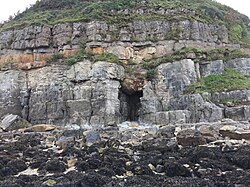
The lower portion of the Carboniferous is characterized by the Tournaisian, Visean, and Serpukhovian stages. The base of the system is defined at La Serre in Montagne Noire, France, by the first appearance of the conodont (a tooth-like microfossil) Siphonodella sulcata, though recent studies have noted biostratigraphic complexities at this site.
The Pennsylvanian Subsystem
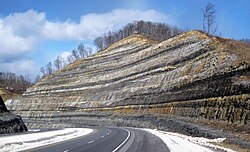
The upper portion consists of the Bashkirian, Moscovian, Kasimovian, and Gzhelian stages. This era is noted for cyclothems—repeated sequences of marine and non-marine sedimentary rocks caused by fluctuating sea levels.
| Subsystem | Stage/Age | Lower Boundary (Ma) |
|---|---|---|
| Pennsylvanian | Gzhelian | 303.7 ± 0.1 |
| Kasimovian | 307 ± 0.1 | |
| Moscovian | 315.2 ± 0.2 | |
| Bashkirian | 323.4 ± 0.4 | |
| Mississippian | Serpukhovian | 330.3 ± 0.4 |
| Visean | 346.7 ± 0.4 | |
| Tournaisian | 358.86 ± 0.19 |
Palaeogeography and Tectonics
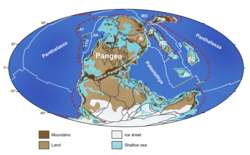
During the Carboniferous, the Earth's landmasses were in a state of significant transition. The supercontinent Laurussia and the massive landmass Gondwana were moving toward one another, eventually colliding to form the supercontinent Pangea. This collision triggered massive mountain-building events known as orogenies, including the Variscan-Alleghanian-Ouachita and Uralian orogenies.
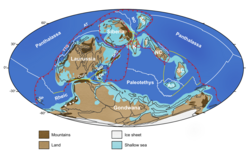
By the late Carboniferous, the arrangement of continents had shifted significantly, closing many ancient oceans and creating the vast interior landmasses that would characterize the Permian period.
Climate and Atmospheric Chemistry
The Carboniferous climate was highly dynamic, reflecting the phases of the Late Paleozoic Ice Age (LPIA). Global average temperatures (GAT) fluctuated wildly: during the Early Tournaisian Warm Interval, the GAT was approximately 22 °C, while during the Permo-Carboniferous Glacial Maximum, it plummeted to about 13 °C.
Atmospheric CO2 levels also saw dramatic shifts. In the early Kasimovian, CO2 dropped to as low as 180 ppm during intense glaciation, before rapidly spiking to approximately 600 ppm, likely due to increased pyroclastic volcanism or changes in the burial of organic matter.
Life in the Carboniferous
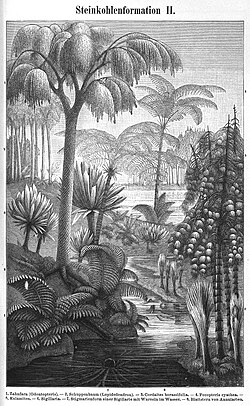
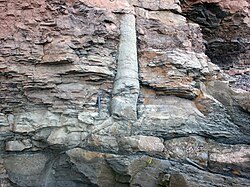
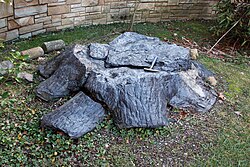
The period is most famous for its terrestrial flora. Massive forests of lycopsids (giant club mosses) like Sigillaria dominated the landscape, utilizing bifurcating stigmarian roots to anchor themselves in swampy soils.
In the oceans, life was diverse, featuring bivalves like Aviculopecten subcardiformis, tabulate corals, and proetid trilobites—the only order of trilobites to survive the end-Devonian extinction. The freshwater and lagoonal environments were home to eurypterids (sea scorpions), including the massive Hibbertopterus.
The era also saw the rise of early tetrapods and a variety of fish, such as the Edestus, a large fish characterized by unique tooth whorls.
Frequently Asked Questions
Why is the period called "Carboniferous"?
The name is derived from the abundance of carbon-rich rock strata, specifically the vast coal measures found globally that formed from the decayed vegetation of ancient swamp forests.
What is the difference between the Mississippian and Pennsylvanian?
The Mississippian is the earlier subperiod, characterized largely by carbonate-rich marine deposits. The Pennsylvanian is the later subperiod, known for its siliciclastic rocks, coal deposits, and cyclothemic sedimentation.
What were cyclothems?
Cyclothems are repeating sequences of sedimentary layers (such as limestone, shale, and coal) that indicate repeated cycles of rising and falling sea levels, often linked to glacial cycles.
How did the climate change during this period?
The climate shifted from a warm interval in the Early Tournaisian to a period of intense glaciation. This included a significant drop in CO2 levels and a decrease in global average temperatures during the Permo-Carboniferous Glacial Maximum.