Archean Eon: The Dawn of Life and Earth's Early Geology
The Archean Eon represents one of the most pivotal chapters in our planet's history. Derived from the Greek word arkhē, meaning "beginning" or "origin," this vast stretch of time marks the period when Earth transitioned from a molten wasteland into a world capable of supporting life. Spanning from approximately 4,031 million years ago (Ma) to 2,500 Ma, the Archean is a cornerstone of the Precambrian supereon.
For a long time, scientists believed the early Earth was "azoic," or devoid of life. However, the discovery of ancient fossils and chemical signatures has rewritten this narrative, revealing a dynamic world of volcanic activity, shifting chemistry, and the first biological pioneers.
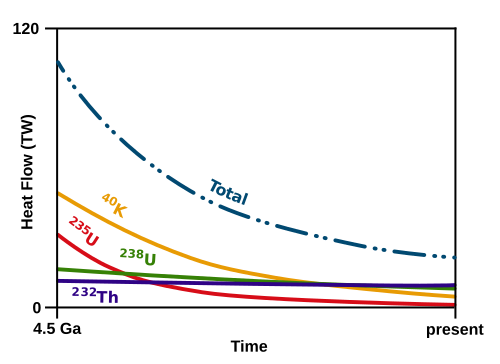
Key Facts
- Time Span: 4,031 ± 3 Ma to 2,500 Ma.
- Lower Boundary: Defined by the ten oldest U-Pb (Uranium-Lead) zircon ages.
- Global Standard: The lower Global Standard Stratigraphic Age (GSSA) is located along the Acasta River in Canada.
- Atmosphere: Believed to be methane-rich and hazy, similar to the modern atmosphere of Titan.
- First Life: Evidence includes 3.48 billion-year-old stromatolites and chemical traces of bacteria.
Chronology and Classification
The Archean is divided into four distinct eras, each representing a stage in the planet's cooling and stabilization. These eras allow geologists to track the evolution of the crust and the emergence of early life forms.
The Four Eras of the Archean
- Eoarchean: The earliest phase, beginning shortly after the Hadean Eon.
- Paleoarchean: A period of continued crustal formation.
- Mesoarchean: The middle era, where evidence of early biological activity becomes more prominent.
- Neoarchean: The final phase, leading up to the Proterozoic Eon.
Historically, the Archean was thought to begin at the very formation of Earth (about 4,540 Ma). However, with the formal recognition of the Hadean Eon, the Archean now begins specifically at the point where the oldest stable crustal materials, such as zircons, can be dated.
The Early Earth Environment
The environment of the Archean was vastly different from the world we know today. The atmosphere was prebiotic and secondary, lacking the high levels of oxygen we breathe now. Instead, it was rich in methane and other gases, creating a thick haze that likely gave the planet an orange appearance.
![The pale orange dot, an artist's impression of the early Earth which is believed to have appeared orange through its hazy, methane rich, prebiotic secondary atmosphere. Earth's atmosphere at this stage was somewhat comparable to today's atmosphere of Titan.[19]](/images/93/9a/939a43caa7bdce7fde5659c25de742305a0ff635766584bd7e2884151f510ad5.jpg)
Geologically, the planet was characterized by intense heat flow and the formation of the first continental crust. The interaction between the cooling mantle and the surface created a volatile landscape of volcanic arcs and early oceans.
The Emergence of Early Life
The Archean Eon provides the first direct evidence of life on Earth. The most famous of these are stromatolites—layered sedimentary formations created by the activity of photosynthetic microorganisms.
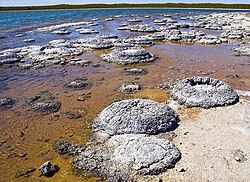
Beyond visible fossils, scientists look for chemical "fingerprints" to identify early life. In the Warrawoona Group of Western Australia, 3.47 billion-year-old baryte (a barium sulfate mineral) shows significant sulfur fractionation. This chemical imbalance suggests the presence of sulfate-reducing bacteria, which prefer to metabolize sulfur-32 over sulfur-34, leaving a permanent record in the rock.
Archean Summary Table
| Feature | Details |
|---|---|
| Duration | 4,031 ± 3 Ma to 2,500 Ma |
| Etymology | Greek arkhē ("beginning") |
| Key Biological Evidence | Stromatolites and sulfur fractionation in baryte |
| Atmospheric State | Methane-rich, anoxic, hazy (Titan-like) |
| Lower Boundary Marker | U-Pb zircon ages (Acasta River, Canada) |
Frequently Asked Questions
What is the difference between the Archean and the Hadean?
The Hadean is the earliest eon, covering the time from Earth's formation until the start of the Archean. The Archean begins when the Earth's crust became stable enough to preserve rocks, specifically marked by the oldest dated zircons.
What are stromatolites?
Stromatolites are lithified (turned to stone) layered structures formed by the trapping, binding, and cementation of sedimentary grains by microorganisms, primarily cyanobacteria.
Why was the early Earth's atmosphere orange?
The atmosphere was rich in methane and other prebiotic gases, which created an organic haze. This haze scattered light in a way that would have made the planet appear pale orange from space.
How do scientists know bacteria existed 3.47 billion years ago?
They analyze sulfur isotopes in minerals like baryte. Because certain bacteria prefer sulfur-32 over sulfur-34, the resulting "fractionation" (imbalance) in the mineral serves as a chemical signature of biological metabolism.
What is a zircon and why is it important?
A zircon is a durable mineral that can withstand extreme heat and pressure. Because they trap uranium and lead, they act as tiny time capsules that allow scientists to use U-Pb dating to determine the age of the Earth's oldest crust.