Greenhouse Gases and the Mechanics of Global Warming
Greenhouse Gases and the Mechanics of Global Warming Greenhouse gases (GHGs) are essential components of our atmosphere that play a critical role in regulating Earth's temperature. By abs...
Greenhouse Gases and the Mechanics of Global Warming
Greenhouse gases (GHGs) are essential components of our atmosphere that play a critical role in regulating Earth's temperature. By absorbing the radiation emitted by a planet, these gases create the greenhouse effect, a process that traps heat and keeps the surface warm enough to support life. Without this natural mechanism, Earth's average surface temperature would plummet to approximately −18 °C (0 °F), rather than the current average of 15 °C (59 °F).
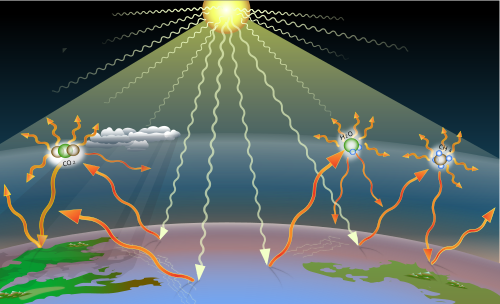
Greenhouse gases trap some of the heat that results when sunlight heats the Earth's surface. Three important greenhouse gases are shown symbolically in this image: carbon dioxide, water vapor, and methane.: Greenhouse gases trap some of the heat that results when sunlight heats the Earth's surface. Three important greenhouse gases are shown symbolically in this image: carbon dioxide, water vapor, and methane.
However, human activities have significantly altered the concentration of these gases. Since the Industrial Revolution, carbon dioxide levels have risen by over 50%, and methane levels have increased by 150%. This imbalance is driving human-induced warming at an unprecedented rate, reaching 0.27±0.1 °C per decade between 2015 and 2024.
Key Facts
Carbon dioxide (CO2) is responsible for approximately three-quarters of global warming.
Methane (CH4) is a potent gas that lasts in the atmosphere for an average of only 12 years.
Water vapor is the most abundant greenhouse gas and accounts for about half of the greenhouse effect.
Current CO2 concentrations are higher than they have been for at least three million years.
If current emission rates persist, global warming may surpass 2.0 °C (3.6 °F) between 2040 and 2070.
The Science of Radiative Forcing
To understand how these gases drive temperature changes, scientists use the concept of radiative forcing. This refers to the change in the energy balance of the Earth's atmosphere. When greenhouse gas concentrations increase, they absorb more outgoing thermal radiation, creating a warming influence.
The radiative forcing (warming influence) of long-lived atmospheric greenhouse gases has accelerated, almost doubling in 40 years.[42][43]: The radiative forcing (warming influence) of long-lived atmospheric greenhouse gases has accelerated, almost doubling in 40 years.[42][43]
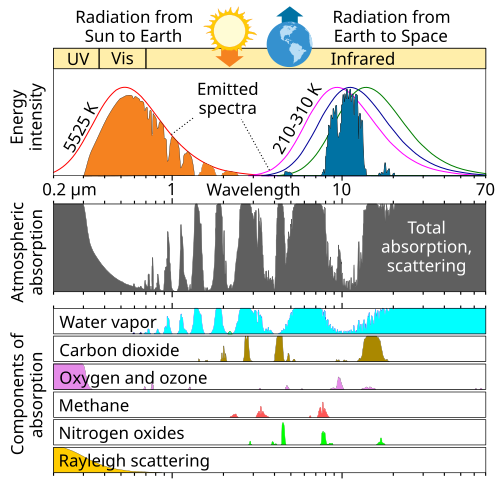
The mechanism involves the absorption and scattering of electromagnetic waves. As the Earth's surface is heated by sunlight, it radiates heat back toward space. Greenhouse gases intercept these wavelengths, preventing the energy from escaping.
Atmospheric absorption and scattering at different wavelengths of electromagnetic waves. The largest absorption band of carbon dioxide is not far from the maximum in the thermal emission from ground, and it partly closes the window of transparency of water—explaining carbon dioxide's major heat-trapping effect.: Atmospheric absorption and scattering at different wavelengths of electromagnetic waves. The largest absorption band of carbon dioxide is not far from the maximum in the thermal emission from ground, and it partly closes the window of transparency of water—explaining carbon dioxide's major heat-trapping effect.
Atmospheric gases only absorb some wavelengths of energy but are transparent to others. The absorption patterns of water vapor (blue peaks) and carbon dioxide (pink peaks) overlap in some wavelengths.[36]: Atmospheric gases only absorb some wavelengths of energy but are transparent to others. The absorption patterns of water vapor (blue peaks) and carbon dioxide (pink peaks) overlap in some wavelengths.[36]
The Role of Specific Gases
While many gases contribute to the greenhouse effect, their impact varies based on their abundance and their ability to absorb specific wavelengths of energy.
Water Vapor: Acts as a climate change feedback, responding to the warming caused by other gases.
Carbon Dioxide: The primary driver of long-term warming due to its persistence in the atmosphere.
Methane: A highly effective warmer, though it has a shorter atmospheric lifetime than CO2.
Nitrous Oxide and Ozone: Other significant contributors to the atmospheric heat trap.
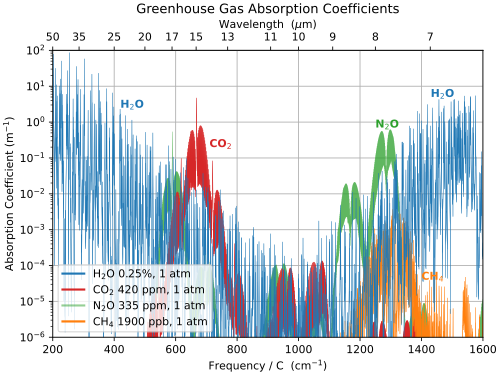
Longwave-infrared absorption coefficients of primary greenhouse gases. Water vapor absorbs over a broad range of wavelengths. Earth emits thermal radiation particularly strongly in the vicinity of the carbon dioxide 15-micron absorption band. The relative importance of water vapor decreases with increasing altitude.: Longwave-infrared absorption coefficients of primary greenhouse gases. Water vapor absorbs over a broad range of wavelengths. Earth emits thermal radiation particularly strongly in the vicinity of the carbon dioxide 15-micron absorption band. The relative importance of water vapor decreases with increasing altitude.
Global Warming Potential (GWP)
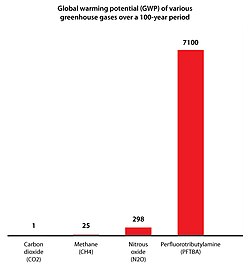
Not all greenhouse gases are created equal. Scientists use Global Warming Potential (GWP) to compare the warming impact of different gases relative to carbon dioxide over a specific timeframe, usually 100 years. For example, while CO2 is the baseline (GWP of 1), other gases like perfluorocarbons or methane have much higher GWPs, meaning they trap significantly more heat per ton emitted.
Comparison of global warming potential of three greenhouse gases over a 100-year period (GWP-100) per ton: Perfluorotributylamine (PFTBA), nitrous oxide and methane, compared to carbon dioxide (the latter is the reference value, therefore it has a GWP of one). PFTBA is here used as an example of a larger group of potent fluorinated greenhouse gases. Fluorinated hydrocarbons combined contribute about 10% to global warming.: Comparison of global warming potential of three greenhouse gases over a 100-year period (GWP-100) per ton: Perfluorotributylamine (PFTBA), nitrous oxide and methane, compared to carbon dioxide (the latter is the reference value, therefore it has a GWP of one). PFTBA is here used as an example of a larger group of potent fluorinated greenhouse gases. Fluorinated hydrocarbons combined contribute about 10% to global warming.
Atmospheric Lifetimes and the Carbon Cycle
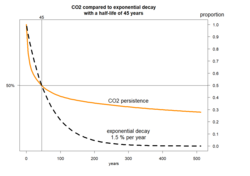
The duration a gas remains in the atmosphere determines its long-term impact. Carbon dioxide is particularly challenging because the carbon cycle—the natural movement of carbon between the atmosphere, oceans, soil, and plants—takes thousands of years to fully absorb excess CO2.
A comparison of CO2 persistence in the atmosphere with an exponential decay function with the same half-life: A comparison of CO2 persistence in the atmosphere with an exponential decay function with the same half-life
Estimated atmospheric methane lifetime before the industrial era (shaded area); changes in methane lifetime since 1850 as simulated by a climate model (blue line), and the reconciled graph (red line).[67]: Estimated atmospheric methane lifetime before the industrial era (shaded area); changes in methane lifetime since 1850 as simulated by a climate model (blue line), and the reconciled graph (red line).[67]
In contrast, methane is relatively short-lived, lasting about 12 years. However, the sheer volume of emissions from agriculture, fossil fuel production, and waste makes it a major contributor to current warming trends.
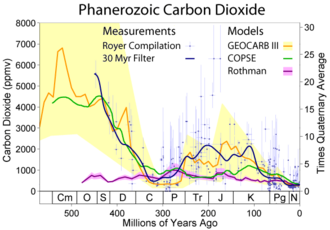
CO2 concentrations over the last 500 million years: CO2 concentrations over the last 500 million years
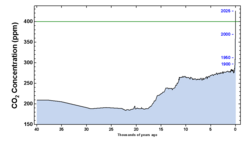
Concentration of atmospheric CO2 over the last 40,000 years, from the Last Glacial Maximum to the present day. The current rate of increase is much higher than at any point during the last deglaciation.: Concentration of atmospheric CO2 over the last 40,000 years, from the Last Glacial Maximum to the present day. The current rate of increase is much higher than at any point during the last deglaciation.
Human Impact and Emission Sources
Anthropogenic (human-caused) activities have disrupted the natural balance of the carbon cycle. The primary driver is the burning of fossil fuels for energy and industry, which releases stored carbon into the atmosphere.
Schematic representation of the overall perturbation of the global carbon cycle caused by anthropogenic activities, averaged from 2010 to 2019[90]: Schematic representation of the overall perturbation of the global carbon cycle caused by anthropogenic activities, averaged from 2010 to 2019[90]
Taking into account direct and indirect emissions, industry is the sector with the highest share of global emissions. Data as of 2019 from the IPCC.: Taking into account direct and indirect emissions, industry is the sector with the highest share of global emissions. Data as of 2019 from the IPCC.
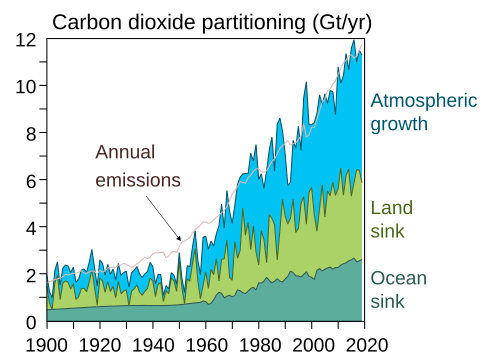
While natural carbon sinks like oceans and forests absorb a significant portion of emissions, they cannot keep pace with the current rate of release. Recent data shows that human-induced temperature rise and greenhouse gas concentrations have all reached new records.
Most CO2 emissions have been absorbed by carbon sinks, including plant growth, soil uptake, and ocean uptake (2020 Global Carbon Budget).: Most CO2 emissions have been absorbed by carbon sinks, including plant growth, soil uptake, and ocean uptake (2020 Global Carbon Budget).
This 1912 article succinctly describes how burning coal creates carbon dioxide that causes climate change.[107]: This 1912 article succinctly describes how burning coal creates carbon dioxide that causes climate change.[107]
The Aerosol Factor and Climate Sensitivity
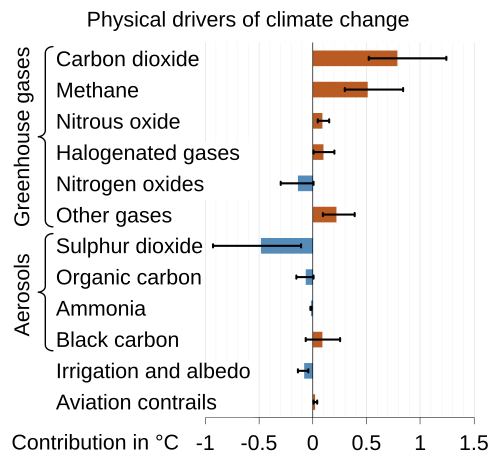
Recent research has highlighted a complex relationship between greenhouse gases and aerosols (tiny particles in the air). While greenhouse gases warm the planet, certain aerosols actually have a cooling effect. However, as air quality regulations reduce aerosol pollution, this "cooling shield" is weakened, potentially accelerating warming.
Hansen et al. (2025) wrote that the IPCC had underestimated aerosols' cooling effect, causing it to also underestimate climate sensitivity (Earth's responsiveness to increases in greenhouse gas concentrations).[27] In what Hansen called a Faustian bargain, regulation of aerosols improved air quality, but aerosols' cooling effect became inadequate to temper the increasing warming effect of greenhouse gases—explaining unexpectedly large global warming in 2023–2024.[27]: Hansen et al. (2025) wrote that the IPCC had underestimated aerosols' cooling effect, causing it to also underestimate climate sensitivity (Earth's responsiveness to increases in greenhouse gas concentrations).[27] In what Hansen called a Faustian bargain, regulation of aerosols improved air quality, but aerosols' cooling effect became inadequate to temper the increasing warming effect of greenhouse gases—explaining unexpectedly large global warming in 2023–2024.[27]
Physical drivers of global warming that has happened so far. Future global warming potential for long-lived drivers like carbon dioxide emissions is not represented. Whiskers on each bar show the possible error range.: Physical drivers of global warming that has happened so far. Future global warming potential for long-lived drivers like carbon dioxide emissions is not represented. Whiskers on each bar show the possible error range.
Summary of Key Greenhouse Gases
Comparison of Major Greenhouse Gases
Gas Species
Approx. Lifetime (Years)
100-Year GWP
Primary Source
Carbon Dioxide (CO2)
Variable (Long-lived)
1
Fossil fuel combustion, industry
Methane (CH4)
~12
28
Agriculture, fossil fuels, waste
Nitrous Oxide (N2O)
~121
265
Agriculture, industrial processes
CFC-12
~100
10,200
Refrigerants, industrial use
Frequently Asked Questions
What is the difference between the natural and enhanced greenhouse effect?
The natural greenhouse effect is the process by which existing gases in the atmosphere trap heat to keep Earth habitable. The enhanced greenhouse effect refers to the additional warming caused by human activities increasing the concentration of these gases.
Why is carbon dioxide considered the most important greenhouse gas?
While other gases like methane are more potent per molecule, carbon dioxide is responsible for about 75% of global warming because of the massive volumes emitted and its ability to remain in the atmosphere for very long periods.
How long does it take for CO2 to leave the atmosphere?
The carbon cycle is a slow process; it can take thousands of years for the Earth's natural sinks, such as the oceans and terrestrial ecosystems, to fully absorb and process excess carbon dioxide.
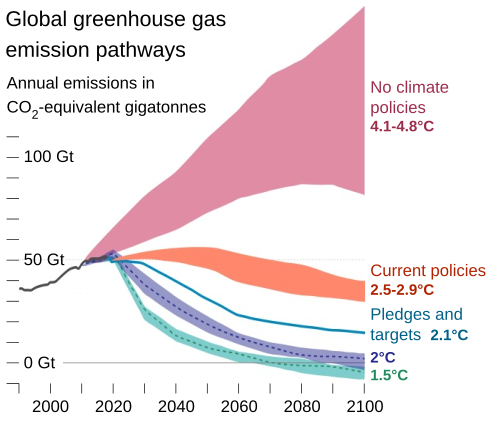
What are greenhouse gas emission scenarios?
Emission scenarios are models used to predict future concentrations of greenhouse gases based on different levels of human policy, technological advancement, and economic activity.
Global greenhouse gas emission scenarios, based on policies and pledges as of 11/21: Global greenhouse gas emission scenarios, based on policies and pledges as of 11/21
Can we stop global warming by reducing emissions?
The IPCC suggests that to limit warming to 1.5 °C, emissions must peak before 2025 and decline by 43% by 2030. Drastic cuts in emissions are required to avoid the most dangerous climate outcomes.
References
Mole fractions: μmol/mol = ppm = parts per million (106); nmol/mol = ppb = parts per billion (109); pmol/mol = ppt = parts per trillion (1012).
Values are relative to year 1750. AR6 reports the effective radiative forcing which includes effects of rapid adjustments in the atmosphere and at the surface.[54]
The IPCC states that "no single atmospheric lifetime can be given" for CO2.[49]: 731 This is mostly due to the rapid growth and cumulative magnitude of the disturbances to Earth's carbon cycle by the geologic extraction and burning of fossil carbon.[59] As of year 2014, fossil CO2 emitted as a theoretical 10 to 100 GtC pulse on top of the existing atmospheric concentration was expected to be 50% removed by land vegetation and ocean sinks in less than about a century, as based on the projections of coupled models referenced in the AR5 assessment.[60] A substantial fraction (20–35%) was also projected to remain in the atmosphere for centuries to millennia, where fractional persistence increases with pulse size.[61][62]
Natural sources do exist, but these do not produce a concentration as high as 1 part per quadrillion[63]
Figure is combined total natural abundance of all perfluorocarbons: no data exist for individual compounds.
![The radiative forcing (warming influence) of long-lived atmospheric greenhouse gases has accelerated, almost doubling in 40 years.[42][43]](/images/ac/47/ac47769b3a544fa2d14251cefa74f60adeb662340463ddaf1d93130afe2ec568.webp)
![Atmospheric gases only absorb some wavelengths of energy but are transparent to others. The absorption patterns of water vapor (blue peaks) and carbon dioxide (pink peaks) overlap in some wavelengths.[36]](/images/b1/f2/b1f2cea736112f484602450e525e7fbfa4d5d239a9b4e340e4d7b926a928f496.png)
![Estimated atmospheric methane lifetime before the industrial era (shaded area); changes in methane lifetime since 1850 as simulated by a climate model (blue line), and the reconciled graph (red line).[67]](/images/d5/3b/d53b781e2766beed525fcc5057605f0fb83c7e2a7846b2e0934f115e47587ddb.png)
![Schematic representation of the overall perturbation of the global carbon cycle caused by anthropogenic activities, averaged from 2010 to 2019[90]](/images/ec/6c/ec6c4dc3a1cdd9447c5eb09a3e8cd01fbd013c9052d8d0c4a652105b32a58fc7.png)

![This 1912 article succinctly describes how burning coal creates carbon dioxide that causes climate change.[107]](/images/cb/8a/cb8a773a79d76779581bc2d56bf0bd600343986790905c8a85ebf7241339eca5.jpg)
![Hansen et al. (2025) wrote that the IPCC had underestimated aerosols' cooling effect, causing it to also underestimate climate sensitivity (Earth's responsiveness to increases in greenhouse gas concentrations).[27] In what Hansen called a Faustian bargain, regulation of aerosols improved air quality, but aerosols' cooling effect became inadequate to temper the increasing warming effect of greenhouse gases—explaining unexpectedly large global warming in 2023–2024.[27]](/images/ec/ac/ecacb3c75d0774f69405ca75037b2c1abd5ab00eb086db46c3644f17586a8dc0.webp)