Gravitational Redshift: How Gravity Warps Light and Time
In the vast theater of the universe, gravity does more than just keep our feet on the ground; it actually alters the nature of light itself. This phenomenon is known as gravitational redshift (historically referred to as the Einstein shift). It occurs when electromagnetic waves or photons travel out of a gravitational well—a region of space where gravity is strong—and lose energy in the process.
When a photon loses energy, its frequency decreases and its wavelength increases. Because longer wavelengths are shifted toward the red end of the visible spectrum, scientists call this a redshift. Conversely, when photons travel into a gravitational well, they gain energy, resulting in a decrease in wavelength known as gravitational blueshift.
First described by Albert Einstein in 1907, this effect was predicted eight years before he published his complete theory of general relativity. Today, observing this shift within our own Solar System serves as one of the classical tests proving that Einstein's theories of gravity are correct.
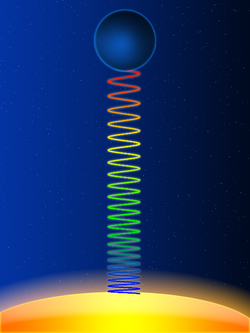
Key Facts
- Energy Loss: Photons lose energy and increase in wavelength as they move away from a massive body.
- Time Connection: Gravitational redshift is equivalent to gravitational time dilation; clocks closer to a massive body tick slower.
- Solar Effect: Light escaping the Sun is redshifted by approximately 2 parts per million (ppm).
- GPS Impact: While the frequency shift is tiny, the associated time dilation is critical for the accuracy of GPS satellite navigation.
- Extreme Gravity: In high-gravity environments, such as white dwarfs, the redshift is significantly more pronounced.
The Science Behind the Shift
Gravitational redshift can be understood through several different physical lenses. One primary interpretation is the equivalence principle, which suggests that gravitational effects are locally equivalent to inertial effects (acceleration), meaning the redshift is essentially a Doppler effect caused by gravity.
Another perspective involves the conservation of energy and mass-energy equivalence: as a photon "falls" into a gravitational well, it gains energy; as it climbs out, it must expend energy, leading to the redshift. Furthermore, this can be viewed as gravitational time dilation. If two oscillators (transmitters) are at different gravitational potentials, the one further from the attracting body (at a higher potential) will tick faster. To an observer, the oscillator closer to the mass will appear to have a lower frequency.
Measuring the Magnitude
To a first approximation, the redshift is proportional to the difference in gravitational potential divided by the speed of light squared. Because the speed of light is so immense, the effect is usually very small in our daily lives:
- On Earth: The redshift is roughly 0.1 parts per quadrillion per meter of elevation change.
- GPS Satellites: Orbiting at 20,000 km, these signals are blueshifted by about 0.5 parts per billion (ppb).
- White Dwarfs: These dense stars produce a much larger average redshift of around 170 ppm.
Predictions of General Relativity
General relativity provides specific mathematical frameworks to predict these shifts based on the environment. In a uniform gravitational field (such as on Earth's surface), the redshift is approximately 1.1 × 10⁻¹⁶ per meter, which is equivalent to a 3.3 × 10⁻⁸ m/s Doppler shift.
For a spherically symmetric gravitational field, the shift depends on the mass of the body and the distance of the observer. In the Newtonian limit—where the distance is large compared to the Schwarzschild radius (the radius of the event horizon of a non-rotating black hole)—the redshift can be approximated using gravitational acceleration. For example, the redshift from the Moon's surface relative to infinity is approximately 3 × 10-11.
Summary of Gravitational Redshift Magnitudes
| Object/Location | Approximate Redshift (z) | Velocity Equivalent |
|---|---|---|
| Earth (Surface to Infinity) | 7 × 10⁻¹⁰ | 0.2 m/s |
| Moon (Surface to Infinity) | 3 × 10-11 | ~1 cm/s |
| Sun (Surface to Infinity) | 2 × 10⁻⁶ (2 ppm) | 633 m/s |
| White Dwarf (Average) | 170 ppm | 50 (km/s)/c |
From Theory to Observation
The history of gravitational redshift began long before Einstein. In the late 18th century, John Michell and Pierre-Simon Laplace used Newton's concept of light corpuscles to suggest that some stars might be so massive that light could not escape them. However, these early theories incorrectly assumed light could slow down and "fall."
Astronomical Evidence
Measuring the Sun's redshift is challenging because the motion of the Sun's surface creates a Doppler shift of a similar magnitude. Despite this, James W. Brault made measurements in 1962, and a 2020 study analyzing iron spectral lines reflected by the Moon found a mean lineshift of 638 ± 6 m/s, closely matching the theoretical 633.1 m/s.
More extreme tests occurred in 2018 with the star S2, which passed near Sagittarius A*, the supermassive black hole at the center of the Milky Way. Observations by the GRAVITY and KECK/UCLA groups revealed a combined transverse Doppler and gravitational redshift of up to 200 (km/s)/c, confirming general relativity's predictions in a high-gravity environment.
Terrestrial Verification
On Earth, the Pound-Rebka experiment (1959) provided definitive verification by measuring the change in wavelength of gamma-ray photons over a height of 22.5 meters using the Mössbauer effect (a phenomenon that allows for extremely narrow line widths in radiation).
Modern technology has pushed these tests to incredible precision. In 2020, researchers at the University of Tokyo used strontium-87 optical lattice clocks separated by 450 meters at the Tokyo Skytree to measure a redshift of 21.18 Hz. By 2021, physicists at JILA reported measuring gravitational redshift on a sub-millimeter scale using an ultracold cloud of 100,000 strontium atoms.
Frequently Asked Questions
What is the difference between gravitational redshift and Doppler redshift?
Doppler redshift is caused by the relative motion between a source and an observer (moving away from each other). Gravitational redshift is caused by light escaping a gravitational field, regardless of whether the source is moving.
Why is gravitational redshift important for GPS?
While the frequency shift of the radio signal is small, the gravitational time dilation causes the atomic clocks on satellites to tick faster than those on Earth. If this were not corrected, GPS location data would become inaccurate very quickly.
What is a gravitational blueshift?
A gravitational blueshift is the opposite of a redshift; it occurs when a photon gains energy and its wavelength decreases as it moves into a stronger gravitational field.
How does the Schwarzschild radius relate to redshift?
The Schwarzschild radius defines the boundary of a black hole. As light is emitted from a point closer to this radius, the gravitational redshift becomes more extreme, eventually becoming infinite at the event horizon, meaning light cannot escape.
What was the significance of the Pound-Rebka experiment?
It was the first terrestrial experiment to definitively verify gravitational redshift by using gamma-ray photons and the Mössbauer effect to detect tiny changes in wavelength over a short vertical distance.