Gravitational Time Dilation: How Gravity Warps the Flow of Time
Imagine two identical clocks: one sitting on a beach and another perched atop a mountain. While they seem to tick in unison, physics tells us a different story. Because of gravitational time dilation, the clock on the mountain actually ticks slightly faster than the one at sea level. This is not a mechanical error, but a fundamental property of our universe.
Gravitational time dilation is a phenomenon where the elapsed time between two events differs based on the observers' distances from a gravitating mass. In simpler terms, the stronger the gravity (or the lower the gravitational potential), the slower time passes. This effect was first predicted by Albert Einstein and has since been rigorously confirmed through various tests of general relativity.
Key Facts
- Gravity slows time: Clocks closer to a massive body run slower than those further away.
- Einstein's Prediction: First described in 1907 and later integrated into the general theory of relativity.
- Measurable Effects: While tiny on Earth (measured in nanoseconds), the effect is significant enough to require corrections for GPS satellites.
- Cosmic Scale: Over 4.6 billion years, Earth's core is approximately 2.5 years younger than its surface.
- Light Interaction: This phenomenon is closely linked to gravitational redshift, where light frequency drops as it moves away from a massive body.
The Science of Spacetime and Gravity
To understand why time slows down near mass, we must look at the equivalence principle. This principle suggests that the effects of acceleration and gravity are physically equivalent. Whether you are in a rocket accelerating through space or standing on a planet, the physics of time dilation remains the same.
In general relativity, this is described as a difference in the passage of proper time (the time measured by a clock following a specific path) at different positions within the metric tensor of spacetime. Essentially, massive objects warp the fabric of spacetime, and this curvature affects the rate at which time flows.
The Relationship with Gravitational Redshift
Gravitational time dilation is the engine behind gravitational redshift. When a body emits light of a constant frequency near a massive object, the time dilation slows the emission process. To a distant observer, the frequency of that light appears lower, shifting it toward the red end of the spectrum.
Calculating Time Dilation
Physicists use specific mathematical models to determine exactly how much time slows down. One of the most common is the Schwarzschild metric, which describes spacetime around a non-rotating, spherically symmetric mass.
Using this metric, we can compare the proper time of an observer deep within a gravitational field to the coordinate time of an observer at an infinite distance. For example, without considering rotation, a clock on Earth's surface loses about 0.0219 seconds per year compared to a distant observer. On the surface of the Sun, the effect is much more dramatic, with a loss of approximately 66.4 seconds per year.
| Location/Scenario | Time Difference/Effect | Timeframe |
|---|---|---|
| Earth's Surface vs. Distant Observer | -0.0219 seconds | Per Year |
| Sun's Surface vs. Distant Observer | -66.4 seconds | Per Year |
| Mt. Everest (9,000m) vs. Sea Level | +39 hours | 4.6 Billion Years |
| Earth's Core vs. Surface | -2.5 years | 4.6 Billion Years |
Experimental Proof
While the effects are minuscule in our daily lives, they are easily detectable with high-precision instruments. The Pound–Rebka experiment in 1959 provided the first direct confirmation of this effect. Later, the Hafele–Keating experiment used atomic clocks on airplanes to show that clocks at higher altitudes ran faster than those on the ground.
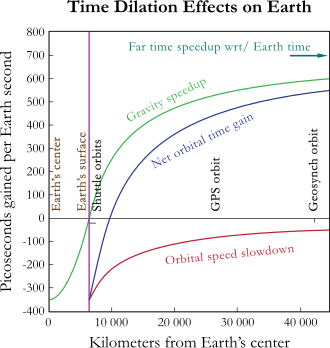
This is not just theoretical physics; it is a practical necessity for modern technology. The Global Positioning System (GPS) relies on satellites with atomic clocks. Because these satellites are further from Earth's mass, their clocks run faster. If engineers did not permanently correct for this time dilation, GPS location data would quickly become inaccurate.
Other confirmations include measurements from the Viking 1 Mars lander and observations of the white dwarf star Sirius B.
Frequently Asked Questions
Does this mean time actually moves slower, or is it just a measurement error?
Time actually passes slower. Gravitational time dilation is a physical difference in the elapsed time between two events, not an optical illusion or a clock malfunction.
Why do GPS satellites need corrections for this?
GPS satellites are located in a weaker gravitational field than receivers on Earth. This causes their onboard atomic clocks to tick faster, which would lead to significant errors in distance calculations if not corrected.
What is the difference between gravitational time dilation and velocity time dilation?
Gravitational time dilation is caused by the proximity to a mass (gravitational potential), whereas velocity time dilation (from special relativity) is caused by the relative speed between two observers.
Can we feel time dilation in our daily lives?
No. The effect on Earth is measured in nanoseconds, which is far below the threshold of human perception. It only becomes noticeable with ultra-precise atomic clocks or over billions of years.
How does the speed of light stay constant if time changes?
The speed of light is always measured as c by any observer in their own local region of spacetime. While a distant observer might see light travel a finite distance near a sun differently, any local measurement always yields the constant speed of light.