Gravitational Singularities: The Points Where Spacetime Breaks Down
In the vast landscape of astrophysics, few concepts are as challenging or as provocative as the gravitational singularity. Often described as a point of infinite density, a singularity represents a theoretical condition where gravity becomes so intense that the very fabric of spacetime—the four-dimensional continuum of space and time—breaks down catastrophically.
Because a singularity is, by definition, the point where the laws of physics as we know them cease to function, it is no longer considered part of regular spacetime. Consequently, it cannot be located using traditional coordinates of "where" or "when." While general relativity—our most successful theory of gravity—predicts their existence, it lacks a complete and precise definition of them. Instead, physicists identify singularities when scalar invariant curvature becomes infinite or when a geodesic (the path a freely-falling particle follows) becomes incomplete.
Key Facts
- Infinite Density: Singularities occur when mass is compressed into a region of zero volume.
- Cosmic Origins: General relativity suggests the Big Bang began as a singularity of infinite temperature and density.
- Black Hole Cores: Every black hole is predicted to contain a singularity at its center.
- Event Horizons: In most cases, singularities are hidden from the outside universe by an event horizon.
- Theoretical Limits: Many scientists believe a quantum description of gravity is needed to explain singularities, as classical theories fail at these extremes.
Singularities in Black Holes
General relativity predicts that any object collapsing beyond its Schwarzschild radius (the critical radius at which the escape velocity equals the speed of light) will form a black hole. At the heart of this black hole lies the singularity.
The shape of this singularity depends on the black hole's properties. In a non-rotating (Schwarzschild) black hole, the singularity is a single point. However, in a rotating (Kerr) black hole, the singularity is "smeared" into a ring singularity lying in the plane of rotation. Despite these different shapes, both possess zero volume and contain all the black hole's mass, resulting in infinite density.
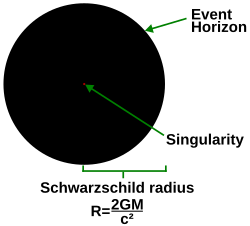
For an observer falling into a non-rotating black hole, the journey is one-way. Once they cross the event horizon, they are inevitably drawn toward the singularity. As they approach, they experience extreme tidal forces that stretch the body vertically and compress it horizontally—a process known as spaghettification (or the noodle effect)—before being crushed into an infinitely small point.
Alternative Theoretical Models
Because infinite density is physically problematic, some models propose regular (nonsingular) black holes. For instance, the fuzzball model from string theory suggests black holes are composed of quantum microstates without a singularity or event horizon. Similarly, loop quantum gravity proposes that while curvature and density at the center are immense, they remain finite rather than infinite.
Types of Singularities
Not all singularities are created equal. Physicists categorize them based on their geometric and physical properties:
- Conical Singularities: These occur at points where spacetime is not smooth, making the region look like a cone with the singularity at the tip. Examples include cosmic strings and the central singularity of a Schwarzschild black hole.
- Curvature Singularities: These are characterized by the Kretschmann scalar (the square of the Riemann tensor) becoming infinite. While the event horizon of a black hole may seem singular in some coordinate systems, it is actually regular; the true curvature singularity exists only at the center.
More broadly, a spacetime is considered singular if it is geodesically incomplete. This means a freely-falling particle's motion simply ends at a finite time because it has reached the singularity. This applies to both the center of a black hole and the initial state of the universe at the moment of the Big Bang.
The Mystery of Naked Singularities
For decades, the cosmic censorship hypothesis suggested that all singularities must be hidden behind an event horizon, protecting the rest of the universe from their unpredictability. Such hidden singularities are standard; a singularity without an event horizon is called a naked singularity.
In 1991, simulations of rotating planes of dust suggested that general relativity might actually allow naked singularities to exist. Additionally, the Reissner–Nordström geometry describes charged black holes; if the electrical charge is high enough, the event horizon could theoretically disappear. However, such a state would require a charge exceeding physically plausible limits, and actual astrophysical black holes are not expected to carry such significant charges.
A black hole that sits exactly at the threshold of losing its event horizon is referred to as extremal.
Summary of Singularity Characteristics
| Type/Model | Geometry | Key Characteristic | Example |
|---|---|---|---|
| Schwarzschild | Point | Infinite density, zero volume | Non-rotating black hole |
| Kerr | Ring | Rotational plane singularity | Rotating black hole |
| Conical | Cone-tip | Non-smooth spacetime | Cosmic string |
| Naked | Variable | No event horizon | Theoretical high-charge BH |
| Fuzzball | Quantum state | No singularity or horizon | String theory model |
Frequently Asked Questions
What exactly is a gravitational singularity?
It is a theoretical region in spacetime where gravity is so intense that the curvature becomes infinite and the known laws of general relativity break down, resulting in a point of infinite density.
Can we ever see a singularity?
In standard black holes, no. They are shielded by an event horizon, which prevents any light or information from escaping. Only a theoretical "naked singularity" would be visible, though these are not known to exist in nature.
What is spaghettification?
Spaghettification is the process where the extreme difference in gravitational pull between two points (such as your head and your feet) stretches an object into a long, thin shape as it falls toward a singularity.
Was the Big Bang a singularity?
According to classical general relativity, yes. The universe is thought to have started as a singularity of infinite density and temperature. However, many physicists believe quantum effects prevented a true singularity from forming.
How does a ring singularity differ from a point singularity?
A point singularity occurs in non-rotating black holes and is a single zero-dimensional point. A ring singularity occurs in rotating black holes, where the singularity is spread into a circular line in the plane of rotation.