Schwarzschild Metric: The Foundation of Black Hole Physics
In the realm of Albert Einstein's general relativity, the Schwarzschild metric (or Schwarzschild solution) stands as a cornerstone of modern astrophysics. It provides an exact solution to the Einstein field equations, describing the gravitational field surrounding a spherical mass. To maintain this precision, the solution assumes that the mass has no electric charge, no angular momentum (meaning it is non-rotating), and that the universal cosmological constant is zero.
While it describes idealized conditions, the Schwarzschild metric serves as a highly effective approximation for slowly rotating astronomical bodies, including our own Sun and Earth. Discovered independently in 1916 by Karl Schwarzschild and Johannes Droste, this mathematical framework allows scientists to predict how spacetime curves around massive objects.
Key Facts
- Nature: The most general spherically symmetric vacuum solution of the Einstein field equations (per Birkhoff's theorem).
- Schwarzschild Black Hole: A non-rotating, uncharged black hole defined solely by its mass.
- Event Horizon: The mathematical boundary at the Schwarzschild radius from which nothing, not even light, can escape.
- Singularities: Features an intrinsic curvature singularity at the center (r = 0) and a coordinate singularity at the event horizon.
- Scale: For most stars and planets, the Schwarzschild radius is negligible compared to their actual size.
The Event Horizon and the Schwarzschild Radius
A Schwarzschild black hole is defined by its event horizon, a spherical boundary located at the Schwarzschild radius. It is important to note that the event horizon is not a physical surface; an observer falling through it would not feel a physical barrier, though they would eventually be destroyed by tidal forces.
Any non-rotating, uncharged mass that is compressed smaller than its Schwarzschild radius will inevitably form a black hole. According to general relativity, such a black hole could theoretically exist at any mass, provided the conditions for its formation are met.
To put the scale of these objects into perspective, the Schwarzschild radius of the Earth is roughly 8.9 mm. The Sun, which is significantly more massive, has a Schwarzschild radius of approximately 3.0 km. These ratios only become significant when dealing with ultra-dense objects like neutron stars or black holes.
Mathematical Formulation and Singularities
The metric describes spacetime using coordinates including time (t), colatitude (θ), longitude (φ), and the radial coordinate (r). Within this framework, two types of singularities appear:
- Intrinsic Curvature Singularity: Located at r = 0, where the curvature of spacetime becomes infinite.
- Coordinate Singularity: Located at the event horizon (r = rs). For decades, physicists debated if this was a physical barrier.
Later research by scientists such as Arthur Eddington, Georges Lemaître, and Martin Kruskal demonstrated that the singularity at the event horizon is a coordinate artifact. By switching to different coordinate systems—such as Kruskal-Szekeres or Eddington-Finkelstein coordinates—the metric remains regular at the horizon, proving that a free-falling observer could cross it in a finite amount of proper time.
Visualizing Spacetime: Flamm's Paraboloid
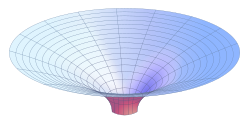
To visualize the spatial geometry of the Schwarzschild metric, physicists often use Flamm's paraboloid. This surface represents a slice of the metric in the equatorial plane at a fixed time. It demonstrates how the radial distance is stretched as one approaches the mass, providing a geometric representation of the curvature of space.
Orbital Motion in Curved Spacetime
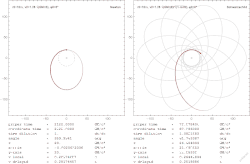
The Schwarzschild metric reveals that orbits around a massive object behave differently than in Newtonian physics. While stable circular orbits can exist at distances greater than 3 rs, orbits between 1.5 rs and 3 rs are unstable. Below 1.5 rs, no circular orbits are possible.
One of the most distinct differences is apsidal precession, where the orbit of a particle does not close perfectly in an ellipse but instead shifts over time, a phenomenon observed in the orbit of Mercury.
Summary of Coordinate Systems
Because the original Schwarzschild coordinates fail at the event horizon, several alternative systems have been developed to describe the spacetime more completely.
| Coordinate System | Key Feature | Horizon Status |
|---|---|---|
| Schwarzschild | Standard radial/time coordinates | Singular at r = rs |
| Eddington–Finkelstein | Uses null coordinates | Regular at future/past horizon |
| Gullstrand–Painlevé | Rain-frame coordinates | Regular at both horizons |
| Kruskal–Szekeres | Maximal analytic extension | Regular; covers full spacetime |
| Lemaître | Synchronous coordinates | Regular at either horizon |
Frequently Asked Questions
What is the difference between a coordinate singularity and a physical singularity?
A coordinate singularity, like the one at the event horizon, is a result of the chosen mathematical mapping and can be removed by changing coordinates. A physical (or intrinsic) singularity, like the one at r = 0, is a point where spacetime curvature becomes infinite regardless of the coordinate system used.
Can any object become a Schwarzschild black hole?
Theoretically, yes. According to the Schwarzschild solution, any non-rotating, uncharged mass will form a black hole if it is compressed to a size smaller than its Schwarzschild radius.
Why is the Schwarzschild metric useful if most objects rotate?
While most astronomical bodies rotate, many do so slowly enough that the Schwarzschild metric provides a highly accurate approximation for calculating gravitational effects, making it a practical tool for most astrophysical calculations.
What happens to an observer crossing the event horizon?
A free-falling observer would cross the event horizon in a finite amount of their own proper time without noticing a physical surface. However, they would be unable to return or send signals back to the exterior region, and they would eventually be drawn toward the central singularity.