Einstein Field Equations: The Mathematical Foundation of General Relativity
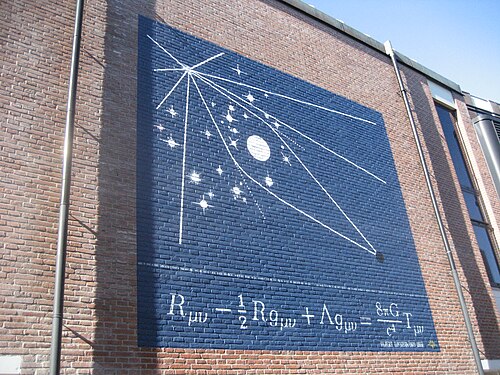
At the heart of modern astrophysics lies a profound realization: gravity is not a force acting at a distance, but rather a consequence of the curvature of spacetime. This revolutionary concept is mathematically codified in the Einstein field equations (EFE). Published by Albert Einstein in 1915, these equations describe how the distribution of matter and energy dictates the geometry of the universe, and conversely, how that geometry determines the motion of matter.
To understand the EFE, one can look at them as an analogue to Maxwell's equations in electromagnetism. While Maxwell's equations relate electromagnetic fields to charges and currents, the EFE relate the curvature of spacetime to the local energy, momentum, and stress. In essence, they determine the metric tensor—the mathematical object that defines distances and time intervals in spacetime—for any given arrangement of mass and energy.
Key Facts
- Core Purpose: Relates spacetime geometry (curvature) to the distribution of matter-energy.
- Mathematical Nature: A system of ten coupled, nonlinear, hyperbolic-elliptic partial differential equations.
- Key Components: Uses the Einstein tensor to represent curvature and the stress-energy tensor to represent matter/energy.
- Newtonian Limit: Reduces to Newton's law of universal gravitation in weak fields and low velocities.
- Vacuum Solutions: When the stress-energy tensor is zero, the equations describe vacuum regions, leading to predictions like black holes.
The Mathematical Framework
The Einstein field equations are expressed as a tensor equation. In its standard form, the equation relates the Einstein tensor ($G_{\mu\nu}$) to the stress-energy tensor ($T_{\mu\nu}$), incorporating the cosmological constant ($\Lambda$) and the Einstein gravitational constant ($\kappa$).
Defining the Tensors
The Einstein tensor is a symmetric, divergenceless second-degree tensor. It is derived from the Ricci curvature tensor (which describes the degree to which the geometry of a space differs from that of ordinary Euclidean space) and the scalar curvature. These components depend entirely on the metric tensor and its first and second derivatives.
The stress-energy tensor, on the other hand, represents the physical content of spacetime, including energy density, momentum density, and stress (pressure).
The Role of the Metric Tensor
The ultimate goal of solving the EFE is to find the components of the metric tensor. Once the metric is known, physicists can use the geodesic equation to calculate the inertial trajectories of particles and radiation—the paths they follow through the resulting curved geometry.
The Cosmological Constant and Vacuum Energy
Originally, Einstein included the cosmological constant ($\Lambda$) to allow for a static universe that neither expanded nor contracted. After the discovery that the universe is expanding, Einstein famously referred to the introduction of this term as the "biggest blunder of his life."
However, modern physics has revisited this term. The cosmological constant can be algebraically incorporated into the stress-energy tensor, where it describes a vacuum state with a fixed energy density and isotropic pressure. Consequently, the terms "cosmological constant" and "vacuum energy" are often used interchangeably in contemporary general relativity.
Special Formulations and Features
Vacuum Field Equations
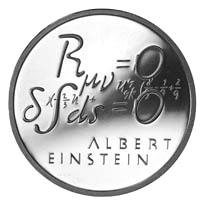
When a region of spacetime contains no matter or energy (meaning the stress-energy tensor is zero), the EFE become the vacuum field equations. Solutions to these equations are known as vacuum solutions. The simplest is the flat Minkowski space, but more complex solutions include the Schwarzschild solution (describing a non-rotating black hole) and the Kerr solution (describing a rotating black hole).
Einstein-Maxwell Equations
When the stress-energy tensor specifically represents an electromagnetic field in free space, the system is referred to as the Einstein-Maxwell equations. This formulation combines the laws of gravitation with the covariant Maxwell equations, describing how electromagnetic energy curves spacetime.
Conservation and Correspondence
The EFE are designed to be consistent with the local conservation of energy and momentum. Furthermore, they adhere to the correspondence principle: in the limit of weak gravitational fields and velocities much slower than the speed of light, the EFE reduce exactly to Newton's law of gravitation.
Summary of EFE Components
| Component | Symbol | Physical/Mathematical Meaning |
|---|---|---|
| Einstein Tensor | $G_{\mu\nu}$ | Represents the local curvature of spacetime. |
| Stress-Energy Tensor | $T_{\mu\nu}$ | Represents the distribution of matter, energy, and stress. |
| Metric Tensor | $g_{\mu\nu}$ | Defines the geometry and distance intervals of spacetime. |
| Cosmological Constant | $\Lambda$ | Represents vacuum energy density. |
| Gravitational Constant | $\kappa$ | The coupling constant relating geometry to energy. |
Frequently Asked Questions
What do the Einstein field equations actually calculate?
They calculate the metric tensor of spacetime. By knowing the distribution of mass and energy, the equations reveal how spacetime is curved, which in turn determines how objects move under the influence of gravity.
Why are these equations considered "nonlinear"?
They are nonlinear because the Ricci tensor and scalar curvature depend on the metric tensor in a complex way. This means that the gravitational field itself can act as a source of further gravitation, making exact solutions very difficult to find.
What is a "vacuum solution"?
A vacuum solution is a solution to the EFE where the stress-energy tensor is zero. This describes regions of space empty of matter, such as the area surrounding a black hole.
How do the EFE relate to Newton's laws?
The EFE are a generalization of gravity. In environments where gravity is weak and speeds are low (like on Earth), the complex tensor equations simplify to the familiar inverse-square law described by Isaac Newton.
What is the significance of the geodesic equation?
While the EFE tell us how matter curves spacetime, the geodesic equation tells us how matter moves within that curved spacetime. It describes the "straightest possible path" an object takes through curved geometry.