Grapefruit: History, Nutrition, and Essential Health Considerations
The grapefruit (Citrus × paradisi) is a vibrant, acidic citrus fruit known for its distinct flavor and health-promoting properties. Unlike many other citrus fruits that evolved over millennia, the grapefruit is a relatively modern hybrid, originating from an accidental cross between the sweet orange and the pomelo. Once referred to as the "forbidden fruit," it has grown from a Caribbean curiosity into a global agricultural staple.
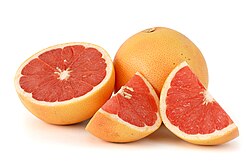
![The grapefruit, like many cultivated Citrus species, is a hybrid, in its case of the sweet orange and pomelo.[29]](/images/1b/50/1b50ade4c721d96b33dded912d392478768aa372956dc52caf44713160e50d08.webp)
Key Facts
- Origin: A natural hybrid of sweet orange and pomelo, originating in Barbados during the 18th century.
- Nutrition: An excellent source of Vitamin C, providing 37% of the Daily Value per 100g.
- Global Production: China is the leading producer, accounting for 52% of the world's supply.
- Drug Interaction: Contains furanocoumarins that can dangerously alter the metabolism of certain medications.
- Varieties: Available in white, pink, and red pulps, with redder varieties generally being the sweetest.
Botanical Description and Varieties
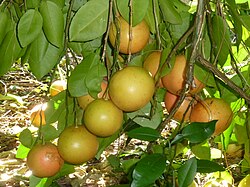
Grapefruit trees are evergreens that typically reach heights of 4.5 to 6 meters, though some can grow as tall as 13.7 meters. They are characterized by glossy, dark green leaves and fragrant white flowers with four or five petals.
The fruit itself is an oblate spheroid with a yellow-orange skin, usually measuring between 10 and 15 cm in diameter. The interior consists of segmented, acidic flesh. While white and pink varieties are common, the 1929 'Ruby Red' (or 'Redblush') patent brought significant commercial success. This variety is so prized in the United States that it was designated the official State Fruit of Texas in 1993.
Modern Breeding and Mutations
To prevent the red tones of the fruit from fading to pink, scientists used radiation to trigger mutations. A notable result is the 'Rio Red' variety, registered in 1984. Developed by treating bud sticks with thermal neutrons, the 'Rio Red' offers a deeper red color in both the fruit and juice and possesses wider environmental adaptation.
Nutritional Profile
Grapefruit is highly hydrating, consisting of approximately 90% water. It is low in calories and fat, making it a popular choice for health-conscious diets. Its most significant micronutrient is Vitamin C, which is essential for immune function and skin health.
| Nutrient | Amount | % Daily Value (DV) |
|---|---|---|
| Energy | 33 kcal (138 kJ) | - |
| Carbohydrates | 8.41 g | - |
| Sugars | 7.31 g | - |
| Protein | 0.8 g | - |
| Vitamin C | - | 37% |
| Potassium | - | 5% |
| Pantothenic acid (B5) | - | 6% |
Culinary Uses and Production
Grapefruit is versatile in the kitchen, appearing in both sweet and savory dishes. Popular preparations include caramelized grapefruit, roasted grapefruit chicken, and salmon tartar. It is also a key ingredient in the Greyhound cocktail, mixed with gin.
Global production is dominated by Asia. In 2023, total world production (including pomelos) reached 9.93 million tonnes. China leads the market, followed by Vietnam, Mexico, South Africa, and the United States.
Critical Drug Interactions
While healthy for most, grapefruit can be dangerous for individuals taking certain medications. This is due to furanocoumarins—compounds like bergamottin found in both the peel and the flesh. These substances inhibit the CYP3A4 enzyme, a member of the cytochrome P450 family responsible for metabolizing roughly 90% of all drugs.
![Grapefruit juice contains bergamottin, one of the furanocoumarins which inhibit the metabolism of many drugs, causing multiple side-effects.[21]](/images/f3/a1/f3a1833279d0b12053c611bfb0ec72c55ff149a50d6b059d3468285bf2ce27be.png)
When the CYP3A4 enzyme is inhibited, the body cannot break down certain medications as efficiently. This can lead to abnormally high levels of the drug in the bloodstream, increasing the risk of toxicity and adverse side effects. Conversely, for drugs that require metabolism to become active, grapefruit can reduce the medication's effectiveness. A single glass of 200 mL of juice or one whole fruit is sufficient to trigger these interactions.
History and Origins
The grapefruit's journey began in the West Indies. Both the sweet orange and the pomelo were introduced to the Caribbean from Asia in the 17th century. The grapefruit emerged as a natural hybrid of these two species in Barbados. Early accounts from 1750 describe a "forbidden fruit," though historians debate if this was exactly the same plant as the modern grapefruit.
The term "grapefruit" was published in 1814 by John Lunan, who noted the fruit's taste similarity to grapes. Others suggest the name refers to the way the fruit grows in clusters. In the 19th century, the American citrus industry expanded rapidly, notably with the Atwood Grapefruit Company, which became the largest grove in the world and discovered pink grapefruit in 1906.
![Kimball Chase Atwood founded the Atwood Grapefruit Company in the late 19th century. It became the largest grapefruit grove in the world.[33]](/images/24/64/246403d5f9004d658f6f2f11bc088854d06c8c789972b943d0bfaadf7815e8ec.jpg)
Frequently Asked Questions
Why is grapefruit called "grapefruit"?
There are two primary theories: one suggests the name comes from the fruit's taste similarity to grapes, while the other suggests it refers to the grape-like clusters in which the fruit grows on the tree.
How does grapefruit interact with medication?
Grapefruit contains furanocoumarins that block the CYP3A4 enzyme in the intestines and liver. This prevents the body from breaking down certain drugs, which can lead to dangerously high concentrations of the medication in the blood.
What is the difference between a pomelo and a grapefruit?
The pomelo (Citrus maxima) is a distinct species and one of the ancestral parents of the grapefruit. The grapefruit (Citrus × paradisi) is a hybrid of the pomelo and the sweet orange.
Which grapefruit variety is the sweetest?
Generally, the redder the pulp, the sweeter the fruit. Red varieties, such as 'Ruby Red' and 'Rio Red,' are typically sweeter than pink or white varieties.
Who are the top producers of grapefruit globally?
China is the largest producer by a significant margin, producing 52% of the world's supply, followed by Vietnam.