The Versatile World of Common Purslane (Portulaca oleracea)
Often dismissed as a mere weed, Portulaca oleracea—commonly known as purslane, little hogweed, or pursley—is a remarkable succulent with a rich history and significant nutritional value. This resilient plant belongs to the Portulacaceae family and is recognized globally for its ability to thrive in challenging environments, from drought-stricken lands to salty soils.
Understanding the Plant
Physical Characteristics
Purslane is characterized by its fleshy, succulent nature. It grows from a central taproot accompanied by fibrous secondary roots, reaching heights of up to 40 centimetres (16 inches). The stems are typically smooth and reddish, often growing in a prostrate (lying flat along the ground) manner. Its leaves, which can be arranged alternately or oppositely, tend to cluster at the ends and joints of the stems.
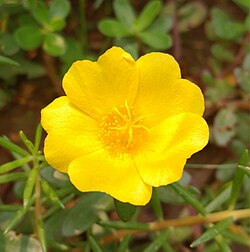
The plant produces small, five-parted flowers that typically open on sunny mornings for only a few hours. These flowers are essential for the plant's reproduction, as they produce many-seeded capsules that release tiny seeds upon maturity.
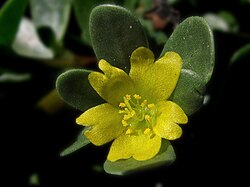
The flowers are often a bright yellow and measure up to 6 millimetres (1/4 inch) in width. Depending on the availability of rainfall, these blooms can appear at any time throughout the year.
One of the most impressive aspects of purslane is its reproductive capacity. A single large plant can produce as many as 240,000 seeds. These seeds are "light germinators," meaning they require light to sprout; even a thin layer of soil, such as 5 mm, can hinder their ability to germinate. Optimal growth occurs at temperatures above 25 °C (77 °F).
Taxonomy and Varieties
First recorded by Carl Linnaeus in 1753, P. oleracea has been subject to much taxonomic debate due to its high variability. While many subspecies and varieties have been described, most are considered part of the natural variation within the species. Currently, approximately 40 cultivars are grown. Two main varieties are widely accepted: Portulaca oleracea var. delicatula, which is endemic to the Seychelles, and Portulaca oleracea var. oleracea, which covers the species' primary range.
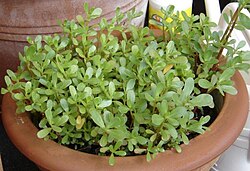
It is important not to confuse purslane with its ornamental relative, Portulaca grandiflora (commonly known as moss rose), which is grown for its bright colors rather than as an edible. Additionally, the "winter purslane" (Claytonia perfoliata) is a member of a completely different family and is not closely related.
Remarkable Biological Adaptations
A Dual-Pathway Metabolism
Purslane possesses a rare and fascinating biological trait: it can utilize both C4 and Crassulacean Acid Metabolism (CAM) photosynthesis pathways. C4 photosynthesis is highly efficient in high-temperature and high-light environments, while CAM is a specialized adaptation that allows plants to conserve water by fixing carbon dioxide at night. While these two pathways were previously thought to be incompatible, P. oleracea can switch between them during periods of drought to ensure survival.
Resilience in Saline Soils
Beyond drought resistance, purslane is exceptionally tolerant of soil salinity (salt content). This makes it an ideal candidate for "biodesalinating" or cleaning agricultural land. When grown as an intercrop—a plant grown alongside a primary crop—purslane can actually remove chloride and sodium from the soil, creating a more hospitable environment for salt-sensitive plants like tomatoes.
Nutritional Profile and Culinary Uses
A Nutritional Powerhouse
Every part of the purslane plant is edible, whether consumed raw or cooked. It is a highly hydrating food, consisting of approximately 93% water. Nutritionally, it is a significant source of alpha-linolenic acid, an essential omega-3 fatty acid. It is also exceptionally rich in Vitamin E (81% of the Daily Value) and Vitamin C (23-25% DV).
| Nutrient | Quantity | % Daily Value (Approx.) |
|---|---|---|
| Energy | 20 kcal | - |
| Protein | 2.03 g | - |
| Carbohydrates | 3.39 g | - |
| Fat | 0.36 g | - |
| Vitamin E | High | 81% |
| Vitamin C | High | 23% |
| Magnesium | Moderate | 16% |
| Potassium | Moderate | 16% |
| Iron | Moderate | 11% |
Note: Purslane leaves are high in oxalates, which should be considered in dietary planning.
Global Culinary Traditions
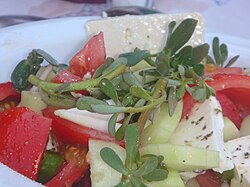
The flavor of purslane is often described as slightly sour and salty, a profile created by the presence of malic and oxalic acids. This sourness is most pronounced when the plant is harvested in the early morning. Because of its mucilaginous (slightly slippery) texture, it is excellent in soups and stews, but it is also widely enjoyed fresh in salads.
Culinary uses vary significantly across the globe. In Greece, it is often paired with feta cheese, tomatoes, and olives. In Turkey, it may be mixed with yogurt to create a variant of tzatziki, while in Sudan, it is frequently prepared as a vegetable stew. In Mexico and the American Southwest, it is known and consumed as verdolagas.
Key Facts
- Edibility: All parts of the plant, including stems, leaves, and flower buds, are edible.
- Metabolism: It is one of the few plants that can switch between C4 and CAM photosynthesis.
- Nutrients: It is a potent source of Vitamin E, Vitamin C, and omega-3 fatty acids.
- Soil Benefit: It can help reduce soil salinity by removing chloride and sodium.
- Growth: It is a succulent that thrives in poor soil and can produce up to 240,000 seeds per plant.
Frequently Asked Questions
Is all of the purslane plant edible?
Yes, all parts of the Portulaca oleracea plant, including the leaves, stems, and flower buds, can be eaten either raw or cooked.
How does purslane differ from moss rose?
While both belong to the same genus, Portulaca grandiflora (moss rose) is an ornamental plant grown for its flowers, whereas P. oleracea is a widespread edible plant.
Why does purslane have a sour taste?
The sour flavor is due to the presence of oxalic and malic acids within the plant.
Can purslane be used to improve soil?
Yes, purslane has a high tolerance for salt and can help remove chloride and sodium from the cultivation medium, which can benefit companion plants.
Is purslane related to winter purslane?
No, despite the similar name, winter purslane (Claytonia perfoliata) belongs to the Montiaceae family and is not closely related to common purslane.