Gott mit uns: The History and Usage of the German Motto
The phrase Gott mit uns, translating to "God [is] with us," is a powerful motto that has permeated centuries of European heraldry and military tradition. While most famously associated with the Prussian state and the German military, its roots extend back to ancient biblical prophecy and the battle cries of fallen empires.
Key Facts
- Biblical Origin: Derived from the name Immanuel (Emmanuel), meaning "God with us" in Matthew 1:23 and Isaiah 7:14.
- Prussian Adoption: Used in Prussian heraldry starting in 1701 under Frederick I.
- Military Use: Featured on the belt buckles of the German Empire and the Wehrmacht.
- Modern Transition: Replaced in the Bundeswehr (modern German army) by "Einigkeit und Recht und Freiheit" in 1962.
- Police Usage: Remained on West German police belt buckles until the 1970s.
Biblical and Ancient Origins
The theological foundation of the phrase is found in the Bible. In Matthew 1:23, referencing a prophecy from Isaiah 7:14, the name Immanuel (Emmanuel) is explicitly interpreted as "God with us." This spiritual sentiment transitioned from scripture into a declaration of divine support during conflict.
Long before its adoption in Germany, similar sentiments served as battle cries for the later Roman Empire and the Byzantine Empire. In Latin, this was rendered as Nobiscum Deus, and in Ancient Greek as Meth hēmō̂n ho Theós.
Evolution in Germany
The first instance of the phrase's use within Germany is attributed to the Teutonic Order. By the 17th century, it had evolved into a practical military tool; the army of Gustavus Adolphus used Gott mit uns as a "field word"—a password for recognition—during the Thirty Years' War at the battles of Wittstock, Lützen, and Breitenfeld.
Prussian Heraldry and the German Empire
In 1701, Frederick I of Prussia integrated the motto into his coat of arms as Prince-Elector of Brandenburg, placing it on the pedestal beneath the electoral scepter's shield. The phrase continued to appear in various official capacities, including the blue enamel ring of the Prussian Order of the Crown, established in 1861.
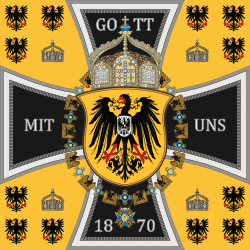
Following the unification of Germany in 1871, the motto became a symbol of the new Empire. It was prominently featured on the imperial standard, specifically on the arms of an Iron Cross.
The motto also reached the general public through currency; the edges of German silver 3 and 5 mark coins, as well as 20 mark gold coins, bore the inscription Gott mit uns.
The World Wars and Political Satire
During World War I, the phrase was inscribed on the belt buckles of German soldiers. This visibility made it a target for Allied propaganda; for example, a 1916 New-York Tribune cartoon used the phrase to symbolize the brutality of the conflict and encourage the United States to abandon its neutrality.
In the interwar period, the motto became a subject of social critique. In 1920, artist George Grosz released a lithographic collection titled Gott mit uns. This satirical work on the counter-revolution and German society was banned, and Grosz was fined 300 Papiermark for insulting the Reichswehr (the German army of the Weimar Republic).
World War II and Post-War Transition
During World War II, soldiers of the Wehrmacht (the unified armed forces of Nazi Germany) continued to wear the motto on their belt buckles. However, this differed from the Waffen-SS, who instead used the motto Meine Ehre heißt Treue ("My honour is loyalty").
After 1945, the motto's usage declined. The Bundeswehr (the modern West German military) abandoned the phrase entirely. In contrast, the West German police forces continued to use it on their belt buckles until the 1970s. East Germany, for ideological reasons, avoided the motto entirely, despite maintaining other Prussian military traditions within the Nationale Volksarmee.
Summary of Motto Usage
| Entity/Period | Motto Used | Application |
|---|---|---|
| Byzantine Empire | Meth hēmō̂n ho Theós | Battle cry |
| Prussia (from 1701) | Gott mit uns | Coat of arms / Heraldry |
| German Empire (1871–1918) | Gott mit uns | Imperial standard, coins, belt buckles |
| Wehrmacht (1933–1945) | Gott mit uns | Belt buckles |
| Waffen-SS | Meine Ehre heißt Treue | Belt buckles |
| Bundeswehr (since 1962) | Einigkeit und Recht und Freiheit | Belt buckles |
Frequently Asked Questions
What is the biblical origin of "Gott mit uns"?
The phrase is the German translation of the name Immanuel (Emmanuel), which appears in Matthew 1:23 and Isaiah 7:14, meaning "God with us."
Did all German soldiers in WWII use this motto?
No. While the Wehrmacht soldiers wore Gott mit uns on their belt buckles, members of the Waffen-SS wore Meine Ehre heißt Treue ("My honour is loyalty").
When did the modern German army stop using the phrase?
The Bundeswehr abandoned the motto after World War II. By 1962, they adopted the motto Einigkeit und Recht und Freiheit ("Unity and Justice and Freedom"), taken from the national anthem.
Was the motto used in East Germany?
No. Due to ideological reasons, the motto was not used in East Germany, although the Nationale Volksarmee still adopted other Prussian military traditions.
How was the motto used in the 17th century?
During the Thirty Years' War, the army of Gustavus Adolphus used Gott mit uns as a "field word," which functioned as a password for recognition during battles.