Gomphotheres: The Ancient Ancestors of Modern Elephants
Long before the modern African and Asian elephants roamed the earth, a diverse group of proboscideans known as gomphotheres dominated the landscapes of several continents. These prehistoric mammals, characterized by their unique tusk structures and varied jaw shapes, represent a critical chapter in the evolutionary history of the order Proboscidea. As a paraphyletic group—meaning they include a common ancestor and some, but not all, of its descendants—gomphotheres are ancestral to both the Stegodontidae and the Elephantidae, the family that includes all living elephants.
From their origins in Afro-Arabia to their eventual migration into the Americas, gomphotheres adapted to a wide array of environments over millions of years, leaving behind a rich fossil record that helps scientists trace the lineage of the world's largest land animals.
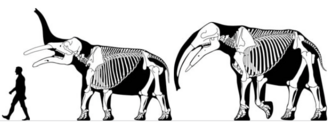
Key Facts
- Temporal Range: Existed from approximately 28 million to 10,000 years ago (28–0.01 Ma).
- Origins: First appeared in Africa during the Oligocene epoch.
- Global Reach: Dispersed into Eurasia and North America during the Miocene, and South America during the Pleistocene.
- Anatomy: Known for having enamel bands on the lateral surfaces of their tusks, a trait seen in juvenile modern elephants.
- Lineage: Ancestral to the family Elephantidae (modern elephants) and Stegodontidae.
Physical Characteristics and Anatomy
Gomphotheres exhibited significant morphological diversity, particularly in their tusks and jaw structures. Paleontologists often categorize them based on their dental patterns, specifically the "trilophodont" (three-ridged) and "tetralophodont" (four-ridged) molar types.
Tusk Evolution
In primitive longirostrine (long-jawed) gomphotheres, the upper tusks typically curved gently downward. These tusks generally did not exceed 2 meters (6.6 ft) in length or 35 kilograms (77 lb) in weight. However, later brevirostine (short-jawed) species developed larger upper tusks that could be straight or curve upward.
A defining characteristic of many gomphotheres was a band of enamel running along the lateral surface of the tusks from the tip to the root. In some species, this band spiraled if the tusk was twisted. While modern adult elephants lack this feature, it is still present in early juvenile elephants, highlighting the ancestral link between the two groups.
Jaw and Dental Structure
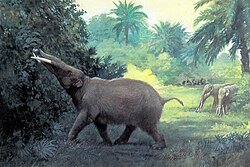
The transition from longirostrine to brevirostine forms marked a shift in feeding mechanics. Some genera, such as Cuvieronius hyodon, evolved shortened lower jaws and even lost their lower tusks entirely. This evolutionary trend suggests a shift in how these animals interacted with their environment and processed food.
Evolutionary History and Global Migration
The journey of the gomphotheres is a story of massive migrations and environmental adaptation. They originated in Afro-Arabia during the mid-Oligocene, with some of the earliest remains found in Saudi Arabia's Shumaysi Formation, dating back 28 to 29 million years.
The Proboscidean Datum Event
Around 19 million years ago, during the Early Miocene, a land connection between Afro-Arabia and Eurasia allowed gomphotheres to migrate northward. This migration is known as the Proboscidean Datum Event. By approximately 16 million years ago, the genus Gomphotherium had reached North America, where it likely served as the ancestor for subsequent New World species.
Diversification and Decline
During the Late Miocene, a shift in vegetation toward C4 grass-dominated habitats led to a dramatic decline in trilophodont gomphotheres. In their place, tetralophodont gomphotheres became the dominant proboscideans in Eurasia. It is believed that the genus Tetralophodon eventually gave rise to the family Elephantidae in Afro-Arabia.
The decline continued into the Pliocene and Pleistocene. In North America, gomphotheres were eventually extirpated, likely due to competition with mammoths and mastodons. However, the genera Notiomastodon and Cuvieronius successfully migrated into South America around 2.5 million years ago via the Isthmus of Panama as part of the Great American Biotic Interchange.
Summary of Gomphothere Classification
The following table provides an overview of the taxonomic groups and representative genera within the gomphothere lineage.
| Category | Representative Genera | Key Characteristics |
|---|---|---|
| Trilophodont Gomphotheres | Gomphotherium, Sinomastodon, Blancotherium | Three-ridged molars; declined in Late Miocene. |
| Tetralophodont Gomphotheres | Tetralophodon, Anancus, Paratetralophodon | Four-ridged molars; ancestral to Elephantidae. |
| New World Gomphotheres | Notiomastodon, Cuvieronius, Stegomastodon | Migrated to South America during the Pleistocene. |
Frequently Asked Questions
Are gomphotheres the same as mastodons?
While often grouped together in casual conversation, gomphotheres are a broader, ancestral group of proboscideans. Some gomphotheres share similarities with mastodons, but the group as a whole is paraphyletic and includes the ancestors of both modern elephants and stegodonts.
What is the "Proboscidean Datum Event"?
The Proboscidean Datum Event refers to the period around 19 million years ago when proboscideans, including gomphotheres, migrated from Afro-Arabia into Eurasia following the formation of a land bridge.
How did gomphotheres differ from modern elephants?
The most striking differences include their tusk structure—specifically the presence of a lateral enamel band in adults—and their jaw morphology, which varied from long-jawed (longirostrine) to short-jawed (brevirostine) forms.
Why did gomphotheres go extinct in North America?
Evidence suggests that gomphotheres in North America were extirpated from the latter half of the Early Pleistocene onwards, likely due to intense competition for resources with mammoths and mastodons.
When did gomphotheres reach South America?
Gomphotheres arrived in South America approximately 2.5 million years ago during the Pleistocene. This occurred via the Isthmus of Panama as part of the Great American Biotic Interchange.