The Majestic World of Elephants: Evolution, Anatomy, and Conservation
Elephants are among the most iconic and intelligent creatures on Earth. Belonging to the order Proboscidea, these massive mammals have a biological history that stretches back tens of millions of years. From their tiny ancestors to the giants roaming the African savannas and Asian forests today, elephants have undergone remarkable evolutionary changes to become the masters of their environments.
Evolutionary History
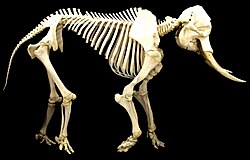
The lineage of the elephant began in the Paleocene epoch of Africa, approximately 60 million years ago. The earliest known members of the Proboscidea order, such as Eritherium, were significantly smaller than modern elephants, with a body mass ranging from only 3 to 8 kg (6.6–17.6 lb). As time progressed, these animals grew in scale. By the late Eocene, species like Barytherium had reached an estimated mass of 2 tonnes, while others, such as Moeritherium, are believed to have been semi-aquatic.
Living Elephant Species
Today, there are three distinct living species of elephants, categorized into two main genera: Loxodonta (African elephants) and Elephas (Asian elephants).
| Species Name | Scientific Name | Primary Distribution |
|---|---|---|
| African bush elephant | Loxodonta africana | Africa |
| African forest elephant | Loxodonta cyclotis | Africa |
| Asian elephant | Elephas maximus | Asia |
The African bush elephant is widely recognized for its massive size and ability to thrive in hot climates. In contrast, the African forest elephant inhabits more densely wooded regions.

The Asian elephant is found across various parts of Asia. While their range was once much broader—extending from Western to East Asia and south to Sumatra and Java—their current habitat is highly fragmented.
Physical Anatomy and Specialized Traits
Ears and Hearing
One of the most striking features of an elephant is its pinnae, or ear flaps. These flaps are typically 1–2 mm thick in the center, becoming thinner toward the edges. They are filled with numerous capillaries (tiny blood vessels) that allow the elephant to regulate its temperature. By flapping their ears, elephants circulate warm blood through these vessels, releasing excess heat into the environment. African bush elephants, which live in the hottest climates, possess the largest ear flaps to maximize this cooling effect.
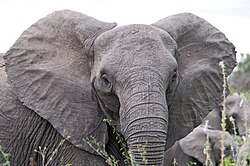
Elephants also possess highly specialized hearing. Their ossicles (small bones within the ear) are adapted to detect low-frequency sounds, though they are most sensitive at 1 kHz.
The Trunk and Skin
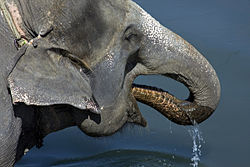
The trunk is a versatile, prehensile organ used for foraging, drinking, and communication. It is a vital tool for daily survival, allowing elephants to manipulate objects and access water with precision.
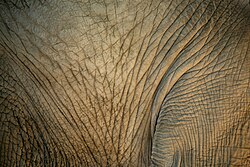
An elephant's skin is also a key part of its biology. The skin is thick and often develops wrinkles, which can serve functional purposes in their environment.
Teeth and Tusks
An adult elephant typically possesses 26 teeth: 12 incisors (known as tusks), 12 deciduous (baby) premolars, and 12 molars. Unlike most mammals, elephant teeth do not grow vertically from the jaw; instead, new teeth emerge from the back of the mouth and push the old ones forward. This process occurs in several stages throughout their lives, with the final set of teeth needing to last the remainder of the elephant's life.
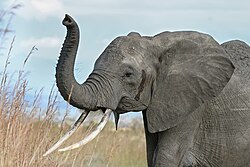
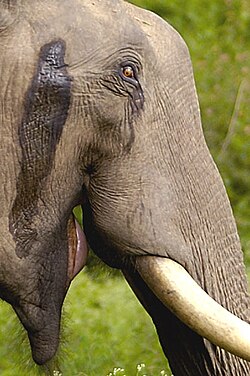
Tusks are actually modified incisors. Most elephants are "right-tusked" or "left-tusked," similar to human handedness, with a dominant "master" tusk that is often shorter and more worn. In African species, both males and females possess tusks, which can reach lengths of up to 300 cm (9 ft 10 in). In Asian elephants, however, large tusks are generally found only in males; females often have very small tusks or none at all. Notably, poaching for ivory has created a selection pressure that has led to an increase in tusklessness among certain populations.

Internal Systems
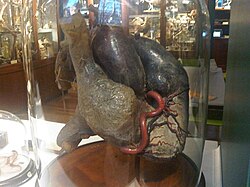
Internally, elephants have unique biological structures. For example, male testes are located internally near the kidneys. The penis can reach lengths of 100 cm (39 in) and features a Y-shaped orifice. Females possess mammary glands located between the front legs, allowing a calf to suckle while remaining within reach of the mother's trunk.
A unique feature found in elephants is the temporal gland, located on both sides of the head. This organ is closely linked to sexual behavior; males secrete fluid from this gland when they enter a state known as musth.
Behavior and Social Structure
Social Dynamics
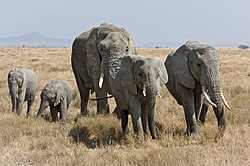
Elephants are highly social animals. African bush elephants often live in complex family groups, while adult male elephants may spend much of their time alone or in single-sex groups.

Development and Lifespan
The life of an elephant is long and characterized by distinct developmental stages. Females typically reach sexual maturity by age nine, while males mature around 14–15 years. Adulthood is generally reached at approximately 18 years of age. Most elephants live between 60 and 70 years, though some, like the captive Asian elephant Lin Wang, have lived as long as 86 years.
Reproduction and Musth
During mating, complex behaviors are observed. Males may enter musth, a period of heightened sexual activity and aggression marked by secretions from the temporal gland. This state is a significant driver of reproductive behavior in the wild.

Conservation and Human Interaction
Conservation Status
Many elephant species face significant threats. In 2020, the IUCN listed the Asian elephant as endangered, noting that populations had declined by half over the last three generations. Currently, the total population of Asian elephants is estimated to be between 40,000 and 50,000, with approximately 60% residing in India.
Human Relations and Cultural Impact
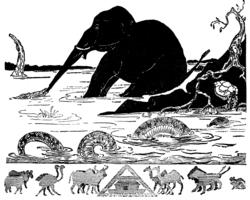
Throughout history, humans have had a complex relationship with elephants. They have been used as working animals for transport, utilized in warfare, and featured in entertainment such as circuses. Culturally, elephants hold deep significance, appearing in religious iconography, such as the Hindu god Ganesha, and in classic literature.




Key Facts
- Evolution: The earliest proboscideans, like Eritherium, lived 60 million years ago and weighed only 3–8 kg.
- Species: There are three living species: African bush elephant, African forest elephant, and Asian elephant.
- Lifespan: Elephants typically live 60–70 years.
- Dentition: Elephants have 26 teeth, and their teeth replace themselves from the back of the mouth.
- Conservation: Asian elephants are currently listed as endangered.
Frequently Asked Questions
How long do elephants live?
Most elephants have a lifespan of 60 to 70 years, though some individuals in captivity have been known to live longer, reaching up to 86 years.
What is the difference between African and Asian elephant tusks?
In African elephants, both males and females typically have tusks. In Asian elephants, large tusks are usually only found in males, while females have very small tusks or none at all.
Why do elephants flap their ears?
Elephants flap their ears to regulate their body temperature. The movement helps circulate blood through the capillaries in their ear flaps, releasing excess heat into the air.
What is musth?
Musth is a periodic state of heightened sexual behavior and aggression in male elephants, characterized by the secretion of fluid from the temporal glands located on the sides of the head.
Are Asian elephants endangered?
Yes, the Asian elephant is listed as endangered by the IUCN due to significant population declines over recent generations.