Germanisation of Poles: Policies and Impact from the Partitions to World War I
Following the partitioning of Poland at the end of the 18th century, the Kingdom of Prussia and the subsequent German Empire implemented a series of Germanisation policies. These measures were designed to limit the ethnic presence and cultural influence of Poles within newly acquired territories. This systemic effort to assimilate or displace the Polish population continued through various stages until the end of World War I, when much of the land became part of the Second Polish Republic.
Key Facts
- Colonization: Frederick the Great settled approximately 300,000 colonists, mostly of German ethnicity, to populate Prussian provinces.
- Administrative Control: By 1830, Polish language use in courts and institutions was largely ignored, and Poles were systematically removed from high-level official posts.
- Land Acquisition: The Prussian Settlement Commission was established in 1885 to buy land from Polish owners for German colonists.
- Industrial Migration: Around 350,000 Polish nationals migrated to the Ruhr area for mining and iron work, where they faced strict surveillance and discrimination.
- WWI Ambitions: Germany planned to annex 35,000 square kilometers of Congress Poland and ethnically cleanse 2 to 3 million Poles and Jews.
Early Prussian Policies and the 19th Century
The initial phase of Germanisation focused on demographic shifts. Frederick the Great sought to populate his kingdom by settling German-speaking groups and removing the Polish nobility. After 1815, the Prussian government reinstated systemic immigration of German officials and tradesmen to solidify rule.
During the early 19th century, the Prussian government wavered between two strategies: ruthless assimilation or gaining the support of the Polish upper classes to distance them from the Russian Tsar. While the latter initially prevailed, the state soon began narrowing Polish rights. By 1819, the gradual elimination of the Polish language in schools began, replaced by German.
By 1824, the Provincial Parliament in Greater Poland was based on a wealth census, effectively granting power to the German minority. Requests for a Polish University in Posen and the establishment of a Polish Society of Friends of Agriculture, Industry and Education were rejected by the authorities.
Intensification of Anti-Polish Measures (1830–1848)
The November Uprising in Russian-held Congress Poland triggered a surge in anti-Polish policies. Prussia collaborated with Russia to suppress independence movements, introducing a state of emergency and deploying 80,000 soldiers to the region.
Under the administration of Eduard Heinrich Flotwell, a vocal proponent of German cultural superiority, a program was launched to remove Poles from the judiciary, local administration, and official offices. By 1830, the right to use Polish in courts was no longer respected. In Posen, only 30 out of 700 officials were Polish.
Flotwell also targeted land ownership. Between 1832 and 1842, Polish holdings decreased from 1,020 to 950, while German holdings rose from 280 to 400. During this time, the Prussian state granted rights to the Jewish minority, hoping to integrate them into German society as a counterweight to Polish influence.
The German Empire and the Kulturkampf
After the unification of Germany, Chancellor Otto von Bismarck integrated the struggle against Polish identity into his Kulturkampf (culture struggle), labeling Poles as Reichsfeinde (foes of the empire). This era saw the suppression of Catholic services conducted in Polish.
In 1885, the Prussian Settlement Commission was created to purchase land from Poles and distribute it to German colonists, eventually settling 22,000 German families in the province of Posen. Simultaneously, 35,000 Poles without German citizenship were deported. Harsh measures in schools, including the abuse of children, led to events like the Września children's strike, though these policies often backfired by strengthening Polish unity and home schooling.
The Polish Experience in the Ruhr Area
Germanisation also extended to the industrial heartland. Approximately 350,000 Polish migrants moved to the Ruhr area to work in coal and iron industries. Viewed as a political threat, these workers were required to carry special identity cards and were subjected to constant surveillance.
Anti-Polish stereotypes were common, and many traditional songs were forbidden. In response, Poles formed their own support networks, including the Sokół sports clubs and the Zjednoczenie Zawodowe Polskie (ZZP) union. To avoid discrimination, many "Ruhr-Poles" changed their names to Germanized forms under the Namensänderungsgesetz (Law of Changing Surnames).
Demographic Reversal After World War I
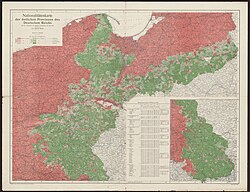
The end of World War I and the Treaty of Versailles led to a significant reversal of Germanisation as territories returned to the Second Polish Republic. The following tables illustrate the sharp decline of the ethnic German population in these regions between 1910 and 1934.
| Region/County | Pop. 1910 | Pop. 1934 | Absolute Decline | Percent Decline |
|---|---|---|---|---|
| Poznań (Town) | 65,321 | 4,387 | −60,934 | −93.3% |
| Bydgoszcz (Town) | 74,292 | 10,021 | −64,271 | −86.5% |
| Toruń (Town) | 30,509 | 2,057 | −28,452 | −93.3% |
| Grudziądz (Town) | 34,194 | 3,875 | −30,319 | −88.7% |
| Poznań Voivodship (Total) | 679,339 | 203,135 | −468,204 | −68.9% |
| Pomeranian Voivodship (Total) | 421,033 | 107,555 | −313,347 | −74.5% |
Frequently Asked Questions
What was the primary goal of the Prussian Settlement Commission?
The commission was established in 1885 to use national funds to buy land from Polish owners and redistribute it to German colonists, thereby increasing the German ethnic presence in the eastern territories.
How did the German state treat Polish workers in the Ruhr area?
Polish miners and ironworkers were viewed as a political threat. They were forced to carry special identity cards, were under constant police observation, and faced systemic ethnic discrimination and stereotypes.
What was the 'Kulturkampf' in the context of Polish history?
The Kulturkampf was a policy under Chancellor Bismarck that targeted the Catholic Church and Polish identity, labeling Poles as "foes of the empire" and suppressing the use of the Polish language in religious services.
How did the Polish population resist Germanisation?
Resistance took many forms, including the establishment of home schools, the creation of ethnic organizations like the Sokół sports clubs, and the formation of their own land-buying commissions to counter the Prussian Settlement Commission.
What happened to the German population after World War I?
Following the creation of the Second Polish Republic, there was a massive decline in the ethnic German population in regions like Poznan and Pomerania, with some cities seeing population drops of over 90% by 1934.