German Colonial EmpireOtto von BismarckKaiser Wilhelm IIScramble for AfricaGerman East Africa

German Colonial Empire: Rise and Fall of the Overseas Protectorates

German Colonial Empire: Rise and Fall of the Overseas Protectorates The German Colonial Empire existed from 1884 to 1920, marking a period where the German Empire sought to establish itse...

German Colonial Empire: Rise and Fall of the Overseas Protectorates

The German Colonial Empire existed from 1884 to 1920, marking a period where the German Empire sought to establish itself as a global power through the acquisition of territories in Africa, Asia, and the Pacific. While Germany entered the colonial race later than Britain or France, it rapidly expanded its influence under the leadership of Otto von Bismarck and later Kaiser Wilhelm II.

Initially, Germany's engagement with overseas territories was driven by economic interests and trade. By the late 19th century, this evolved into a formal imperial policy, leading to the establishment of several protectorates that would shape the geopolitical landscape of the early 20th century.

Woermann-Linie factory in Cameroon. From the 1830s, German shipping participated in trade with Africa and established factories there. From the 1850s, trade and plantation agriculture were undertaken by German companies in the South Seas. Some of these economic enterprises eventually formed the basis for the regions' conversion into German colonies.[15]

Key Facts

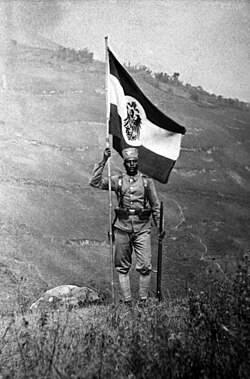
An East African Askari soldier holding Germany's colonial flag
  • Duration: 1884–1920.
  • Peak Area: Approximately 2,953,161 km² in 1912.
  • Major Territories: German South West Africa, German East Africa, Kamerun, Togoland, German New Guinea, and German Samoa.
  • Key Figures: Otto von Bismarck (Chancellor) and Kaiser Wilhelm II.
  • End of Empire: Territories were confiscated following World War I via the Treaty of Versailles.

Origins and the Shift in Policy
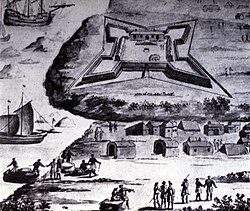
Groß-Friedrichsburg, a Brandenburg colony (1683–1717) in the territory of modern Ghana

Bismarck's Early Hesitation

Between 1862 and 1871, Chancellor Otto von Bismarck largely rejected the idea of colonization. However, the 1867 constitution of the North German Confederation formally placed colonization under the oversight of the Confederation, a provision that carried over into the Imperial constitution of 1871.

The Move Toward Imperialism

Bismarck's stance shifted around 1878 as part of his Schutzzollpolitik—a policy designed to protect the German economy from foreign competition. This economic shift led to the acquisition of interests in Samoa, where German consuls began managing the administration of Apia on the island of Upolu in 1879.
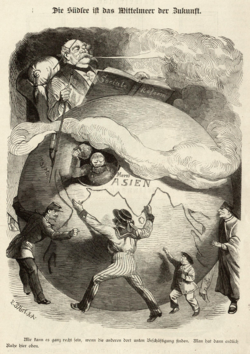
Kladderadatsch caricature, 1884. Bismarck sits atop the globe, smoking a long pipe and reading a book entitled "Social Reforms", while personifications of Britain, France, Russia, and other nations quarrel below. The title reads "The South Seas are the Mediterranean of the Future" and the caption says "I'm fine with the others keeping themselves busy down there. Then there will finally be peace up here."

The Establishment of the Empire (1884–1890)
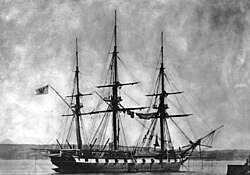
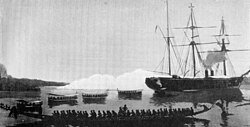
The Thetis, one of the ships of the East Asia Squadron

By 1884, Bismarck fully embraced colonial acquisition but preferred a low-cost model. Rather than establishing direct government rule, he favored chartered companies—private entities granted official letters of protection to manage commerce and administration.

Key companies included the German East Africa Company, the German New Guinea Company, the German Witu Company, and the Jaluit Company in the Marshall Islands. This period coincided with the Congo Conference (1884/1885) in Berlin, which established the rules for the "Scramble for Africa," the colonial division of the continent among European powers.
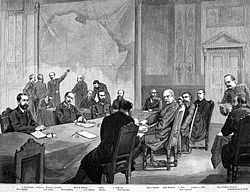
The Congo conference 1884/1885 in Berlin laid the basis for the Scramble for Africa, the colonial division of the continent.

Expansion Under Kaiser Wilhelm II (1890–1914)
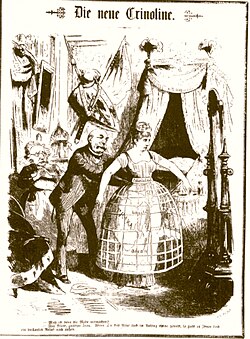
Cartoon on Bismarck's colonial policy: "The new crinoline." The caption reads: "Must I then participate in the fashion? – Have courage, good lady! Even if you are a bit embarrassed by the novel to start with, it will give you a brilliant appearance on the outside." At left in the background, the German Centrist Ludwig Windthorst is depicted as a governess. Engraving by Gustav Heil for the satirical magazine Berliner Wespen 13 March 1885

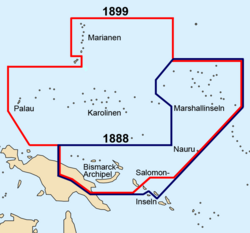
Under the reign of Kaiser Wilhelm II, German colonial ambitions grew. In 1899, Germany acquired the Caroline Islands, Mariana Islands, and Palau from Spain for 17 million gold marks. The western part of the Samoan islands also became a protectorate during this time.

The empire expanded inland within existing colonies, such as the addition of the kingdoms of Burundi and Rwanda to German East Africa. However, this expansion met fierce resistance, including the Bafut Wars in Cameroon and conflicts with the Hehe in East Africa.
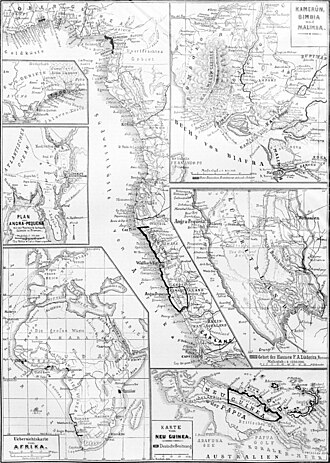
German colonies in Africa and Papua New Guinea in 1885

Colonial Administration and Resistance
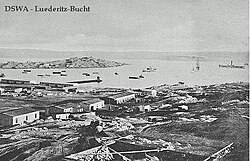
Lüderitz Bay (around 1900), the first colonial acquisition of the German Empire

Indigenous Resistance and Conflict

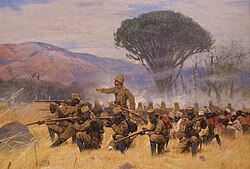
German rule was often marked by violent clashes with indigenous populations. The Herero Wars (1904) and the Maji Maji Rebellion (1905/6) in German East Africa were significant uprisings. The suppression of the Maji Maji rebellion, characterized by scorched earth tactics, resulted in an estimated 100,000 native deaths, many due to famine.
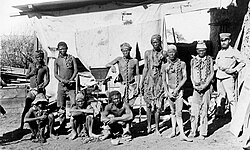
A photograph of chained Herero and Nama prisoners during the genocide

Social and Legal Structures

The colonial population grew from 5,125 in 1903 to approximately 23,500 by 1913. Legal inequality was systemic, and by 1905, a ban on marriages between Germans and the native population was enacted in South West Africa, followed by a similar ban in Samoa in 1912.
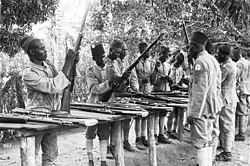
Askari troops in German East Africa, c. 1906

The Fall of the Empire (1914–1920)

SMS Olga during the bombardment of Hickorytown (Douala), Cameroon, December 1884

The outbreak of World War I led to the rapid collapse of the German colonial system. Allied forces conquered German territories in Africa and the Pacific starting in 1914. Despite the efforts of figures like General Paul von Lettow-Vorbeck, who continued fighting in East Africa until the Armistice on November 25, 1918, the empire was defeated.
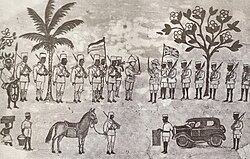
Paul von Lettow-Vorbeck's force stops fighting the Allies on 25 November 1918 after the Armistice.

Under the Treaty of Versailles (1919), Germany was stripped of all its overseas possessions, and the empire was formally disestablished in 1920.

Summary of German Colonies (1912)
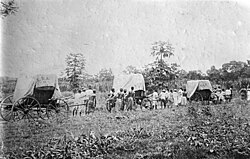
Cotton transport in Togo, c. 1900. Coffee, cacao, cotton, and products from the coconut palm were pretty much the only goods produced for the German and international markets in Togo, as in the other German tropical colonies.
Overview of German Colonial Territories in 1912
Territory Capital Area (km²) Total Population German Population Modern Countries
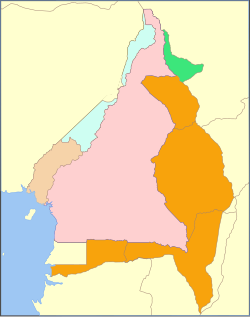
Kamerun Jaunde 495,000 4,645,000 1,359 Cameroon, Nigeria, Chad, Gabon, CAR, Congo
Togoland Lomé 87,200 1,003,000 316 Ghana, Togo
German South West Africa Windhuk 835,100 86,000 12,135 Namibia
German East Africa Dar es Salaam 995,000 7,511,000 3,579 Burundi, Kenya, Mozambique, Rwanda, Tanzania
German New Guinea Simpsonhafen 242,776 601,000 665 PNG, Solomon Islands, Palau, Micronesia, Nauru, Marshall Islands
German Samoa Apia 2,570 38,000 294 Samoa
Kiautschou Bay Tsingtau 515 200,000 400 China

Frequently Asked Questions

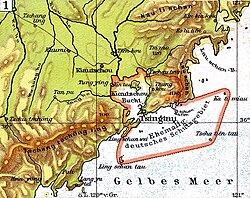
The German-leased territory of Kiautschou and the port of Qingdao
Borders of German New Guinea before (in blue) and after (in red) the 1899 German-Spanish treaty
Kamerun, annexed to French Cameroon Kamerun, annexed to British Northern Cameroons Kamerun, annexed to British Southern Cameroons Neukamerun, annexed to French Equatorial Africa Kamerun, annexed to French Chad
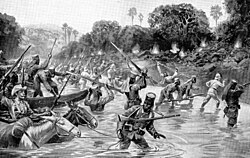
"Battle of Mahenge", Maji-Maji rebellion, painting by Friedrich Wilhelm Kuhnert, 1908
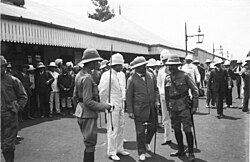
German Colonial Secretary Bernhard Dernburg (2nd from right) on an inspection tour in East Africa, with British officials at Nairobi in 1907
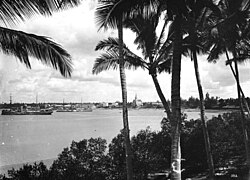
Port of Dar es Salaam, German East Africa, c. 1910
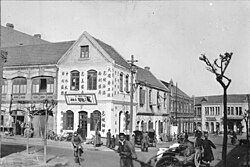
Tsingdao with German buildings, c. 1900
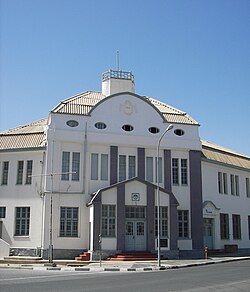
Railway station (1914) in Lüderitz, Namibia, pictured in 2006
Austrian lieutenant Paul Fiedler[114] bombarding a South African military camp at the railway station of Tschaukaib, German South West Africa, December 1914
General Paul von Lettow-Vorbeck's troops defeat Portugal at Ngomano, Portuguese East Africa on 25 November 1917.
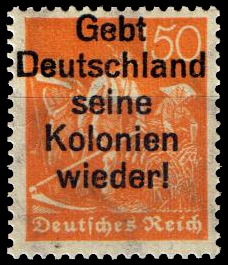
Stamp from 1921, "Give Germany its colonies back!"
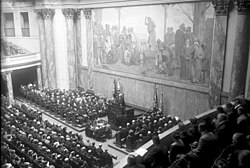
Colonial Memorial Day on 24 April 1924 at the Humboldt University of Berlin, celebrating the 40th anniversary of the declaration of the Southwest African protectorate
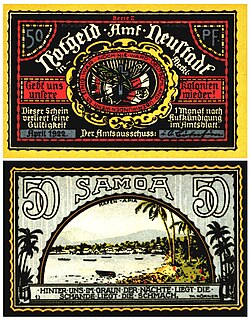
Notgeld of 1922, "Give us our colonies back! – Samoa."
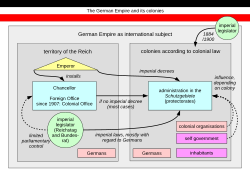
Political diagram of the German Empire and its colonies
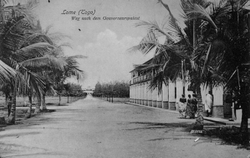
The way to the governor's palace in Togo, 1904
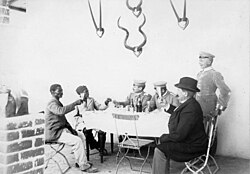
Hendrik Witbooi with the German governor Theodor Leutwein of South West Africa (toasting to each other), 1896
German colonial leader in Togo, c. 1885
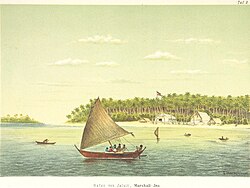
German trading station at Jaluit Atoll with a Marshallese korkor outrigger canoe in the foreground
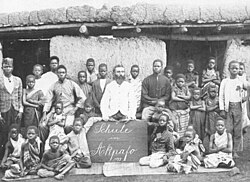
School of the North German Missionary Society in Togo, 1899
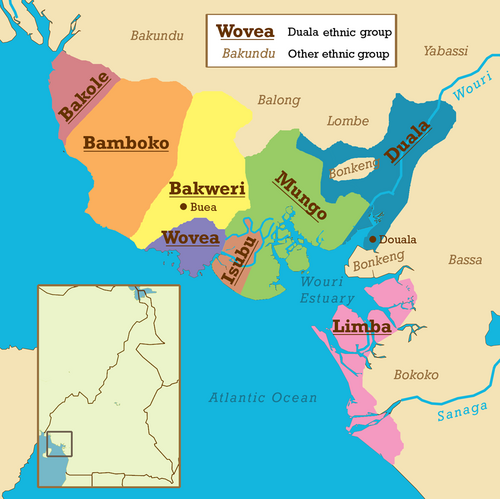
Map showing the location of the various Duala ethnic groups of Cameroon
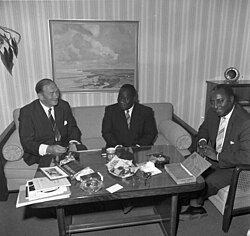
West German vice minister of workfare, Wilhelm Claussen (left), with Paul Armegee, transport minister of Togo, in Bonn, 1961
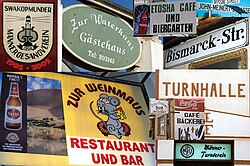
Examples of German language on signs in Namibia

Why did Otto von Bismarck initially oppose colonies?

Bismarck was primarily concerned with the financial costs and the potential for diplomatic complications. He only shifted his policy when he saw economic benefits through the protection of German trade and the Schutzzollpolitik.

What was the role of chartered companies in German colonies?

To avoid the expense of direct government administration, Bismarck used chartered companies (such as the German East Africa Company) to manage the commerce and governance of protectorates via official letters of protection.

What happened during the Maji Maji Rebellion?

The Maji Maji Rebellion was an uprising in German East Africa (1905/6). The German military suppressed it using scorched earth tactics, which led to an estimated 100,000 deaths, largely due to resulting famine.

How did Germany lose its colonies?

Germany's colonies were conquered by Allied forces during World War I. Following the war, the Treaty of Versailles in 1919 mandated the confiscation of these territories, leading to the empire's end in 1920.

Which modern countries were once part of the German Empire?

Former German territories now comprise parts of Namibia, Tanzania, Rwanda, Burundi, Togo, Ghana, Cameroon, Papua New Guinea, Samoa, and several island nations in Micronesia.