German Republic Proclamation: The Dual Events of November 9, 1918
On November 9, 1918, the course of German history shifted dramatically. In a single day, the German Empire transitioned from a monarchy to a parliamentary democratic republic. This transformation was not a single event but rather two distinct proclamations made in Berlin by men with vastly different visions for the nation's future.
The first proclamation was delivered by Philipp Scheidemann of the Majority Social Democratic Party of Germany (MSPD) at the Reichstag building. Only a few hours later, Karl Liebknecht, leader of the Marxist Spartacus League, proclaimed a socialist republic at the Berlin Palace. These competing declarations mirrored the ideological struggle between bourgeois-democratic ideals and the radical desire for a soviet-style state.
Key Facts
- Date: November 9, 1918.
- First Proclamation: Philipp Scheidemann (MSPD) at the Reichstag.
- Second Proclamation: Karl Liebknecht (Spartacus League) at the Berlin Palace.
- Outcome: The German Empire became the Weimar Republic, a parliamentary democracy.
- Key Figure: Friedrich Ebert became the Reich chancellor.
- Monarchy: Emperor Wilhelm II abdicated and fled to the Netherlands.
The Road to Revolution
The collapse of the monarchy was precipitated by Germany's defeat in World War I and internal pressure for democratization. By October 1918, constitutional reforms had already shifted the German Reich toward a parliamentary monarchy, making the government answerable to the Reichstag rather than the Emperor.
While the MSPD initially sought to maintain the monarchy for the sake of continuity, Emperor Wilhelm II's position became untenable. On the morning of November 9, Prince Max von Baden, the last Reich chancellor of the Empire, announced the Emperor's abdication to forestall more radical demands from the Independent Social Democratic Party (USPD), a left-leaning breakaway group.
Following this announcement, Wilhelm II fled to exile in the Netherlands. At noon, Prince Max von Baden transferred the office of Reich chancellor to Friedrich Ebert, though Ebert still hoped to save the monarchy in some form.
Scheidemann's Proclamation at the Reichstag
The first official proclamation of the republic occurred shortly after 2 p.m. Philipp Scheidemann, then a state secretary, learned that Karl Liebknecht intended to proclaim a soviet republic. To ensure the MSPD retained political initiative, Scheidemann stepped to a second-floor window of the Reichstag and announced the birth of the German Republic.
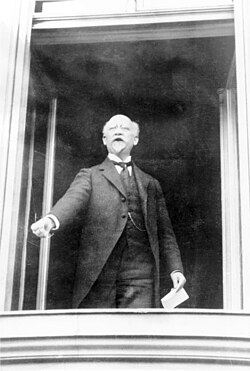
This action was not coordinated; Friedrich Ebert was reportedly furious, arguing that the future form of government should be decided by a constituent assembly. Despite the internal conflict, Scheidemann's speech signaled the end of the Empire and the birth of the Weimar Republic.
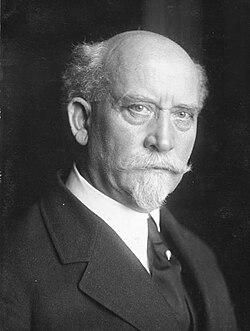
The Controversy of the Text
Historians have long debated the exact words Scheidemann used. While contemporaneous reports from the Vossische Zeitung and stenographic notes by Ernst Friedegg provide one version, Scheidemann's own later memoirs and a 1920 recording differed significantly. In 1968, historian Manfred Jessen-Klingenberg concluded that Scheidemann's later version was a forgery intended to counter the "stab-in-the-back myth"—the false claim that the war was lost due to internal betrayal by the Left and Jews rather than military defeat.
Liebknecht's Socialist Proclamation
At approximately 4 p.m. on the same day, Karl Liebknecht addressed a crowd in the Lustgarten in front of the Berlin Palace. Standing on a vehicle, he proclaimed the "Free Socialist Republic of Germany," calling for a state order of the proletariat and a world revolution.
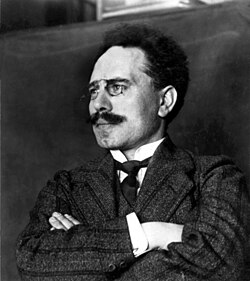
Liebknecht's vision was far more radical than Scheidemann's, emphasizing the end of capitalism and the establishment of a government of workers and soldiers. He explicitly referenced the Russian Revolution, urging German workers to follow the example of their "Russian brothers."
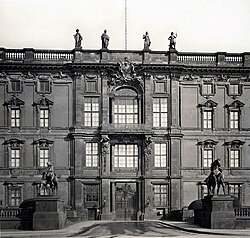
Although Liebknecht's proclamation received extensive press coverage, it lacked a sufficient power base to override the MSPD. His influence waned following the suppression of the Spartacist uprising in January 1919.
Summary of the Two Proclamations
| Feature | Philipp Scheidemann | Karl Liebknecht |
|---|---|---|
| Affiliation | MSPD (Majority Social Democrats) | Spartacus League (Marxist) |
| Location | Reichstag Building | Berlin Palace (Lustgarten) |
| Vision | Parliamentary Democratic Republic | Free Socialist Republic |
| Goal | Stability and bourgeois-democracy | Proletarian state and world revolution |
| Long-term Impact | Foundation of the Weimar Republic | Symbolic for later East Germany (GDR) |
Aftermath and Legacy
The immediate aftermath was marked by instability. The MSPD and USPD briefly formed the Council of the People's Deputies, but the USPD resigned by late December 1918. In January 1919, the Spartacist uprising broke out, leading the MSPD to deploy right-wing Freikorps troops to suppress the revolutionaries.
During this violence, Karl Liebknecht and Rosa Luxemburg were murdered on January 15, 1919, with the approval of Friedrich Ebert. Meanwhile, the Weimar National Assembly drafted the Weimar Constitution, which officially declared in Article 1: "The German Reich is a republic."
The personal fates of the protagonists diverged sharply. Scheidemann became a target of nationalists and eventually fled to Denmark in 1933 after Adolf Hitler seized power, where he died in 1939. Liebknecht's legacy was later embraced by the German Democratic Republic (East Germany) after 1949, and the "Liebknecht Portal" from the Berlin Palace was preserved as a historical monument.
Frequently Asked Questions
Why were there two different proclamations of the republic?
The two proclamations represented a power struggle between the moderate Social Democrats (MSPD), who wanted a parliamentary democracy, and the radical Marxists (Spartacus League), who wanted a soviet-style socialist republic.
Did Emperor Wilhelm II abdicate before the republic was proclaimed?
Yes. Prince Max von Baden announced the abdication on the morning of November 9, though the Emperor and Crown Prince did not formally sign the abdication documents until November 28, 1918, after fleeing to the Netherlands.
What was the "stab-in-the-back myth" mentioned in the text?
The "stab-in-the-back myth" was a false narrative claiming that the German army had not been defeated on the battlefield but was betrayed at home by socialists, strikers, and Jewish people.
What happened to the Berlin Palace portal where Liebknecht spoke?
Portal IV of the Berlin Palace was salvaged during the building's post-war demolition and was later integrated into the State Council building as the "Liebknecht Portal."
How did the Weimar Republic officially begin?
While the proclamations of November 9 marked the end of the monarchy, the republic was formalized through the elections of the Weimar National Assembly and the adoption of the Weimar Constitution on August 11, 1919.