Germ Layers: The Blueprint of Animal Embryonic Development
Every complex animal begins as a single cell, but the journey from a zygote to a fully formed organism requires a precise architectural plan. This plan is executed through the formation of germ layers—primary layers of cells that emerge during early embryonic development. These layers serve as the foundation for all future tissues and organs through the processes of histogenesis (the formation of tissues) and organogenesis (the formation of organs).
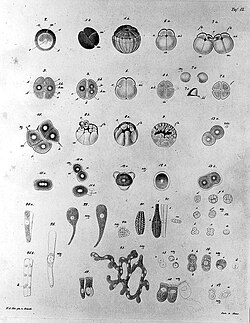
The emergence of these layers occurs during a critical phase called gastrulation, where a simple ball of cells reorganizes itself into a multi-layered structure. Depending on the species, an embryo may develop two or three of these primary layers, determining the complexity of the animal's body plan.
Key Facts
- Germ layers are the primary cell layers formed during gastrulation.
- Diploblasts (e.g., cnidarians) have two layers: ectoderm and endoderm.
- Triploblasts (most animals) have three layers: ectoderm, endoderm, and mesoderm.
- Sponges lack a gastrula stage and have no true germ layers.
- The neural crest is so vital it is sometimes referred to as a fourth germ layer, though it originates from the ectoderm.
The Evolution of Germ Layers
Not all animals share the same embryonic complexity. Evolution has produced varying levels of compartmentalization across the animal kingdom:
- Non-germ layer animals: Sponges do not undergo gastrulation. While they possess two cell layers separated by a gel-like substance called mesohyl, these are not considered true germ layers.
- Diploblastic animals: Aquatic invertebrates like comb jellies (Ctenophora) and cnidarians develop from only two layers: the ectoderm and endoderm. These animals possess recognizable tissues but lack complex organs.
- Triploblastic animals: Most animals exhibit bilateral symmetry and develop a third middle layer, the mesoderm. This additional layer allows for the development of complex internal organs.
The Process of Development
The transition from a single cell to a layered embryo follows a strict biological sequence. It begins with fertilization, creating a zygote. This zygote undergoes cleavage—a series of rapid mitotic cell divisions—transforming it into a hollow ball of cells known as a blastula.
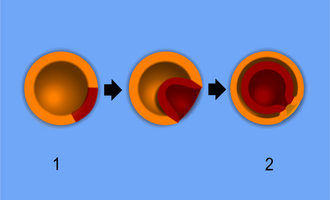
In humans, this process is highly specialized. After three days, the zygote becomes a solid mass called a morula, which then evolves into a blastocyst. The blastocyst consists of an outer trophoblast and an inner cell mass called the embryoblast. As the embryo implants in the uterus, the inner cell mass divides into the hypoblast and epiblast. During the second week, a primitive streak appears, and cells from the epiblast migrate inward to form the endoderm and mesoderm, leaving the remaining surface cells as the ectoderm.
In mice, this differentiation is governed by transcription factors. The protein Sox2 promotes ectodermal development, while Oct4 promotes mesendodermal development. These two proteins mutually inhibit one another, and their relative concentrations determine the fate of the embryonic stem cells.
The Three Primary Germ Layers
Endoderm: The Inner Layer
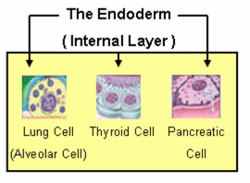
The endoderm is the innermost layer, formed as cells migrate inward along the archenteron. Initially composed of flattened cells that later become columnar, it primarily creates the epithelial linings of the internal systems.
The endoderm is responsible for forming the digestive tract (excluding parts of the mouth, pharynx, and rectum), the liver, pancreas, thyroid, parathyroid, bladder, and the lining of the respiratory system, including the trachea, bronchi, and lungs.
Mesoderm: The Middle Layer
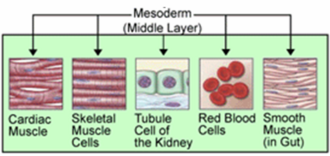
The mesoderm develops between the ectoderm and endoderm in triploblastic animals. Its formation leads to the creation of the coelom, the main body cavity. This cavity is essential because it allows internal organs to grow and move independently of the body wall, while providing a fluid cushion for protection.
The mesoderm is divided into four components:
- Axial mesoderm: Forms the notochord.
- Intermediate mesoderm: Forms the kidneys and gonads.
- Paraxial mesoderm: Forms cartilage, skeletal muscle, and the dermis.
- Lateral plate mesoderm: Forms the circulatory system (heart and spleen), the body wall, and the gut wall.
Ectoderm: The Outer Layer
The ectoderm is the outermost layer, originating from the embryo's epiblast. It differentiates into three main structures: the surface ectoderm, the neural crest, and the neural tube.
- Surface ectoderm: Produces the epidermis, hair, nails, tooth enamel, cornea, lens of the eye, and the epithelium of the nose and mouth.
- Neural tube: Forms the central nervous system, including the brain, spinal cord, retina, and posterior pituitary.
- Neural crest: Gives rise to the peripheral nervous system, melanocytes, facial cartilage, and the adrenal medulla.
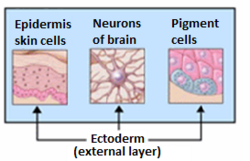
Because the neural crest contributes to so many diverse and critical structures, some scientists categorize it as a fourth germ layer, although it is biologically derived from the ectoderm.
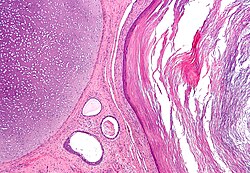
The importance of these layers is vividly illustrated in a teratoma—a type of tumor that can contain tissues from all three germ layers, such as cartilage (mesoderm), gastrointestinal glands (endoderm), and epidermis (ectoderm).
Summary of Germ Layer Derivatives
| Germ Layer | Primary Derivatives | Key Examples |
|---|---|---|
| Endoderm | Internal linings and glands | Lungs, Liver, Pancreas, Thyroid, Digestive tract lining |
| Mesoderm | Structural and circulatory systems | Heart, Skeletal muscle, Bones, Kidneys, Dermis, Blood cells |
| Ectoderm | Outer covering and nervous system | Brain, Spinal cord, Epidermis, Hair, Nails, Retina |
Frequently Asked Questions
What is the difference between a diploblast and a triploblast?
A diploblast is an animal that develops from two germ layers (ectoderm and endoderm), such as cnidarians. A triploblast develops from three germ layers, adding a middle mesoderm layer, which allows for the development of complex organs.
Do sponges have germ layers?
No, sponges do not have a gastrulation stage and therefore possess no true germ layers, although they do have two cell layers separated by a gel-like mesohyl.
What is the role of the coelom?
The coelom is the main body cavity formed by the mesoderm. It protects internal organs from shocks via fluid cushioning and allows them to grow and move independently of the outer body wall.
How is germ layer fate determined in mice?
Differentiation is controlled by two transcription factors: Sox2, which promotes ectodermal fate, and Oct4, which promotes mesendodermal fate. These proteins inhibit each other to determine the cell's final identity.
Why is the neural crest sometimes called a fourth germ layer?
The neural crest is considered so significant due to the vast array of tissues it produces—including the peripheral nervous system and facial cartilage—that some researchers view it as a distinct primary layer, despite its ectodermal origin.