Georges-Louis Leclerc, Comte de Buffon: The Architect of Natural History
Georges-Louis Leclerc, better known as the Comte de Buffon (1707–1788), was a towering figure of the Enlightenment. A French naturalist, mathematician, and cosmologist, Buffon bridged the gap between early descriptive science and the modern analytical approach to the natural world. As the longtime director of the Jardin du Roi, he transformed the institution into a global hub for research and specimen collection, leaving an indelible mark on how humanity categorizes life and understands the age of the Earth.
Key Facts
- Major Work: Authored Histoire Naturelle (1749–1804), one of the most widely read scientific works of the 18th century.
- Mathematical Contribution: Developed the "Buffon's needle problem," integrating calculus into probability theory.
- Cosmological Insight: Challenged biblical timelines by estimating the Earth to be at least 75,000 years old.
- Institutional Leadership: Served as the intendant (director) of the Jardin du Roi (now the Jardin des Plantes).
- Philosophical Stance: Advocated for monogenism, the belief that all humans share a single origin.
Early Life and Education
Born in Montbard, Burgundy, to a family of civil servants, Georges-Louis Leclerc's life was significantly altered at age seven when he inherited a considerable fortune from his godfather, Georges Blaisot. This wealth allowed his father to purchase the village of Buffon, providing the young Georges with the social standing and financial freedom to pursue intellectual interests.
His education was diverse, beginning at the Jesuit College of Godrans in Dijon and moving into the study of law. However, his true passions lay in the sciences; he later studied mathematics and medicine at the University of Angers. During his youth, he traveled extensively through southern France and Italy in the company of Evelyn Pierrepont, the Duke of Kingston, an experience that expanded his horizons before he settled in Paris in 1732 to pursue science and mechanics.
A Multifaceted Scientific Career
Upon arriving in Paris, Buffon immersed himself in the intellectual circles of the era, befriending figures like Voltaire. He first gained recognition in mathematics, specifically in probability theory, where he introduced differential and integral calculus through his work Sur le jeu de franc-carreau. This period also saw the creation of the famous Buffon's needle problem, a classic experiment in geometric probability.
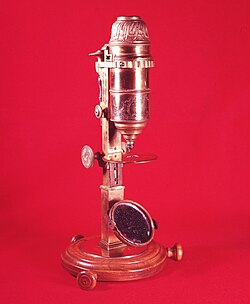
Beyond mathematics, Buffon applied rigorous empirical testing to practical problems. In 1733, he conducted extensive research on the mechanical properties of wood for shipbuilding. By testing over a thousand small specimens and comparing them to full-size timbers, he concluded that properties of small samples could not be simply extrapolated to larger structural members.
In 1739, Buffon was appointed head of the Jardin du Roi. Under his leadership, the garden evolved into a premier research center and museum, expanding its land and its collection of botanical and zoological specimens from across the globe.
Literary Influence and Style
Buffon was as much a master of language as he was of science. Elected to the Académie Française in 1753, he famously declared in his Discours sur le style that "the style is the man himself" (Le style c'est l'homme même). While his brilliant prose made his scientific works accessible to the educated public across Europe, it also drew criticism from peers like Jean le Rond d'Alembert, who viewed him as a "phrase-monger."
The Masterwork: Histoire Naturelle
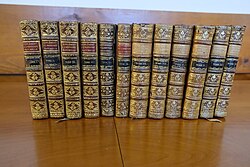
Buffon's magnum opus, Histoire naturelle, générale et particulière, was published between 1749 and 1788. Spanning 36 volumes (with a later supplementary volume), the work aimed to describe the natural world. Although originally intended to cover all three kingdoms of nature, it focused primarily on the mineral kingdom and the birds and quadrupeds of the animal kingdom.
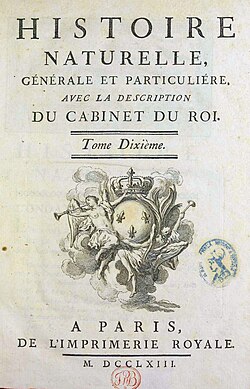
The work was a massive collaborative effort involving artists and scientists such as Louis Jean-Marie Daubenton. Its popularity was immense, rivaling the works of Rousseau and Voltaire, and it even inspired the Sèvres porcelain factory to create "Buffon services" featuring species names on the porcelain.
Cosmology and the Age of the Earth
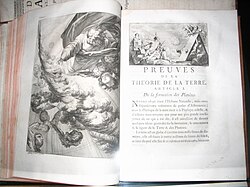
In Les époques de la nature (1778), Buffon ventured into cosmology. He speculated that the Solar System formed when a comet collided with the Sun. More controversially, he challenged the traditional biblical chronology of 4004 BC. By studying the cooling rate of iron in his laboratory at Montbard, he estimated the Earth to be at least 75,000 years old. This conclusion led to condemnation by the Sorbonne, forcing Buffon to issue a retraction.
Anthropology and Biological Legacy
Buffon's views on humanity were rooted in monogenism—the theory that all humans share a single origin. He argued that physical differences between populations were not innate but resulted from adaptation to environmental factors, such as diet and climate. He suggested that the first humans may have been dark-skinned Africans, though he placed the origin of humanity within a temperate band between the 40th and 50th degrees of latitude.
While Buffon did not formulate a theory of evolution in the modern sense, he asked the foundational questions that later scientists, including Charles Darwin, would seek to answer. His work on heredity and adaptation provided an early framework for biological thought.
| Field | Key Contribution | Impact |
|---|---|---|
| Natural History | Histoire Naturelle | Standardized the description of animals and minerals for 18th-century Europe. |
| Mathematics | Buffon's Needle Problem | Introduced calculus into the study of probability. |
| Cosmology | Cooling rate of iron tests | Proposed a significantly older Earth than biblical accounts. |
| Anthropology | Monogenism | Argued for a single human origin and environmental adaptation. |
| Institutional | Director of Jardin du Roi | Transformed the garden into a world-class research museum. |
Frequently Asked Questions
What is Buffon's needle problem?
It is a problem in geometric probability that involves dropping a needle on a floor with parallel lines. Buffon used this to demonstrate how differential and integral calculus could be applied to probability theory.
How did Buffon determine the age of the Earth?
Buffon conducted experiments on the cooling rate of iron at his laboratory in Montbard. Based on these observations, he calculated that the Earth was at least 75,000 years old, contradicting the then-accepted biblical timeline.
What is monogenism in the context of Buffon's work?
Monogenism is the belief that all human beings belong to a single species and share a common origin. Buffon believed that physical variations among humans were caused by environmental factors like climate and diet rather than different origins.
What happened to Buffon's remains?
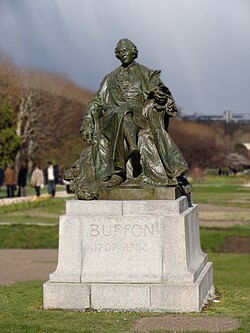
During the French Revolution, his tomb was ransacked for lead to make bullets. While his heart was lost, his cerebellum is preserved today in the base of the statue commissioned by Louis XVI, located at the Museum of Natural History in Paris.
What was the scope of the Histoire Naturelle?
Although intended to cover all kingdoms of nature, the final work focused on the mineral kingdom and the animal kingdom, specifically detailing birds and quadrupeds.