Gastrulation: The Fundamental Process of Embryonic Development
Gastrulation is a pivotal phase in early embryonic development where a simple, single-layered blastula (an early-stage embryo) transforms into a multi-layered structure known as a gastrula. This process involves the inward folding and enlargement of cells, effectively establishing the basic body plan of the organism.
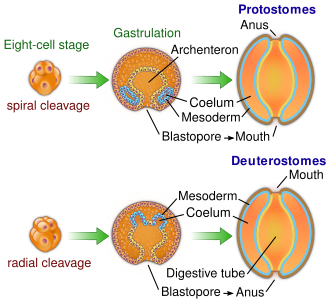
The term "gastrula" (meaning "little belly") and "gastrulation" were first introduced by Ernst Haeckel in 1872. During this stage, the embryo develops the archenteron, which serves as the primary gut, and the blastopore, an opening that leads into the archenteron.
Key Facts
- Transformation: Converts a single-layered blastula into a multi-layered gastrula.
- Germ Layers: Establishes the ectoderm (outer layer) and endoderm (inner layer).
- Primary Structures: Creates the archenteron (primitive gut) and the blastopore.
- Amniote Sequence: In mammals, reptiles, and birds, it involves symmetry breaking, the formation of the primitive streak, and cell ingression.
- The 14-Day Rule: In human in vitro research, the formation of the primitive streak at 14 days often marks a legal and ethical boundary for experimentation.
Mechanisms of Cell Movement
Gastrulation is driven by several distinct types of cell movements that rearrange the embryo's architecture:
- Invagination: A cell layer rolls inward on itself to create an indentation.
- Involution: A cell layer rolls inward over an edge to spread across the interior surface.
- Ingression: Individual cells migrate from the external layer into the embryo's interior.
- Delamination: A single sheet of cells splits into two parallel layers.
- Epiboly: A cell layer expands and thins to enclose the deeper layers of the embryo.
Comparative Embryology: Protostomes vs. Deuterostomes
One of the most significant distinctions in animal development is the difference between protostomes and deuterostomes, primarily defined by the fate of the blastopore.
| Feature | Protostomes | Deuterostomes |
|---|---|---|
| Blastopore Fate | Typically becomes the mouth | Becomes the anus |
| Model Organisms | Various invertebrates | Sea urchins, amphibians, amniotes |
Gastrulation in Amniotes
In amniotes—which include reptiles, birds, and mammals—gastrulation follows a specific sequence to organize the body axis. First, the embryo undergoes symmetry breaking, becoming asymmetric. This is followed by the formation of the primitive streak.
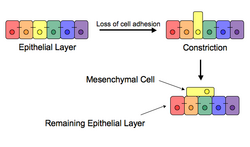
Cells from the epiblast at the primitive streak undergo an epithelial-mesenchymal transition (EMT). During EMT, cells lose their adhesion to one another, allowing them to change shape and migrate into the interior of the embryo to form the primary germ layers.
In Vitro Research and Ethics
In laboratory settings using in vitro fertilization (IVF), the primitive streak typically forms 14 days after fertilization. In some jurisdictions, this milestone is viewed as the point of "human individuality," where the embryo becomes its own entity. Consequently, a "14-day rule" exists, making it illegal to experiment on human embryos beyond this point. To study later development, researchers often use mouse embryos, though biological differences between the two species persist.
Frequently Asked Questions
What is the difference between a blastula and a gastrula?
A blastula is a hollow, single-layered sphere of cells, while a gastrula is the multi-layered structure that results from the blastula folding inward during gastrulation.
What is the archenteron?
The archenteron is the primitive gut cavity formed during gastrulation, which eventually develops into the digestive tract of the animal.
What happens during the epithelial-mesenchymal transition (EMT)?
EMT is a process where epithelial cells lose their tight adhesion to neighboring cells, allowing them to become mobile mesenchymal cells that can migrate to new locations within the embryo.
Why is the 14-day rule significant in human embryo research?
The 14-day rule is an ethical and legal boundary based on the appearance of the primitive streak, which some consider the beginning of individual human entity status.
How do deuterostomes differ from protostomes during gastrulation?
The primary difference is that in deuterostomes, the blastopore (the first opening of the gastrula) develops into the anus, whereas in protostomes, it typically develops into the mouth.