Animal Embryonic Development: From Fertilization to Organogenesis
Animal embryonic development, also known as embryogenesis, is the complex biological process that transforms a single fertilized cell into a multicellular organism. This journey begins the moment a sperm cell (spermatozoon) fertilizes an egg cell (ovum), creating a diploid cell called a zygote. Through a series of precise divisions and cellular specializations, the zygote evolves through several distinct stages before becoming a fetus or a larva.
In mammals, these early stages are referred to as prenatal development, while later stages are described as fetal development. The process is characterized by a transition from totipotency—where a cell can become any cell type—to specialized differentiation.
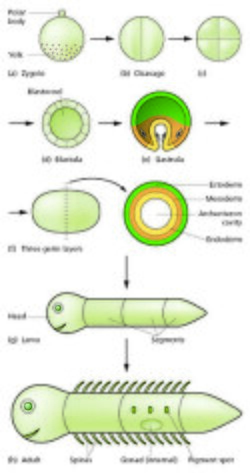
Key Facts
- Fertilization creates the zygote, the starting point of all animal development.
- Cleavage consists of rapid mitotic divisions without overall growth of the embryo.
- Gastrulation is the critical phase where the three primary germ layers (ectoderm, mesoderm, and endoderm) are formed.
- Organogenesis is the final embryonic stage where specific organs and tissues develop.
- Blastopore fate distinguishes protostomes (mouth forms first) from deuterostomes (anus forms first).
The Early Stages: Fertilization and Cleavage
The process begins with fertilization, the fusion of male and female gametes. The egg cell is typically asymmetric, featuring an animal pole (which becomes the ectoderm) and protective envelopes. In mammals, the innermost envelope is the zona pellucida (vitelline membrane in other taxa). Depending on the species, this occurs via internal or external fertilization.
Cleavage and the Morula
Following fertilization, the zygote undergoes cleavage—a series of mitotic divisions where cells divide but do not grow in size. The resulting individual cells are called blastomeres. Once at least four divisions have occurred, resulting in a dense ball of roughly sixteen cells, the structure is known as a morula.
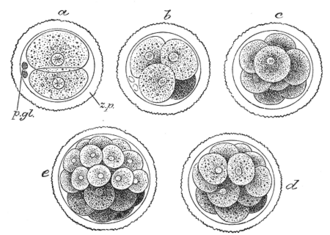
Cleavage patterns vary based on the amount of yolk present in the egg:
- Holoblastic cleavage: Total division, occurring in animals with little yolk (e.g., humans and other mammals).
- Meroblastic cleavage: Partial division, occurring in animals with high yolk content (e.g., birds and reptiles), where division is impeded at the vegetal pole.
Formation of the Blastula and Blastocyst
As the morula continues to divide (reaching approximately 128 cells), it transforms into a blastula. This is typically a spherical layer of cells called the blastoderm surrounding a fluid-filled cavity known as the blastocoel.
In mammals, this stage is specifically called a blastocyst. It features an outer layer called the trophoblast, which helps form the placenta, and an inner cell mass (epiblast) from which the actual embryo develops. In mice, the inner cell mass undergoes extensive genome-wide reprogramming and DNA demethylation to achieve cellular totipotency.
Before the next phase, the trophoblast differentiates into the outer syncytiotrophoblast and the inner cytotrophoblast. Simultaneously, the inner cell mass forms the endoderm (creating the yolk sac) and the embryonic ectoderm, which together form the embryonic disk.
Gastrulation and the Germ Layers
Gastrulation is the process by which the blastula is reorganized into a gastrula. During this phase, cells migrate inward to create the primary germ layers. Animals are classified as diploblastic (two layers) or triploblastic (three layers).
The three germ layers in triploblastic animals are:
- Ectoderm: The outermost layer.
- Mesoderm: The middle layer, extending between the other two.
- Endoderm: The innermost layer.
Cells move into the embryo through various mechanisms, including epiboly (sheet expansion), ingression (individual cell migration), invagination (infolding), delamination (splitting), and involution (inturning). A critical landmark during this stage is the blastopore; in deuterostomes, this becomes the anus, while in protostomes, it becomes the mouth.
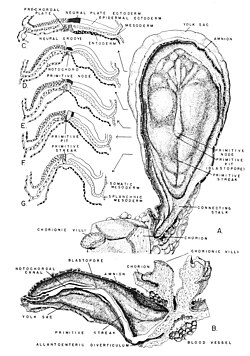
Organogenesis and Specialized Development
Once the germ layers are established, organogenesis begins. In vertebrates, the first major event is neurulation, where the neural plate folds to form the neural tube. This tube eventually develops into the brain (via three primary vesicles: prosencephalon, mesencephalon, and rhombencephalon) and the spinal cord.
Somitogenesis
Parallel to neural development is somitogenesis, the production of somites. These are cubical blocks of paraxial mesoderm that differentiate into the vertebrae, skeletal muscle, and dermis. In the trunk, these are categorized into cervical, thoracic, lumbar, sacral, and coccygeal groups.
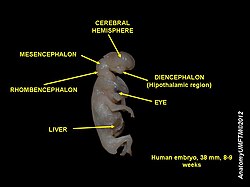
Primitive Structures
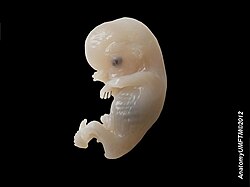
Other early structures include the buccopharyngeal membrane (separating the primitive mouth and pharynx) and the pericardial area, where the heart begins to develop. The process concludes when the embryo transforms into a larva (which may undergo metamorphosis) or a fetus.
Summary of Embryonic Stages
| Stage | Key Process | Resulting Structure | Primary Characteristic |
|---|---|---|---|
| Zygote | Fertilization | Single diploid cell | Fusion of sperm and ovum |
| Morula | Cleavage | Solid ball of cells | Rapid division without growth |
| Blastula | Blastulation | Hollow sphere (Blastocyst in mammals) | Formation of the blastocoel |
| Gastrula | Gastrulation | Multi-layered embryo | Formation of ectoderm, mesoderm, and endoderm |
| Organogenesis | Differentiation | Larva or Fetus | Formation of organs and nervous system |
Frequently Asked Questions
What is the difference between holoblastic and meroblastic cleavage?
Holoblastic cleavage is a total division of the egg, occurring in animals with little yolk, such as mammals. Meroblastic cleavage is partial division, occurring in yolk-rich eggs like those of birds and reptiles, where the yolk prevents the cleavage furrow from passing through the entire egg.
What are the three germ layers and what do they do?
The three germ layers are the ectoderm (outer), mesoderm (middle), and endoderm (inner). Each layer is responsible for giving rise to specific tissues and organs of the body during organogenesis.
What is the significance of the blastopore?
The blastopore is the opening formed during gastrulation. Its fate is used to classify animals: in protostomes, the blastopore becomes the mouth, whereas in deuterostomes, it becomes the anus.
What is somitogenesis?
Somitogenesis is the process of forming somites, which are segmented blocks of mesoderm. These blocks eventually differentiate into the vertebrae, skeletal muscles, and the dermis of the skin in vertebrates.
How does a blastocyst differ from a blastula?
While similar, a blastocyst is a specific type of blastula found in mammals. It is characterized by a distinct inner cell mass (which becomes the embryo) and an outer trophoblast (which contributes to the placenta).