French Quarter: The Historic Heart of New Orleans
The French Quarter, known in French as the Vieux Carré (meaning "Old Square"), is the oldest neighborhood in New Orleans, Louisiana. Founded in 1718 by Jean-Baptiste Le Moyne de Bienville, the district served as the nucleus around which the city grew. While its name suggests a purely French origin, the Quarter's architectural and cultural identity was shaped by a complex succession of French and Spanish rule, followed by American influence after the 1803 Louisiana Purchase.
Today, the district is a world-renowned destination, blending colonial history with a vibrant, bohemian spirit. Most of the historic structures seen today date from the late 18th century—following devastating fires—or the first half of the 19th century.
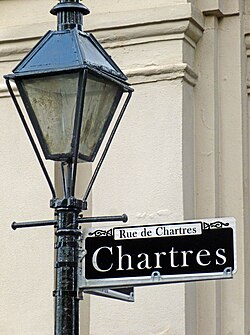
Key Facts
- Founded: 1718 by Jean-Baptiste Le Moyne de Bienville.
- Total Area: 0.66 square miles (approximately 0.49 sq mi land and 0.17 sq mi water).
- Designations: U.S. National Historic Landmark District and listed on the National Register of Historic Places.
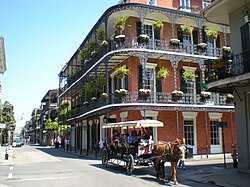
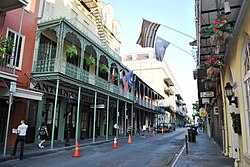
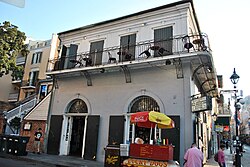
- Key Architecture: Characterized by Spanish colonial styles and elaborate ironwork galleries.
- Governance: Protected by the Vieux Carré Commission (VCC), established in 1925.
A History of Transformation
Colonial Foundations and Fires
The city's street layout was designed in 1721 by royal engineer Adrien de Pauger, who named streets after Catholic saints and French royal houses, including the House of Bourbon. However, the original French structures were largely erased by two catastrophic fires in 1788 and 1794, which destroyed 80% of the city's buildings. Consequently, much of the current architecture reflects the Spanish influence of the late 1790s.
Economic Growth and Immigration
By 1840, New Orleans had become the third-largest metropolis in the United States, driven by a port economy based on cash crops like sugar, tobacco, and cotton produced by enslaved labor. As the century progressed, the demographic makeup shifted. In the late 19th century, the area became a haven for immigrants. Between 1884 and 1924, roughly 290,000 Italian immigrants—many from Sicily—settled here, earning the neighborhood the nickname "Little Palermo." Simultaneously, Irish immigrants settled in the nearby Esplanade area, known as the "Irish Channel."
Preservation and Modern Challenges
In the 1920s, the Quarter's low rents attracted a bohemian artistic community. This group spearheaded early preservation efforts, leading to the creation of the Vieux Carré Commission (VCC) in 1925. The VCC eventually gained regulatory power to protect the district's historic character. A major victory for preservationists occurred in 1969 when a proposed elevated Riverfront Expressway was cancelled after a decade-long legal battle.
Landmarks and Attractions
Jackson Square
Formerly known as Place d'Armes or Plaza de Armas, Jackson Square is a gated park that serves as the district's focal point. It features an equestrian statue of Andrew Jackson, installed in 1856. The square is flanked by the Pontalba Buildings, red-brick row houses constructed between 1849 and 1851 by Baroness Micaela Almonester Pontalba.
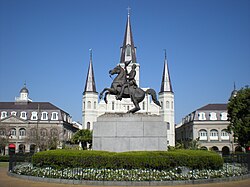
Facing the square are three pivotal 18th-century buildings: the St. Louis Cathedral (a minor basilica), the Cabildo (the former city hall where the Louisiana Purchase papers were signed), and the Presbytère (originally for priests, later a courthouse and museum).
Bourbon Street
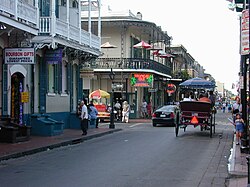
Rue Bourbon, or Bourbon Street, is the most famous thoroughfare in the Quarter, renowned for its nightlife and drinking establishments. Among its historic sites is the Old Absinthe House, which retained its name despite the U.S. ban on absinthe from 1915 to 2007.
District Overview
| Category | Details |
|---|---|
| Coordinates | 29°57′31″N 90°03′54″W |
| Elevation | 3 ft (0.91 m) |
| Population (2010) | 3,888 |
| Adjacent Neighborhoods | Faubourg Marigny, CBD, Iberville, Tremé |
| NRHP Reference No. | 66000377 |
Recent Events
The district has faced significant modern challenges. Following Hurricane Katrina in 2005, the Quarter was officially reopened on September 26, 2005, for cleanup and business restoration. More recently, in 2020, Mayor LaToya Cantrell proposed transitioning the area into a pedestrian-only zone to eliminate automobile use.
On January 1, 2025, the district suffered a terrorist attack when a man, identified by the FBI as Shamsud-Din Bahar Jabbar, rammed a truck into crowds on Bourbon Street. The attack resulted in 14 deaths and at least 36 injuries before the perpetrator was killed by police.
Frequently Asked Questions
Why is it called the French Quarter if much of the architecture is Spanish?
While founded by the French, two major fires in 1788 and 1794 destroyed most of the original French buildings. Because the city was under Spanish rule at the time, the subsequent rebuilding was done in the Spanish colonial style.
What is the Vieux Carré Commission?
Established in 1925, the Vieux Carré Commission (VCC) is a regulatory body tasked with preserving and protecting the historic architecture and character of the French Quarter.
What is the significance of the Cabildo?
The Cabildo served as the city hall during the colonial era and is historically significant as the location where the final transfer papers for the Louisiana Purchase were signed.
What was "Little Palermo"?
This was a nickname for the French Quarter in the late 19th and early 20th centuries, reflecting the large population of Italian immigrants, particularly from Sicily, who settled in the neighborhood.
Who built the Pontalba Buildings?
The Pontalba Buildings were designed and constructed between 1849 and 1851 by Baroness Micaela Almonester Pontalba, a prominent heiress in Creole New Orleans.