Bourbon Street: The History and Culture of New Orleans' Most Famous Thoroughfare
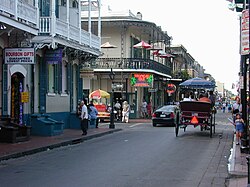
Located in the heart of the French Quarter, Bourbon Street (French: Rue Bourbon; Spanish: Calle de Borbón) is one of the most iconic destinations in the United States. Extending twelve blocks from Canal Street to Esplanade Avenue, this historic stretch is world-renowned for its vibrant nightlife, eclectic mix of bars, restaurants, and deep-rooted cultural legacy.
From its origins as a residential area for the colonial elite to its evolution into a global tourism hub, Bourbon Street mirrors the complex history of New Orleans itself, blending French, Spanish, and American influences.
Key Facts
- Origin: Named in 1721 after the French royal House of Bourbon.
- Architecture: Much of the current aesthetic is Spanish, resulting from the Great New Orleans Fire of 1788.
- Geography: Runs from Canal Street in the Central Business District to Kerlerce/Pauger Streets in the Marigny.
- Tourism: Attracts millions of visitors annually, recovering to 10.5 million by 2016 after a post-Katrina dip.
- Cultural Hubs: Home to the New Orleans Musical Legends Park and the historic Galatoire's restaurant.
The Colonial Era and Architectural Evolution
New Orleans was founded in 1718 by Jean Baptiste Le Moyne de Bienville. In 1721, French engineer Adrien de Pauger designed the city's street layout, naming streets after Catholic saints and French royal houses. Bourbon Street was named in honor of the ruling House of Bourbon.
While the city's roots are French, its visual identity shifted significantly under Spanish rule (1763–1803). The Great New Orleans Fire of 1788 destroyed 80% of the city's buildings, and subsequent fires through 1794 destroyed another 1,068 structures. The Spanish rebuilt these areas using stucco (plaster) exteriors, brickwork, and the heavy iron balconies that define the French Quarter today.
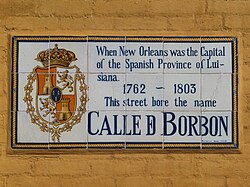
Following the 1803 Louisiana Purchase, the United States took control of the colony, and the street's name was translated into English as Bourbon Street.
From Residential Elegance to the "Vice District"
Throughout the 19th century, New Orleans grew into the third-largest metropolis in the U.S., fueled by a booming economy based on cash crops like sugar and tobacco. Until roughly 1900, Bourbon Street was a desirable residential neighborhood. However, the rise of the Storyville red-light district on adjacent Basin Street began to shift the area's reputation.
By the early 20th century, the area became a magnet for those seeking gambling, prostitution, and vaudeville. This environment fostered the birth of Jazz, with pioneers like Jelly Roll Morton and King Oliver performing in local brothels. This era also saw the birth of culinary landmarks, such as Galatoire's, established by Jean Galatoire in 1905.
The Burlesque Boom (1940s–1950s)
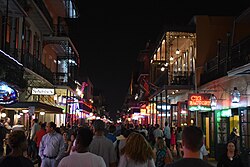
Following World War II, Bourbon Street transitioned into the city's primary nightlife center. The 1940s and 50s were defined by a burlesque boom, featuring exotic dancers, contortionists, and risqué singers. At its peak, over 50 different acts could be found along a single five-block stretch on any given night.
Modern Transformation and Tourism
The 1960s brought a period of "cleanup" led by District Attorney Jim Garrison, who raided adult entertainment venues to combat prostitution and "B-drinking" (a scam where patrons were coerced into buying overpriced drinks). By 1970, Mayor Moon Landrieu shifted the focus toward tourism, converting Bourbon Street into a pedestrian mall to make it more inviting for visitors.
In recent decades, some critics have lamented the "Disneyfication" of the street, arguing that the proliferation of corporate souvenir shops has eroded its authentic Creole character. Despite this, the street continues to evolve, as seen in the 2018 installation of an 11-foot giant saxophone, a gift from Namur, Belgium, honoring instrument inventor Adolphe Sax.
Resilience Through Crisis
Bourbon Street's high-ground location saved it from the worst of Hurricane Katrina in 2005. While visitor numbers plummeted from 10.1 million in 2004 to 3.7 million in 2006, the city prioritized the street's renovation as a catalyst for economic recovery. Tourism rebounded steadily, reaching 10.5 million visitors by 2016.
The street faced further challenges during the COVID-19 pandemic in 2020, which crippled the hospitality sector through lockdowns. More recently, on January 1, 2025, the street was the site of a terrorist attack by US Army veteran Shamsud-Din Jabbar, who drove a pickup truck into a crowd and used firearms, resulting in 15 deaths and 35 injuries. The attack led to the postponement of the 2025 Sugar Bowl.
Entertainment and Local Culture
Bourbon Street is generally divided into two distinct sections:
- Upper Bourbon Street: The area toward Canal Street, characterized by high-traffic tourist attractions, strip clubs, and the New Orleans Musical Legends Park.
- Lower Bourbon Street: The area from St. Ann Street onward, which serves as a hub for the LGBTQ+ community. This section includes the Bourbon Pub and Cafe-Lafitte-in-Exile, the nation's oldest gay bar. It is also the center of the annual Southern Decadence event.
Historic Landmarks
One of the most enduring sites is Lafitte's Blacksmith Shop and Bar, located at the corner of Bourbon and St. Philip. It is one of the oldest operating bars in the U.S. and was allegedly used as a base for John Lafitte's smuggling operations.
| Feature | Details |
|---|---|
| Length | 12 Blocks |
| Key Architectural Style | Spanish Colonial (Stucco and Iron Balconies) |
| Major Events | Southern Decadence (Labor Day Weekend) |
| Notable Establishments | Galatoire's, Lafitte's Blacksmith Shop |
| Primary Influence | French, Spanish, and American |
Legal and Social Issues
The street's lively nature has led to ongoing legal battles. In 1996, the case Yokum v. 615 Bourbon Street established that property owners, rather than individuals, are responsible for noise violations. Additionally, a 2010 ordinance attempted to ban music between 8 pm and 9 am, though enforcement has been inconsistent due to concerns over preserving the city's music culture.
The city also struggled with "aggressive solicitation" bans. A 2011 ordinance prohibiting nighttime religious or political messaging was challenged by the ACLU of Louisiana. In 2013, the New Orleans City Council eventually exempted Bourbon Street from this ban.
Frequently Asked Questions
Why does Bourbon Street look Spanish if it is in the French Quarter?
Much of the original French architecture was destroyed during the Great New Orleans Fire of 1788 and subsequent fires in 1794. Because the city was under Spanish rule at the time, the rebuilding process utilized Spanish architectural styles, including stucco exteriors and iron balconies.
What is the "Velvet Line" or "Lavender Line"?
These terms refer to St. Ann Street, which serves as the approximate boundary for the French Quarter's thriving gay community, particularly in the "Lower Bourbon Street" area.
What is the significance of the giant saxophone on Bourbon Street?
Installed on April 5, 2018, the 11-foot saxophone was a gift from Namur, Belgium, to commemorate Adolphe Sax, the inventor of the saxophone, who was from Dinant in Namur.
How did Hurricane Katrina affect Bourbon Street?
Because it is located on high ground, the street remained mostly intact. However, tourism dropped significantly in the years following the storm, falling from 10.1 million visitors in 2004 to 3.7 million in 2006 before eventually recovering.
Is the music on Bourbon Street regulated?
Yes, there have been various noise ordinances, including a 2010 rule banning music between 8 pm and 9 am. However, these are often inconsistently enforced to avoid stifling the city's famous street music culture.