Rampart Street: A Journey Through New Orleans History and Jazz
Rampart Street (French: rue du Rempart) is more than just a thoroughfare in New Orleans, Louisiana; it is a living timeline of the city's evolution. From its origins as a defensive fortification to its role as the heartbeat of early jazz, this historic avenue connects the diverse neighborhoods and cultural legacies that define the Crescent City.
The street is divided by Canal Street into two primary sections. North Rampart Street serves as the inland border of the French Quarter (Vieux Carré), extending through the Faubourg Marigny and Bywater neighborhoods, with a further stretch in the Lower Ninth Ward after a break at the Industrial Canal. South Rampart Street runs through the Central Business District toward St. Andrew Street. Interestingly, in the 19th century, the South Rampart designation extended into Uptown New Orleans, a section now known as Danneel Street.
Key Facts
- Origin: Named after the "Rampart" (Rempart), a wall built to fortify the early French colonial city.
- Cultural Hub: South Rampart Street was a primary center for African-American commerce and entertainment in the early 20th century.
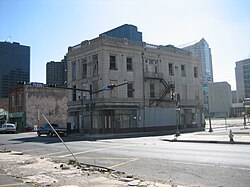
- Jazz Legacy: Home to the Eagle Saloon and the childhood residence of jazz legend Louis Armstrong.
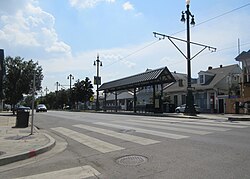
- Transit: The North Rampart-St. Claude streetcar line was completed in October 2016.
- Architecture: Features classic New Orleans lampposts and a tree-lined neutral ground (median) between Canal and St. Claude.
A Legacy of Music and Culture
During the early and mid-20th century, the area around South Rampart Street became a vital epicenter for African-American business and art. This cultural vibrancy is immortalized in jazz standards and songs such as "South Rampart Street Parade," "I've Got the Blues for Rampart Street," and "Saturday Night Fish Fry."
The street's musical influence is anchored by landmarks like the Eagle Saloon & Odd Fellows Hall. This 19th-century building hosted the pivotal Eagle Band and early jazz pioneers including Buddy Bolden, Freddie Keppard, Buddie Petit, and Louis Armstrong.
The Sound of North Rampart
The musical legacy continues on the north side, specifically at the J&M Recording Studio. Under Cosimo Matassa, this studio captured the sounds of luminaries like Fats Domino, Professor Longhair, Big Joe Turner, and Champion Jack Dupree. The intersection of North Rampart and Dumaine is explicitly mentioned in classic tracks such as "Mardi Gras in New Orleans" and "Frankie and Johnny."

Historic Landmarks and Architecture
Rampart Street is dotted with sites that reflect the religious, social, and athletic history of New Orleans.
North Rampart Landmarks
- Louis Armstrong Park: Home to the New Orleans Jazz National Historical Park and the historic Congo Square.
- Our Lady of Guadalupe Chapel: Built in 1826, it is the oldest surviving church building in the city.
- The Saenger Theater: A premier venue for performing arts.
- The New Orleans Athletic Club: Established in 1872, it remains one of the oldest active athletic clubs in the U.S.
- Religious and Civic Sites: Including the Center of Jesus the Lord (Old Carmelite Convent, 1895) and St. Mark's United Methodist Church (1924).
- WWL-TV Channel 4: Studios located in a former 7-UP bottling plant.
South Rampart Landmarks
- The State Palace Theater: Originally known as Loew's State Theatre.
- Iroquois Theater: An early 20th-century Vaudeville house and cinema managed by Clarence Williams.
- Masonic Temple: The Supreme Council of Louisiana maintained a temple at 315 South Rampart during the 1940s.
Modern Developments and Challenges
Transportation on Rampart Street has seen significant shifts. While the St. Claude streetcar line was removed in 1949 to accommodate automobiles, the city returned to its rails in 2016 with the opening of the 1.6-mile North Rampart-St. Claude line, connecting Canal Street to Elysian Fields Avenue.
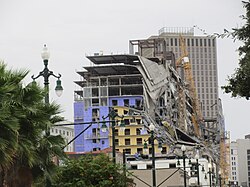
Recent years have also brought tragedy. On October 20, 2019, during an attempted implosion of a crane at the site of the collapsed Hard Rock hotel, a crane jib fell vertically onto Rampart Street near Canal Street. The incident resulted in three deaths and dozens of injuries, and caused a partial collapse of the structure facing North Rampart Street.
Rampart Street Summary
| Feature | North Rampart Street | South Rampart Street |
|---|---|---|
| Primary Area | French Quarter / Marigny / Bywater | Central Business District |
| Key Landmark | Louis Armstrong Park | Eagle Saloon |
| Transit | North Rampart-St. Claude Streetcar | Urban thoroughfare |
| Historical Role | Colonial fortification border | African-American commercial hub |
Frequently Asked Questions
Why is it called Rampart Street?
The street is named after the rempart, or rampart, which was a defensive wall built on the north side of the street during the city's early years to protect the French colonial settlement.
Which famous musicians are associated with Rampart Street?
Louis Armstrong grew up on South Rampart Street. Other jazz greats like Buddy Bolden, Freddie Keppard, and Buddie Petit played at the Eagle Saloon, while artists like Fats Domino and Professor Longhair recorded at the J&M Recording Studio on North Rampart.
What is the significance of the Eagle Saloon?
The Eagle Saloon & Odd Fellows Hall is considered one of the most important surviving buildings from the early days of jazz, serving as the base for the Eagle Band.
What happened at the Hard Rock hotel site on Rampart Street?
In October 2019, a crane jib fell onto Rampart Street during an attempted implosion at the Hard Rock hotel site, leading to three fatalities and numerous injuries.
Is there still a streetcar on Rampart Street?
Yes, the North Rampart-St. Claude streetcar line was completed in October 2016 and runs from Canal Street to Elysian Fields Avenue.