OKeh Records: A Century of Jazz, Blues, and Recording Innovation
From its origins as a niche phonograph supplier to its current status as a premier jazz imprint, OKeh Records has played a pivotal role in documenting the evolution of American music. Founded in 1918 by Otto Heinemann, the label became a trailblazer in recording genres and demographics that were largely ignored by the industry giants of the early 20th century.
The label's journey is one of constant evolution, transitioning through various owners—including Columbia Records and CBS—before eventually becoming a subsidiary of Sony Music. Today, OKeh continues to champion global expressions in jazz under the Sony Masterworks umbrella.
Key Facts
- Founded: 1918 by Otto Heinemann in New York City.
- Pioneering Work: One of the first labels to record "race records" and early country music.
- Legendary Artists: Home to Louis Armstrong's Hot Five and Hot Seven sessions.
- Innovation: Early adopter of remote recording to capture regional talent.
- Current Status: A specialized jazz imprint distributed by Sony Masterworks.
Early History and the Heinemann Era
OKeh Records was established by Otto (Jehuda) Karl Erich Heinemann, a German-American manager who had previously worked for the U.S. branch of Odeon Records. In 1916, Heinemann formed the Otto Heinemann Phonograph Corporation, which built a recording studio and pressing plant in New York City. The label officially launched in 1918, originally spelled "OkeH" (derived from the founder's initials) before shifting to the more recognizable "OKeh" branding.
Technologically, the label began with vertical cut discs—a method where the groove is cut downward into the material—before transitioning to the more standard lateral-cut method, where the groove moves side-to-side.
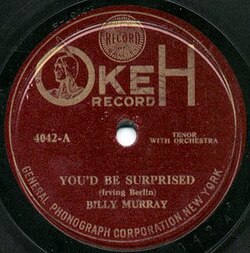
Under the musical direction of Frederick W. Hager (who sometimes used the pseudonym Milo Rega), OKeh expanded beyond standard popular songs. Heinemann targeted immigrant communities by producing recordings in Yiddish, Polish, Czech, German, and Swedish, utilizing both local New York recordings and leased masters from Europe.
The Rise of Race Records and Remote Recording
OKeh achieved historic significance in 1920 when it recorded blues singer Mamie Smith. Her hit "Crazy Blues" proved there was a massive, untapped market for African-American music, leading to the creation of the 8000 series, known as race records (recordings specifically marketed to African-American audiences).
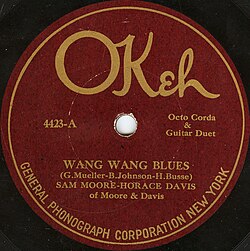
This success led to a golden era of jazz and blues recordings. Between 1921 and 1932, the label recorded legends such as King Oliver, Lonnie Johnson, and Bix Beiderbecke. Most notably, Louis Armstrong recorded his seminal Hot Five and Hot Seven sessions between 1925 and 1928, producing masterpieces like "West End Blues" and "Heebie Jeebies." By 1928, Armstrong's popularity was so great that his records were also marketed to white audiences.
To find more talent, OKeh pioneered remote recording (also called location recording). Starting in 1923, the company sent mobile equipment to cities like New Orleans, Atlanta, and Detroit. This initiative led to some of the first country music recordings, including those by "Fiddlin'" John Carson in June 1923.
The OKeh Laughing Record
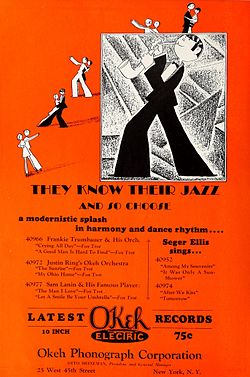
One of the label's most unusual successes was the OKeh Laughing Record. Purchased from Beka Records in Germany, the disc featured opera singer Lucie Bernardo and Otto Rathke laughing for nearly three minutes, accompanied by cornetist Felix Silbers. Released in the U.S. in 1922, it became a massive hit, selling approximately one million copies. This novelty record may have influenced the later use of laugh tracks in radio and television.
Ownership Transitions and the R&B Era (1940–1970)
The label's ownership shifted several times: sold to Columbia Records in 1926, then to the American Record Corporation (ARC) in 1934, and finally to CBS in 1938. After a period of dormancy, the OKeh name was revived in 1940 and again in 1951.
By 1953, OKeh became an exclusive Rhythm & Blues (R&B) label. In the 1960s, under A&R manager Carl Davis, the label found success with soul artists like Major Lance. It also facilitated the return of Little Richard to secular music, producing hit singles such as "Poor Dog" through the production of Larry Williams. However, following the departure of Davis and songwriter Curtis Mayfield, the label was retired by Columbia in 1970.
Modern Revivals and Current Jazz Focus
Sony Music reactivated OKeh twice in the modern era. First, from 1993 to 2000, it served as a new-age blues label featuring artists like Keb' Mo and G. Love & Special Sauce. In January 2013, it was relaunched as Sony's primary jazz imprint under Sony Masterworks.
Today, the label focuses on "global expressions in jazz," representing both established icons and new voices, including David Sanborn, Bob James, and Regina Carter.
| Era | Primary Genre/Focus | Key Artists/Milestones | Parent/Owner |
|---|---|---|---|
| 1918–1930s | Jazz, Blues, Ethnic Music | Louis Armstrong, Mamie Smith | Otto Heinemann / Columbia |
| 1950s–1970 | R&B and Soul | Little Richard, Major Lance | Columbia / Epic |
| 1993–2000 | New-Age Blues | Keb' Mo, G. Love | Sony Music |
| 2013–Present | Jazz | Bill Frisell, Somi | Sony Masterworks |
Frequently Asked Questions
Who founded OKeh Records?
OKeh Records was founded in 1918 by Otto Heinemann, a German-American entrepreneur who previously managed the U.S. branch of Odeon Records.
What are "race records" in the context of OKeh?
Race records were recordings specifically produced and marketed for African-American audiences. OKeh's 8000 series was a pioneer in this field, starting with the success of Mamie Smith's "Crazy Blues" in 1920.
How did OKeh contribute to the birth of country music?
Through remote recording trips to Atlanta in 1923, OKeh recorded early "Hillbilly" (now country) stars, including "Fiddlin'" John Carson, who is believed to have made some of the first country music recordings.
What was the OKeh Laughing Record?
It was a novelty recording of people laughing, accompanied by a cornet. Released in 1922, it sold roughly one million copies and is cited as a possible influence on the use of laugh tracks in media.
Who owns the OKeh Records catalogue today?
Sony Music Entertainment owns the global rights to the catalogue through Epic Records and its reissue subsidiary, Legacy Recordings.