Frederick Lindemann: The Scientist Who Shaped Churchill's War Strategy
Frederick Alexander Lindemann, later known as the 1st Viscount Cherwell, was far more than a physicist; he was one of the most influential civilian advisers in British history. As the prime scientific adviser to Winston Churchill during World War II, Lindemann bridged the gap between complex theoretical science and high-stakes military strategy. From the development of radar to the controversial policies of strategic bombing, his intellect and proximity to power left an indelible mark on the 20th century.
Key Facts
- Primary Role: Prime scientific adviser to Prime Minister Winston Churchill during WWII.
- Scientific Contributions: Developed the Lindemann mechanism for chemical kinetics and the Lindemann melting criterion.
- Military Impact: Influenced the development of radar, infra-red guidance, and the "dehousing" strategy for area bombing.
- Political Rank: Served as Paymaster General and was created Viscount Cherwell.
- Academic Legacy: Director of the Clarendon Laboratory at the University of Oxford.
Early Life and Academic Foundations
Born on April 5, 1886, in Baden-Baden, German Empire, Frederick Lindemann was the son of Adolph Friedrich Lindemann, a naturalized British citizen, and Olga Noble, an American widow. His education spanned Scotland and Darmstadt before he attended the University of Berlin, where he studied under the renowned Walther Nernst.
Lindemann's early research at the Sorbonne confirmed Albert Einstein's theories regarding specific heats at very low temperatures. His brilliance was recognized early; in 1911, he was the youngest attendee at the prestigious Solvay Conference on "Radiation and the Quanta." By 1920, he had been elected a Fellow of the Royal Society.
The First World War and Oxford Years
The outbreak of World War I forced Lindemann to flee Germany hastily to avoid internment. In 1915, he joined the Royal Aircraft Factory at Farnborough, where he developed a mathematical theory for aircraft spin recovery. To prove his theories, Lindemann learned to fly himself, transforming a previously fatal flight error into a recoverable maneuver.
In 1919, Lindemann became the professor of experimental philosophy (physics) and director of the Clarendon Laboratory at the University of Oxford. During this period, he made several landmark contributions to science:
- Solar Wind: He was among the first to suggest that the Sun emits a wind of protons and electrons.
- Chemical Kinetics: In 1921, he proposed the Lindemann mechanism, explaining how unimolecular chemical reactions occur via bimolecular activation.
- Atmospheric Science: He researched temperature inversion in the stratosphere.

The Bond with Winston Churchill
Lindemann's entry into Churchill's inner circle began unexpectedly through a charity tennis match involving Clementine Churchill. Despite their different lifestyles, the two men bonded over their shared passion for sports and Lindemann's ability to distill complex scientific concepts into concise briefings. This friendship lasted 35 years, with Lindemann becoming a trusted confidant during Churchill's "Wilderness Years" in the 1930s, advising him on the urgent need for British rearmament.
The Second World War: Power and Controversy
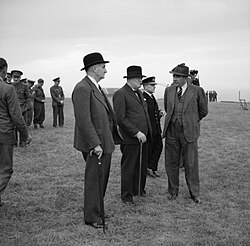
When Churchill became Prime Minister, Lindemann was appointed as his leading scientific adviser. He wielded unprecedented influence, attending War Cabinet meetings and communicating with the Prime Minister daily. He supported the experimental department MD1, working on hollow charge weapons and the "sticky bomb."
Strategic Bombing and "Dehousing"
One of Lindemann's most controversial contributions was his March 1942 paper on "Dehousing." He argued that the most effective way to break German morale was to target working-class housing specifically, as middle-class areas were too spread out to be efficiently bombed. This shift toward area bombing moved away from previous conventions of limiting civilian casualties.
The Bengal Famine and Shipping Policies
Lindemann's influence extended into logistics with devastating consequences. Fearing food shortages in Britain, he convinced Churchill to divert 56% of British merchant ships in the Indian Ocean to the Atlantic. While this secured wheat for Britain, it severely restricted food shipments to India. This policy is cited as a heavy contributor to the 1943 Bengal famine, which resulted in an estimated 1.5 to 4 million deaths.
Skepticism of the V-2 Rocket
Lindemann was famously skeptical of the enemy's V-weapons programme. He believed long-range rockets were only feasible with solid fuels and would need to be enormous, leading him to dismiss reports of compact liquid-fueled rockets. This caused significant friction within the Cabinet Defence Committee.
Political Career and Final Years
Lindemann's service was rewarded with several titles. He was raised to the peerage as Baron Cherwell in 1941 and served as Paymaster General from 1942 to 1945, and again from 1951 to 1953. In 1956, he was created Viscount Cherwell.
Returning to the Clarendon Laboratory after the war, he helped create the Atomic Energy Authority. His personal life remained solitary; after the death of Lady Elizabeth Lindsay in 1937, he withdrew from romantic pursuits. He died in his sleep at Oxford on July 3, 1957, at the age of 71.

Summary of Lindemann's Career
| Category | Details |
|---|---|
| Scientific Legacy | Lindemann mechanism, Lindemann index, Lindemann melting criterion |
| Key Roles | Director of Clarendon Laboratory, Paymaster General, Scientific Adviser to PM |
| War Contributions | Radar, infra-red guidance, aircraft spin recovery, area bombing strategy |
| Honours | Viscount Cherwell, Fellow of the Royal Society (FRS), Order of the Companions of Honour |
Frequently Asked Questions
What was the Lindemann mechanism?
The Lindemann mechanism is a theory in chemical kinetics proposed in 1921 to explain unimolecular reactions, demonstrating that the first step of such a reaction is actually a bimolecular activation process.
How did Lindemann influence the bombing of Germany?
Lindemann authored the "Dehousing" paper, which advocated for the strategic area bombing of working-class residential districts to break the spirit of the German population, shifting the focus toward higher civilian casualties.
What role did Lindemann play in the Bengal famine of 1943?
Lindemann convinced Churchill to divert a majority of merchant ships from the Indian Ocean to the Atlantic to secure British food stocks, which severely limited the transport of wheat to India and contributed to the famine's severity.
What was Lindemann's relationship with Winston Churchill?
They were close friends for 35 years. Lindemann served as Churchill's most influential civilian scientific adviser, providing concise technical briefings and strategic advice during both the "Wilderness Years" and World War II.
Why was Lindemann skeptical of the V-2 rockets?
He believed that liquid fuels were not viable for compact, long-range military rockets and argued that such weapons would require impractical sizes if propelled by solid fuels.