Frederick Lindemann: The Scientific Architect of Churchill's War Strategy
Frederick Alexander Lindemann, later known as the 1st Viscount Cherwell, was far more than a physicist; he was one of the most influential civilian advisers in British history. As the prime scientific adviser to Winston Churchill during World War II, Lindemann bridged the gap between complex theoretical science and the brutal pragmatism of wartime governance.
From his early contributions to chemical kinetics and aviation to his controversial role in strategic bombing and global logistics, Lindemann's life was defined by a relentless pursuit of efficiency and a deep, personal animosity toward Nazi Germany. His relationship with Churchill, spanning over three decades, granted him unprecedented access to the corridors of power, allowing a scientist to shape the fate of millions.
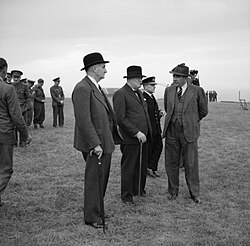
Key Facts
- Scientific Legacy: Known for the Lindemann mechanism (chemical kinetics), the Lindemann index, and the Lindemann melting criterion.
- War Influence: Served as Winston Churchill's primary scientific adviser during WWII and later as Paymaster General.
- Aviation Pioneer: Developed a mathematical theory for aircraft spin recovery, saving countless pilots' lives during WWI.
- Controversial Policies: Authored the "Dehousing" paper advocating for the strategic bombing of working-class German residential areas.
- Political Rank: Elevated to the peerage as Baron Cherwell (1941) and later Viscount Cherwell (1956).
Early Life and Academic Foundations
Born on April 5, 1886, in Baden-Baden, German Empire, Frederick Lindemann was the son of Adolph Friedrich Lindemann, a naturalized British citizen, and Olga Noble, an American widow. His education spanned Scotland and Darmstadt, eventually leading him to the University of Berlin, where he studied under the renowned Walther Nernst.
Lindemann's early research at the Sorbonne focused on specific heats at very low temperatures, confirming theories proposed by Albert Einstein. His brilliance was recognized early; in 1911, he was the youngest attendee at the prestigious Solvay Conference on "Radiation and the Quanta." By 1920, he had been elected a Fellow of the Royal Society (FRS).
WWI and the University of Oxford
The First World War forced Lindemann to flee Germany hastily to avoid internment. He joined the Royal Aircraft Factory at Farnborough in 1915, where he tackled the deadly problem of aircraft spins. By developing a mathematical theory of spin recovery—and testing it himself as a pilot—he transformed a previously fatal occurrence into a recoverable maneuver.
In 1919, Lindemann became the professor of experimental philosophy (physics) at the University of Oxford and director of the Clarendon Laboratory. During this period, he made several landmark contributions:
- Solar Physics: He was among the first to suggest that the Sun emits a wind of positively charged protons and electrons.
- Chemical Kinetics: In 1921, he proposed the Lindemann mechanism, explaining that unimolecular chemical reactions begin with a bimolecular activation step.
- Atmospheric Science: He conducted vital research on temperature inversion in the stratosphere.

The Bond with Winston Churchill
Lindemann's entry into Churchill's inner circle began unexpectedly through a charity tennis match involving Clementine Churchill. Despite their different social styles, the two men bonded over their shared love of sport and Lindemann's ability to distill complex scientific concepts into concise, actionable advice. This friendship lasted 35 years, with Lindemann becoming a trusted confidant during Churchill's "Wilderness Years" in the 1930s, supporting his campaign for British rearmament.
The Second World War: Power and Controversy
When Churchill became Prime Minister, Lindemann was appointed as his leading scientific adviser. He wielded immense power, attending War Cabinet meetings and communicating with the Prime Minister daily. He was instrumental in the development of radar, infra-red guidance systems, and hollow charge weapons.
The "Dehousing" Strategy
One of Lindemann's most controversial contributions was his March 1942 paper on "Dehousing." He argued that to break the spirit of the German population, bombing should be directed specifically at working-class residential areas, as middle-class housing was too spread out to be efficient targets. This shifted the convention of wartime bombing toward targeting civilian populations to disrupt the labor force.
The Bengal Famine and Global Logistics
Lindemann's influence extended to shipping and logistics. Driven by a fear of food shortages in Britain, he convinced Churchill to divert 56% of British merchant ships in the Indian Ocean to the Atlantic. While this secured wheat and raw materials for Britain, it severely restricted food shipments to India. This policy is cited as a significant contributing factor to the 1943 Bengal famine, which resulted in an estimated 1.5 to 4 million deaths.

Skepticism of the V-2 Rocket
Despite his scientific acumen, Lindemann was famously skeptical of the German V-weapons programme. He believed long-range rockets were only feasible with solid fuels and rejected the possibility of compact liquid-fuel rockets, leading to a notable clash with Churchill during a 1943 Cabinet Defence Committee meeting.
Political Career and Later Years
Lindemann's political ascent mirrored his influence. He was created Baron Cherwell in 1941 and served as Paymaster General from 1942 to 1945, and again from 1951 to 1953. He was also a member of the Privy Council and later created Viscount Cherwell in 1956.
In his later years, he returned to the Clarendon Laboratory and helped create the Atomic Energy Authority. Personally, Lindemann remained solitary after the death of Lady Elizabeth Lindsay in 1937, a loss that led him to withdraw from romantic pursuits for the remainder of his life.
| Category | Key Contribution / Role | Impact |
|---|---|---|
| Physics | Lindemann Mechanism | Advanced understanding of unimolecular reactions. |
| Aviation | Spin Recovery Theory | Reduced pilot fatalities during WWI. |
| Military | "Dehousing" Paper | Shifted strategy toward area bombing of cities. |
| Government | Scientific Adviser to PM | Directly influenced WWII radar and weapons policy. |
| Politics | Paymaster General | Held high cabinet-level financial and administrative roles. |
Frequently Asked Questions
What was the Lindemann mechanism?
The Lindemann mechanism is a theory in chemical kinetics proposed in 1921. It explains how unimolecular reactions (where a single molecule breaks down) actually occur through a two-step process, starting with a bimolecular collision that activates the molecule.
How did Lindemann influence the bombing of Germany?
Lindemann authored the "Dehousing" paper, which argued that the most effective way to break German morale and industrial capacity was to target the densely packed housing of the working class, rather than focusing solely on military or middle-class targets.
What role did he play in the Bengal famine of 1943?
Lindemann advised Churchill to divert a majority of merchant shipping from the Indian Ocean to the Atlantic to secure British food stocks. This reduced the availability of ships to transport grain to India, exacerbating the severity of the famine.
Why was he skeptical of the V-2 rockets?
Lindemann believed that liquid-fuel propulsion for large rockets was not feasible and that only massive, solid-fuel rockets could achieve long-range military goals, leading him to doubt early reports of the German rocket program.
What was his relationship with Winston Churchill?
They were close friends for 35 years. Lindemann served as Churchill's most influential civilian adviser, providing scientific expertise and political support during both Churchill's time in government and his "Wilderness Years."