Flute History, Evolution, and Technical Design
The flute is a versatile woodwind instrument classified as an edge-blown aerophone. Known scientifically in the Hornbostel–Sachs system as 421.121.12, it is an open side-blown flute with fingerholes. From its early origins as a simple tube to the complex mechanical marvel of the modern concert flute, the instrument has evolved to provide musicians with an expansive range and precise intonation across various musical genres.
While most people are familiar with the silver concert flute, the instrument exists as part of a vast family, ranging from the high-pitched piccolo to the massive hyperbass flute.

Key Facts

- Standard Pitch: The modern concert flute is pitched in C, with a standard tuning of A4 = 440 Hz.
- Range: Typically spans three and a half octaves, from C4 (middle C) up to C7 or D7.
- The Boehm System: Patented in 1847 by Theobald Boehm, this system introduced the linked key mechanism and metal construction used today.
- Materials: Modern flutes are crafted from brass, sterling silver, gold, platinum, or African blackwood (grenadilla).
- Family Diversity: The flute family includes a wide array of sizes, including the piccolo, alto, bass, and contrabass flutes.
Historical Evolution

Medieval and Renaissance Origins
Between the 11th and 13th centuries, the recorder was the dominant woodwind in Europe. The transverse flute arrived from Asia via the Byzantine Empire, eventually settling in France and Germany. These early versions, often called "German flutes," were used primarily in secular and court music. The first literary mention of the transverse flute dates back to 1285 by Adenet le Roi.
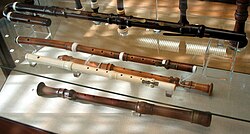
By the 1470s, the flute's use in military signaling—particularly by the Swiss army—helped it spread across Europe. During the 16th and early 17th centuries, flutes were built in various sizes to form a consort (an ensemble of instruments of the same type). These early flutes featured a cylindrical bore and a soft sound, making them ideal for "soft consorts."
The Baroque Traverso
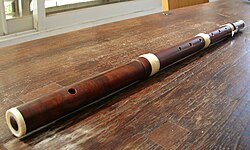
During the Baroque era, the flute—now often referred to as the traverso—transitioned from an ensemble instrument to a soloist's tool. Composers like J.S. Bach, Vivaldi, and Handel began writing dedicated works for the instrument. In 1702, Michael de la Barre published the first written work for the solo traverso, and in 1707, Jacques Martin Hotteterre authored the first method book, Principes de la flûte traversière.
The Modern Era and the Boehm System
The Boehm Revolution
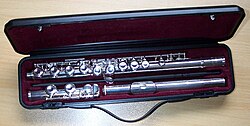
The 19th century marked a turning point with Theobald Boehm, a flautist and silversmith. Boehm redesigned the flute to improve its acoustics and ease of play. His 1847 patent introduced several major innovations:
- Material Shift: A transition from wood to metal.
- Bore Design: A large straight bore with a parabolic tapered headjoint.
- Keywork: Large tone holes covered by a linked key system, which simplified fingering and allowed for better facility in all keys.

Later Modifications
Following Boehm, other variations emerged. The Meyer flute was popular in the mid-19th century, combining traditional keyed flutes with the Viennese style. In the 1950s, Albert Cooper modified the Boehm flute to adjust the timbre and tune it to A440. More recently, in the 1980s, Johan Brögger introduced non-rotating shafts to reduce friction and noise, a design now produced by Miyazawa and Brannen Brothers.
Technical Characteristics and Construction
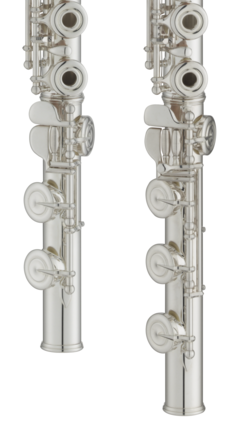
![Close-up of part of the body and the C-foot joint. The instrument features plateau keys with Y-arms, trill keys, and soldered tone holes. The image depicts the D-key adjustment screw, and needle springs.[20]](/images/f0/69/f06909d81a2de039f74b02c971f9398738722d76dc6e55386a62bf69bfaeae9a.jpg)
The Flute Family Range
The standard C flute is the most common, but the family extends significantly in both directions:
| Flute Type | Typical Pitch/Key |
|---|---|
| Piccolo | C or D♭ |
| Treble Flute | G |
| Soprano Flute | E♭ |
| Concert (C) Flute | C |
| Flûte d'amour (Tenor) | B♭, A, or A♭ |
| Alto Flute | G |
| Bass Flute | C |
| Contrabass Flute | C |
| Hyperbass Flute | C |

Materials and Mechanics
Construction materials vary by price and desired tone. Entry-level flutes are typically made of silver-plated brass or nickel silver. Professional instruments use sterling silver (92.5% silver), gold, or platinum. Wood, specifically African blackwood (grenadilla), remains a choice for those seeking a traditional sound.
Modern flutes also offer various mechanical options to suit the player's needs:
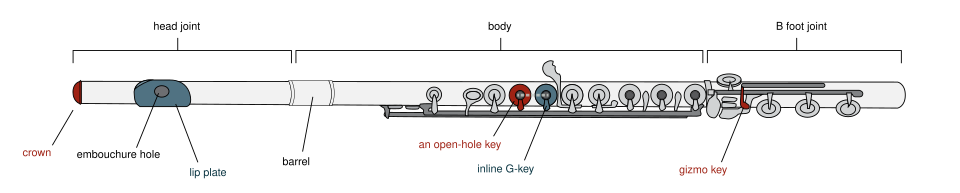
- B-foot joint: Extends the range down to B3.
- Open-hole vs. Plateau keys: Open holes allow for more precise intonation and extended techniques.
- Offset G: Positions the G key slightly away from the F key for better ergonomic reach.
- Gizmo key: An optional key on the B-foot that assists in playing C7.
The Flute in Diverse Musical Genres
In classical music, the flute has been a staple since the Baroque era. Antonio Vivaldi's La tempesta di mare (circa 1713–1716) is one of the earliest known concertos for the instrument. In the 20th century, the flute moved into jazz and rock. While rare in early jazz, musicians like Chick Webb and Frank Wess integrated the instrument in the 1930s and 40s. Because the Boehm fingering system is similar to that of the saxophone, many jazz musicians double on both instruments.

Frequently Asked Questions
What is the difference between a C-foot and a B-foot flute?
A C-foot is the standard length, while a B-foot is slightly longer and includes an extra key, allowing the flautist to play the note B3, which is below the standard range of the C flute.
Why are some flutes made of silver and others of gold?
Materials affect the timbre and cost of the instrument. Silver is the professional standard, while gold and platinum are more expensive and provide different tonal colors and projections.
What is the Boehm system?
The Boehm system is a mechanical design patented by Theobald Boehm in 1847. It uses a system of linked keys and larger tone holes to make the instrument easier to play in all keys and to improve its overall acoustic projection.
Can a flute be made of wood today?
Yes, although metal flutes are more common, professional wooden flutes are still made, typically using African blackwood (grenadilla) to achieve a warmer, more traditional sound.
What is the range of a standard concert flute?
The standard range starts at C4 (middle C) and typically extends to C7 or D7, though highly experienced players can reach as high as F♯7.