Tuba History, Construction, and Evolution
The tuba is the cornerstone of the brass family, providing the deep, resonant foundation for orchestras, concert bands, and jazz ensembles. As a labrosone (a lip-reed aerophone), it produces sound through the vibration of the player's lips against a mouthpiece. From its formal invention in 19th-century Prussia to its modern iterations in late-night television bands, the tuba has evolved from a cumbersome novelty into a versatile solo and ensemble instrument.
Key Facts
- Inventors: Developed in 1835 by Wilhelm Friedrich Wieprecht and Johann Gottfried Moritz.
- Classification: A valved lip-reed aerophone with a wide conical bore.
- Primary Types: Available in bass (F or E♭) and contrabass (C or B♭) pitches.
- Valve Systems: Primarily utilizes either piston valves or rotary valves.
- Notable Variants: Includes the wearable sousaphone and the marching contrabass bugle.
The Evolution of the Tuba
The tuba emerged during the 19th century as valve technology improved, allowing for more precise pitch control. By the 1850s, Adolphe Sax introduced E♭ and B♭ contrabass saxhorns, which became staples of British brass bands. Later, in the 1870s, Václav František Červený developed contrabass tubas in 16′ C and 18′ B♭.
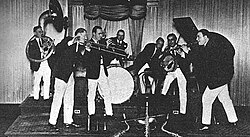
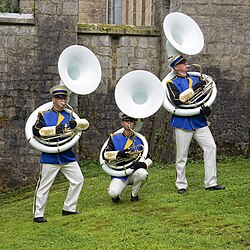
The instrument's design branched into specialized forms for different settings. The helicon, a circular wearable tuba, was created for marching. This design was later modified by John Philip Sousa in the late 1890s to create the sousaphone.
Regional Developments
In Italy, the cimbasso (a contraction of corno basso or "bass horn") served as the primary low brass instrument. Initially a form of upright serpent, it evolved through various valved versions. Composer Giuseppe Verdi, seeking a specific sound, commissioned a valved contrabass trombone in the 1880s, though the tuba eventually replaced these instruments in Italian orchestras.
France and Britain followed different paths. France utilized a small 8′ C tuba with six piston valves, which led to the creation of demanding high-register orchestral parts, such as the "Bydło" solo in Maurice Ravel's orchestration of Pictures at an Exhibition. Britain initially favored the F tuba, though players shifted toward the E♭ tuba in the 1960s due to import restrictions and availability.
Construction and Technical Specifications
Tubas are categorized by their pitch, which is determined by the length of the open tubing. While composers often leave the choice of instrument to the player based on desired timbre, the following sizes are standard:
| Category | Pitch | Tubing Length | Common Use |
|---|---|---|---|
| Bass Tuba | F | 12 feet | Solo work, European orchestras |
| Bass Tuba | E♭ | 13 feet | British brass bands |
| Contrabass Tuba | C | 16 feet | Standard orchestral bass |
| Contrabass Tuba | B♭ | 18 feet | Deep orchestral foundation |
Beyond these standards, novelty subcontrabass tubas exist. These massive instruments include "La Prodigieuse," a 36′ B♭ tuba restored by the Harvard University Band, and a 32′ C tuba that appeared in the first comedy Hoffnung Music Festival in 1956.
Valve Mechanisms
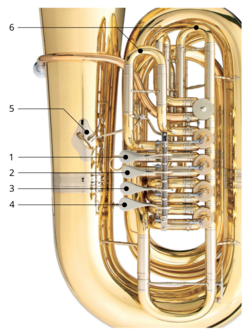
Modern tubas employ two primary valve types: piston valves and rotary valves. Rotary valves, patented by Joseph Riedl in 1835, became common in Austro-Hungarian instruments. Piston valves, developed by François Périnet in 1839, became the standard in France and Britain.
The Tuba in Performance and Jazz
For much of its history, the tuba was viewed as a supporting instrument. However, the mid-20th century saw a shift toward solo repertoire. In 1954, Ralph Vaughan Williams composed the Concerto in F minor for Bass Tuba and Orchestra, which helped establish the tuba as a legitimate solo classical instrument.
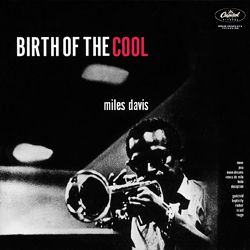
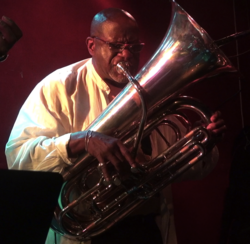
In the realm of jazz, the tuba has seen a significant resurgence. While Miles Davis utilized the tuba in the Birth of the Cool recordings (1949–50), the instrument's presence in contemporary jazz grew after Hurricane Katrina in 2005, as New Orleans musicians migrated to other cities. Today, tubists like Tuba Gooding Jr. and Ibanda Ruhumbika bring the instrument to mainstream audiences via late-night television bands.
Marching Adaptations
The contrabass bugle was introduced in 1959 for drum and bugle corps. Originally pitched in G with two valves, these instruments evolved after 2000 to be pitched in B♭ with three or four valves, and are now commonly called marching tubas.
Frequently Asked Questions
What is the difference between a tuba and a sousaphone?
The sousaphone is a specialized variant of the tuba designed for marching. It features a circular wrap that allows the musician to wear the instrument on their shoulder and a larger bell that points forward.
What are the most common tuba pitches?
The most common pitches are F and E♭ for bass tubas, and C and B♭ for contrabass tubas.
Who invented the tuba?
The tuba was developed in 1835 in Prussia by Wilhelm Friedrich Wieprecht and Johann Gottfried Moritz.
What is a subcontrabass tuba?
A subcontrabass tuba is an oversized novelty instrument pitched an octave below the standard contrabass tuba, with some examples reaching 36 feet in tubing length.
What is the difference between piston and rotary valves?
Piston valves move up and down in a linear motion to redirect air, while rotary valves use a rotating plug to change the air path. Both serve the same purpose of changing the length of the tubing to alter the pitch.