Cornet in B♭
The cornet is a sophisticated brass wind instrument that, while closely resembling the trumpet, possesses a distinct personality. Defined by its conical bore and compact design, the cornet is prized for its warm, mellow tone and agility. While the most common version is a transposing instrument in B♭, other variations exist in E♭, A, and C. It is important to note that the modern valved cornet is entirely unrelated to the cornetto used during the Renaissance and early Baroque periods.

Key Facts
- Classification: A valved aerophone sounded by lip vibration (Hornbostel–Sachs 423.232).
- Origin: Developed in the early 19th century from the post horn.
- Defining Feature: A mostly conical bore, which creates a mellower sound than the cylindrical trumpet.
- Primary Key: Most commonly found in B♭, with soprano models in E♭.
- Key Innovators: Friedrich Blühmel, Heinrich Stölzel, and François Périnet.
History and Evolution
The cornet emerged in the 1820s when valves were first applied to the post horn. This evolution was made possible by the pioneering work of Silesian horn players Friedrich Blühmel and Heinrich Stölzel, who invented the first valves. While Blühmel is often credited as the inventor, Stölzel is recognized for developing a practical instrument. By the 1830s, Parisian makers adopted the improved Périnet piston valves, patented by François Périnet in 1838, which serve as the blueprint for modern brass valves.
The instrument's pedagogical foundation was solidified in 1864 by Jean-Baptiste Arban, whose comprehensive study, La grande méthode complète de cornet à piston et de saxhorn (the Arban method), remains a standard for players today. Throughout the 19th and early 20th centuries, the cornet and trumpet co-existed in ensembles, often with separate parts written for each due to their differing capabilities and timbres.
Cornet vs. Trumpet: Key Differences
Although they share similar fingerings and the same pitch when made in the same key, the cornet and trumpet are not interchangeable. The primary difference lies in the bore—the interior shape of the tubing. A trumpet has a cylindrical bore, whereas the cornet features a conical bore, meaning the tubing gradually widens from the mouthpiece to the bell. This structural difference results in a warmer, less penetrating sound and greater agility for fast melodic passages.
Physically, the cornet is more compact, placing its center of gravity closer to the player, which often makes it a preferred choice for beginners. Additionally, the cornet mouthpiece has a shorter, narrower shank and often a deeper cup than a trumpet mouthpiece.
Varieties of Cornets
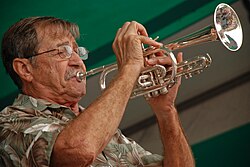
- Short-model (Shepherd's Crook): A traditional, compact shape often featuring a large bore and a rich, mellow sound.
- Long-model (American-wrap): More similar to a trumpet in appearance, typically with a smaller bore and a brighter tone.
- Long Cornet: A rare mid-20th-century variety (produced by C.G. Conn and F.E. Olds) that looks like a trumpet but accepts cornet mouthpieces.

Specialized Variants and Technique
One unusual historical variant is the echo cornet. This instrument featured a secondary mute chamber on the side. When a fourth valve was pressed, the air was diverted to this second bell, creating a sound similar to a Harmon mute, allowing the player to perform "echo" phrases.
The playing technique involves the embouchure—the way a player applies their lips to the mouthpiece to create a "buzz." By altering lip tension and tongue position, the player changes the frequency of the air column. While a valveless instrument can only play a harmonic series, the cornet's valves allow the player to change the length of the tubing, enabling full chromatic playing.
The Cornet in Musical Ensembles
Brass and Concert Bands
In British brass bands, the cornet is the primary melodic voice; trumpets are not used. A typical ensemble includes nine B♭ cornets and one E♭ soprano cornet. In British-style concert bands, the cornet remains a staple, whereas modern American concert bands have largely replaced the cornet with the trumpet.
Jazz and Orchestral Use
In early jazz, the cornet was the preferred lead instrument. Pioneers like Buddy Bolden and Louis Armstrong (who later switched to trumpet) helped define the genre. Other influential cornetists include Bix Beiderbecke and King Oliver. However, as jazz evolved toward the swing and bebop eras, the louder, more piercing trumpet became dominant.
In the symphony orchestra, composers like Hector Berlioz used cornets to bridge the sonic gap between horns and trumpets. Berlioz famously used a solo cornet for a counter-melody in Symphonie fantastique. While composers like Tchaikovsky, Elgar, and Stravinsky utilized the cornet for its agility and mellow tone, the instrument has become rare in modern orchestral settings.
| Feature | Cornet | Trumpet |
|---|---|---|
| Bore Shape | Mostly Conical | Mostly Cylindrical |
| Tone Quality | Mellow, Warm | Bright, Penetrating |
| Agility | High (Easier fast passages) | Standard |
| Physical Shape | Compact | Elongated |
| Common Use | Brass Bands, Early Jazz | Orchestras, Modern Jazz |
Frequently Asked Questions
Is a cornet the same as a trumpet?
No. While they look similar and play the same notes, they differ in bore shape (conical for cornet, cylindrical for trumpet), which gives the cornet a mellower tone and the trumpet a brighter, more piercing sound.
What is a "Shepherd's Crook" cornet?
It is a short-model traditional cornet characterized by its compact, curved shape and typically a larger bore, producing a rich and mellow sound.
Why is the cornet often recommended for beginners?
The cornet is generally easier to hold because its center of gravity is closer to the player than that of a trumpet.
What is the role of the cornet in a British brass band?
The cornet is the leading melodic instrument in a British brass band. These ensembles typically feature several B♭ cornets and one E♭ soprano cornet, and they do not use trumpets.
Who is Jean-Baptiste Arban?
Jean-Baptiste Arban was a virtuoso cornet player who published the "Arban method" in 1864, which remains one of the most influential instructional books for brass players.