Embouchure Techniques for Wind Instruments
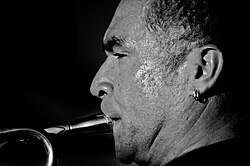
Embouchure (also known as lipping) refers to the strategic use of the lips, facial muscles, tongue, and teeth to produce sound on a wind instrument. Derived from the French word bouche, meaning mouth, the embouchure involves shaping the lips to fit the mouthpiece of a brass or woodwind instrument. Mastering a proper embouchure is essential for any musician, as it allows them to access the full range of their instrument with a clear, full tone while avoiding muscle strain or long-term damage.
Key Facts
- Definition: The positioning and use of facial muscles and lips to play wind instruments.
- Brass Sound: Produced by "buzzing" the lips into a mouthpiece.
- Woodwind Sound: Generated either by air across an opening (flute) or via a vibrating reed.
- Customization: There is no one-size-fits-all approach; anatomy (teeth, jaw, and lip shape) dictates the best technique.
- Health Risks: Improper technique or extreme pressure can lead to embouchure collapse or increased intracranial and intraocular pressure.
Brass Embouchure Fundamentals
In brass playing, sound is created when the player buzzes their lips into a mouthpiece. Pitch is controlled by altering the muscular contraction of the lips, the flow of air, the tension in the jaw and cheeks, and the position of the tongue.
Because of individual anatomical differences—such as dental structure and jaw malocclusion—experts often disagree on the "correct" way to form an embouchure. Research suggests that the direction of the air stream is often personalized. While Philip Farkas initially hypothesized that air should travel straight down the mouthpiece shank, his later research and the work of Donald S. Reinhardt showed that air can travel either upstream or downstream depending on where the mouthpiece is placed on the lips.
The Farkas Approach
Many professionals use a "puckered smile" combination. This involves holding the corners of the mouth firmly, ensuring the skin under the lower lip is taut without air pockets, and avoiding overlapping or rolling the lips. Farkas suggested different mouthpiece ratios based on the instrument:
- French Horn: 2/3 upper lip, 1/3 lower lip.
- Trumpet and Cornet: 2/3 lower lip, 1/3 upper lip (though some prefer a 50/50 split).
- Lower Brass: More latitude in placement for trombone, baritone, and tuba.
Alternative Brass Systems
Beyond the Farkas method, several other systems have been developed to suit different needs and anatomical structures:
- Stevens–Costello: Features a slight rolling in of both lips and a mouthpiece placement of roughly 40–50% top lip and 50–60% lower lip.
- Maggio: A puckered embouchure (similar to a monkey's expression) designed to provide more endurance and help players overcome physical malformations, particularly in the high register.
- Tongue-Controlled (Callet): A minority approach where the tongue remains forward against the teeth, and the lips curl inward to grip the tongue, which advocates claim results in a bigger sound and better intonation.
Lip Buzzing
Lip buzzing is a foundational exercise where the player produces a sound without the instrument, similar to the sensation of spitting seeds but with a continuous air flow. This helps prevent the aperture (the opening between the lips) from becoming too open.
Woodwind Embouchure
Woodwind instruments are divided into those that use a reed and those that do not.
Flute and Piccolo
The transverse flute typically uses a symmetrical embouchure with relaxed corners and the lower lip placed near the embouchure hole. However, symmetry is not a strict requirement for all professionals. When switching to the piccolo, players must place the embouchure hole slightly higher on the lower lip and use greater muscle tone to direct air across the smaller opening.
Reed Instruments
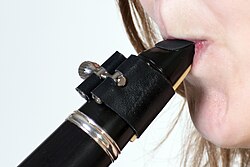
For instruments like the clarinet, saxophone, oboe, and bassoon, the embouchure focuses on sealing the area around the reed to prevent air leaks and control the reed's vibration. If the mouthpiece is too deep in the mouth, the instrument may jump an octave; if it is too shallow, no sound will be produced.
- Single Reeds: Use a mouthpiece to support the reed.
- Double Reeds (Oboe, Bassoon): The reed is placed directly on the lips without a mouthpiece, making tuning and pitch control extremely sensitive to small embouchure changes.
Comparison of Embouchure Styles
The following table summarizes the primary characteristics of various brass embouchure methods.
| Method | Lip Position | Key Characteristic | Primary Goal |
|---|---|---|---|
| Farkas | Puckered Smile | Firm corners, specific lip ratios | Clear tone and range |
| Stevens-Costello | Slightly rolled in | 40-60% lip distribution | Balanced air/pressure |
| Maggio | Puckered | Extended/cushioned lips | Endurance and high notes |
| Tongue-Controlled | Curled inward | Forward tongue position | Open sound and protection |
Health Considerations
Musicians may encounter embouchure collapse, a condition where they lose the ability to form an effective seal. Furthermore, research since the early 2000s suggests that the high air pressure required for brass instruments (and the shofar) can lead to physiological strain. This may include increases in blood pressure, heart rate, and intracranial or intraocular pressure. Symptoms like dizziness can occur, particularly in students learning without professional guidance.
Frequently Asked Questions
What is the difference between a brass and woodwind embouchure?
A brass embouchure relies on the player buzzing their own lips to create sound, whereas a woodwind embouchure typically involves sealing the mouth around a reed or directing air across a hole to initiate vibration.
Is there one "correct" embouchure for everyone?
No. Because of differences in dental structure, jaw shape, and lip size, embouchure techniques must be personalized to the individual's anatomy to be effective.
What is lip buzzing and why is it used?
Lip buzzing is the act of producing a sound with the lips alone, without the instrument. It is used as a training tool to develop the correct aperture and muscle memory for brass playing.
Can playing a wind instrument affect my health?
Yes, in some cases. High-pressure exhalation and mouthpiece pressure can cause increases in intracranial and intraocular pressure, and improper technique can lead to muscle strain or embouchure collapse.
How does the piccolo embouchure differ from the flute?
The piccolo requires the embouchure hole to be placed slightly higher on the lower lip and demands more muscle tone to control the air stream across its smaller opening.