Hammered Dulcimer: History, Tuning, and Global Variations
The hammered dulcimer is a captivating percussion-string instrument, technically classified as a chordophone. It consists of strings stretched across a trapezoidal resonant soundboard, which the musician strikes with small, spoon-shaped mallets known as hammers. The name itself reflects the instrument's melodic nature, deriving from the Latin dulcis (sweet) and the Greek melos (song), literally meaning "sweet song."
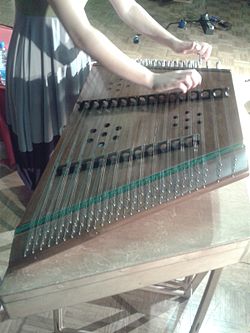
While modern players often use wooden supports to stand or sit, traditional styles frequently involve the musician sitting cross-legged on the floor. The instrument evolved from the psaltery—a similar stringed instrument that is plucked rather than struck.

Key Facts
- Classification: Percussion-string instrument (chordophone).
- Origins: Developed in antiquity, with early evidence from the Middle East (Assyrian and Babylonian carvings).
- Mechanism: Strings are struck with hammers rather than plucked or bowed.
- Global Reach: Found in Asia, Central Europe, the Balkans, Scandinavia, the UK, and the US.
- Tuning: Traditionally based on a circle of fifths pattern.
History and Evolution
The ancestor of the hammered dulcimer is the santur, which originated in the Middle East. Archaeological evidence from 669 BC in Assyrian and Babylonian stone carvings depicts the instrument being played while hanging from the musician's neck. Early versions were likely constructed from wood and stone, utilizing goat intestines for strings.
The santur served as the progenitor for a vast family of instruments, including the harp, the Chinese yangqin, the harpsichord, the qanun, and the cimbalom. By the early 15th century, the hammered dulcimer appeared in European texts and iconography, becoming widely used across England, France, Italy, Germany, the Netherlands, and Spain during the Middle Ages.
![An angel playing a dulcimer and pipe in the c. 1490 fresco Assumption of Mary by Filippino Lippi at Santa Maria sopra Minerva[3]](/images/90/ff/90ff3c4a93f650dac31d4d7ed6f35c8de6d6759336090772b1cc92a68ca3f84a.jpg)
Strings and Tuning Mechanics
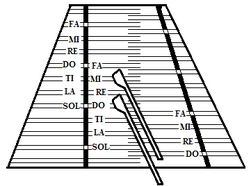
A standard dulcimer features two bridges: a bass bridge on the right and a treble bridge on the left. The bass strings are played to the left of their bridge, while treble strings can be played on either side. Striking the treble strings on the left typically produces a note a fifth higher than striking them on the right.
Instruments are often categorized by the number of strings crossing the bridges (e.g., a "15/14" model has 15 treble and 14 bass strings). Strings are arranged in courses—groups of two or more strings tuned in unison. This design increases volume and creates a "chorus effect" similar to a mandolin, as the strings are rarely in perfect unison.
Diatonic vs. Chromatic Tuning
Traditional diatonic dulcimers are often tuned according to the circle of fifths. A player navigates the scale by moving between tetrachords (groups of four notes), shifting from the bass bridge to the treble bridge to maintain the correct scale. For example, in a D major scale, the player moves from the lower-right corner up the bass bridge, then shifts to the treble bridge to complete the scale.
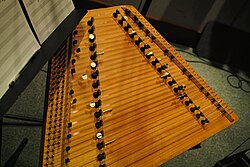
Because this pattern leaves some gaps in the chromatic scale, chromatic dulcimers incorporate extra short bridges to provide the missing pitches. A notable variation is the Salzburger hackbrett, developed in the 1930s, which uses crossed strings to provide a whole tone distance in every row.
The Role of Hammers
The "hammered" aspect of the instrument refers to the mallets used to strike the strings. These are typically crafted from hardwoods like maple, cherry, or walnut, though metal and plastic are also used. In Western traditions, hammers are generally stiff, whereas Asian traditions often employ flexible hammers.
To alter the tone, players may leave the hammer head bare for a sharp attack or cover it with leather, fabric, or adhesive tape for a softer sound. Some players use specialized materials; for instance, historical players have used hacksaw blades, bicycle wheel spokes wrapped in wool, or cane bound with wool.
Global Variants
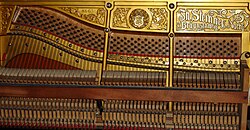
The hammered dulcimer exists in numerous forms across the globe, each with unique regional names and construction styles.
| Region/Country | Local Name |
|---|---|
| Iran, Iraq, Turkey, Afghanistan | Santur |
| China | Yangqin |
| Hungary | Cimbalom |
| Austria, Germany, Switzerland | Hackbrett |
| Thailand, Cambodia, Laos | Khim |
| India, Pakistan, Bangladesh | Santoor |
| Korea | Yanggeum |
| Ireland | Tiompan |
Frequently Asked Questions
What is the difference between a diatonic and a chromatic dulcimer?
A diatonic dulcimer is tuned to a specific scale and may lack some notes of the chromatic scale. A chromatic dulcimer includes additional strings and bridges to provide all the half-steps (semitones) required for any key.
How are the strings of a hammered dulcimer tuned?
Strings are wound around tuning pins and adjusted using a wrench, similar to a piano or harp. They are typically tuned in courses (pairs) and often follow a circle of fifths pattern.
What materials are used to make the hammers?
Hammers are primarily made from hardwoods such as maple, oak, or walnut. Some are covered in leather, felt, or tape to soften the sound, while historical variants have used steel wire or cane.
Which other instruments are related to the hammered dulcimer?
The hammered dulcimer is closely related to the psaltery (its plucked ancestor), as well as the cimbalom, yangqin, autoharp, and zither.