Fauna: Classifying Animal Life Across Regions and Environments
In the study of biology, fauna refers to the collective animal life found within a specific region or during a particular geological time period. While we often use the term broadly, scientists use it to categorize the biological diversity of a place, such as the "Sonoran Desert fauna" or the prehistoric "Burgess Shale fauna." When combined with flora (plants) and funga (fungi), fauna forms the biota—the total sum of all living organisms in an area.
The scientific study of animals in a specific region is known as faunistics. For paleontologists, fauna is often used to identify faunal stages, which are sequences of rock layers containing similar fossils, helping researchers map the history of life on Earth.
The Origins of the Term
The word fauna is rooted in Roman mythology, derived from Fauna, the goddess of earth and fertility, and Faunus, the Roman god of the forest. These figures are cognates of the Greek god Pan. Beyond its biological meaning, a "fauna" can also refer to a published book that catalogues the animals of a specific region. This usage was popularized by the Swedish scientist Carl Linnaeus in his 1745 work, Fauna Suecica.
Key Facts
- Fauna encompasses all animal life in a specific time or place.
- Biota is the collective term for flora, fauna, and funga.
- Faunistics is the specialized study of regional animal life.
- Animal classifications can be based on size (e.g., megafauna vs. microfauna) or habitat (e.g., epifauna vs. infauna).
- Subterranean life is split between troglofauna (caves) and stygofauna (groundwater).
Classifying Fauna by Habitat and Environment
Animals are often categorized by where they live, particularly in aquatic and subterranean environments.
Aquatic and Benthic Fauna
In water bodies, animals are often classified by their relationship to the bottom sediment (the benthos):
- Epifauna (or epibenthos): Animals that live on the surface of the seafloor or bottom substratum.
- Infauna: Organisms that live within the bottom sediments. These range from microscopic bacteria to ghost shrimps (Thalassinidea), which can burrow up to 3 metres (10 ft) deep. Fossil records show that trilobites and worms also utilized this habitat for protection and feeding.
- Limnofauna: A general term for animals inhabiting fresh water.
Subterranean Fauna
Life beneath the surface is divided based on the specific environment and life history:
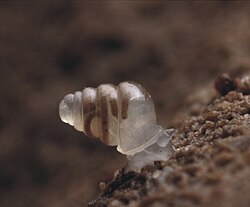
- Troglofauna: Animals adapted to the dark spaces of caves above the water table. Many have evolved heightened senses of smell, touch, and hearing, while losing pigmentation and eyesight. Some species are permanent residents that cannot survive outside the cave.
- Stygofauna: Animals living in groundwater systems, such as aquifers, fissures, and vugs. Like troglofauna, they are categorized as stygophiles, stygoxenes, or stygobites based on their life history.
Specialized Habitats
- Cryofauna: Animals living in or very near extremely cold regions.
- Cryptofauna: Animals that exist in concealed or protected microhabitats.

Classifying Fauna by Size
Biologists also categorize animals by their physical dimensions, often using sieve sizes to define these groups during research.
| Category | Description | Typical Examples/Criteria |
|---|---|---|
| Megafauna | Large animals of a region or era | Australian megafauna |
| Macrofauna | Organisms retained on a 0.3–0.5 mm sieve | Larger soil or benthic organisms |
| Mesofauna | Macroscopic soil animals | Arthropods, Nematodes, Springtails |
| Meiofauna | Small invertebrates between micro and macro | Organisms passing through 0.5–1 mm mesh |
| Microfauna | Microscopic animals | Protozoans, Rotifers |
Other Specialized Terms
Depending on the animal group being studied, more specific terms are used. For example, avifauna refers specifically to birds, while piscifauna (or ichthyofauna) refers to fish. In theoretical science, xenofauna refers to hypothetical alien organisms that serve as animal analogues, a concept explored in astrobiology and evolutionary biology.
Frequently Asked Questions
What is the difference between fauna and biota?
Fauna refers specifically to the animal life of a region, whereas biota is a broader term that includes all living organisms, including plants (flora) and fungi (funga).
How do troglofauna differ from stygofauna?
Both are subterranean, but troglofauna live in cave spaces above the water table, while stygofauna live in groundwater systems and aquifers.
What defines an organism as part of the microfauna?
An organism is considered microfauna if it is microscopic or very small and exhibits animal-like characteristics, distinguishing it from microflora, which are plant-like.
What is the difference between epifauna and infauna?
Epifauna live on top of the sediment surface at the bottom of a body of water, while infauna live buried within the sediment itself.
What are the physical adaptations of troglofauna?
Due to their dark environments, troglofauna often lose their eyesight and skin pigmentation. To compensate, they develop enhanced senses of touch, smell, and hearing, and may evolve longer appendages or a lack of wings.