Understanding Biological Taxonomy: A Guide to the Ranks of Life
Have you ever wondered how scientists organize the millions of different living things on Earth? The answer lies in biological taxonomy, the hierarchical system used to classify organisms based on their evolutionary relationships. By grouping life into specific levels, scientists can better understand how different species are connected through history.
In this system, a taxon (a group of organisms) or a clade (a group consisting of a common ancestor and all its descendants) is assigned to a specific level, known as a taxonomic rank. The most inclusive groups, such as the Animalia (animals), occupy the highest ranks, while the most specific groups, such as Homo sapiens (humans), occupy the lowest ranks.
The Evolution of Classification Methods
The way we classify life has changed drastically over the centuries. Historically, classification was phenomenological, meaning scientists grouped organisms based on their physical appearance, behavior, and organic structure. If two animals looked similar, they were often placed in the same group.
However, the second half of the 20th century introduced two revolutionary methods that moved taxonomy away from mere appearance and toward true evolutionary history:
- Cladistics: Developed from the work of German entomologist Willi Hennig, this method classifies life forms based on shared characteristics called synapomorphies. The logic is simple: the more characteristics two organisms share, the more recently they likely shared a common ancestor.
- Molecular Systematics: This modern approach uses genetic analysis to determine relationships. By looking at DNA, scientists can resolve relationships that are difficult to see through physical traits alone, such as the connections between various bacteria, archaea, and viruses.
The Hierarchy of Taxonomic Ranks
Taxonomic ranks can be categorized as either "absolute" or "relative." Absolute ranks use specific, descriptive terms like "family" or "genus." Relative ranks are instead defined by their position in an indented hierarchy, where the level of indentation indicates the rank. Most formal scientific codes, such as the Zoological Code, require the use of absolute ranks.
While Carl Linnaeus originally used a limited scale including kingdom, class, order, genus, and species, modern science has expanded this. Today, the domain—a rank proposed by Carl Woese—is widely recognized as the most fundamental level of classification.
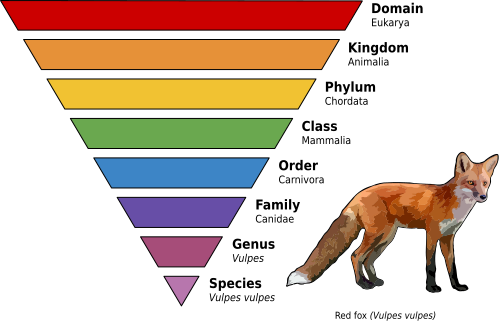
When an organism is formally named, it is assigned a rank. The most basic units are the species and the genus. In a scientific name, the genus name is always included as part of the species name.
| English Rank | Latin Form |
|---|---|
| Domain | dominium |
| Kingdom | regnum |
| Phylum / Division | phylum / divisio |
| Class | classis |
| Order | ordo |
| Family | familia |
| Genus | genus |
| Species | species |
Specialized Ranks in Zoology and Botany
Different branches of biology follow specific rules for naming and ranking. In zoology, the International Code of Zoological Nomenclature organizes names into family-group, genus-group, and species-group categories. This includes ranks such as superfamily, subfamily, tribe, and subspecies.
In botany, the system is even more complex. Plant classification includes various levels such as subkingdom, subdivision, and several infraspecific ranks like variety and form. Botanists also use specific suffixes to denote different ranks, such as -ales for orders or -aceae for families.
Challenges in Modern Taxonomy
Despite its usefulness, the ranking system is not perfect. Because biological variation is often gradual, assigning organisms into rigid, discrete ranks can be subjective. Some scientists argue that these ranks do not fully reflect the continuous nature of evolution. Furthermore, the diversity we see in certain groups, such as vertebrates, may be more a result of intensive study and funding rather than a true reflection of their biological diversity compared to less-studied groups like fungi.
There are also enigmatic taxa—groups of organisms whose broader evolutionary relationships remain unknown or undefined by scientists.
Key Facts
- Taxonomy is the hierarchical classification of organisms based on evolutionary relationships.
- Cladistics uses shared characteristics (synapomorphies) to determine common ancestry.
- Molecular systematics uses genetic data to resolve complex evolutionary relationships.
- The seven main ranks are kingdom, phylum, class, order, family, genus, and species, with domain acting as the highest level.
- Absolute ranks are named levels (like "Family"), while relative ranks are defined by their position in a hierarchy.
Frequently Asked Questions
What is the difference between a taxon and a clade?
A taxon is any group of organisms at a specific level of classification, whereas a clade specifically refers to a group that includes a common ancestor and all of its descendants.
Why do scientists use Latin in biological names?
Latin is used to provide a standardized, universal language for scientific names, ensuring that researchers worldwide can identify the same organism regardless of their native language.
How has technology changed the way we classify life?
The advent of genetic analysis and molecular systematics has allowed scientists to look beyond physical appearance. This helps resolve relationships between organisms that may look very different but are genetically closely related, such as certain bacteria and viruses.
What are enigmatic taxa?
Enigmatic taxa are groups of organisms whose exact place in the tree of life is currently unknown or cannot be clearly defined by existing scientific data.
Are taxonomic ranks permanent?
No. As new scientific methods like genetic sequencing emerge, our understanding of evolutionary relationships changes, which can lead to the reassignment of organisms to different ranks or groups.