Eye Evolution and Anatomy Across the Animal Kingdom
Vision is one of the most critical senses in the animal kingdom, allowing organisms to navigate, hunt, and avoid predators. From the simplest light-sensitive spots to the complex camera-like eyes of humans and the multifaceted compound eyes of insects, the eye has evolved in a staggering variety of forms. While these organs may look different, they all share a fundamental purpose: converting electromagnetic radiation into neural signals that the brain can interpret.
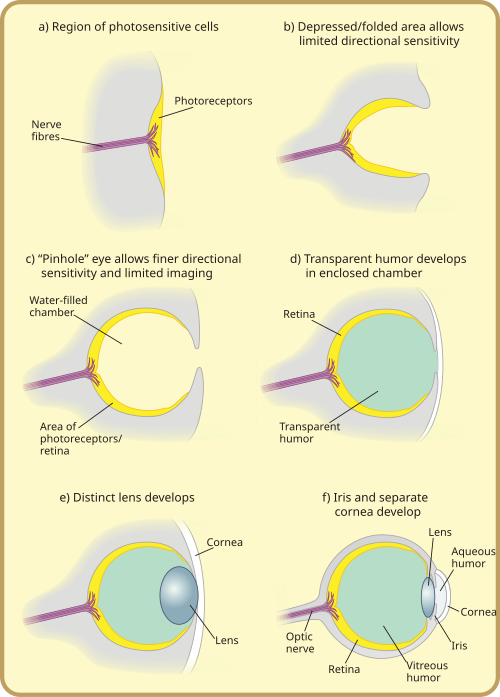
The history of vision began approximately 600 million years ago during the Cambrian explosion. Scientists believe that a common ancestor possessed a basic biochemical toolkit for vision, leading to the development of eyes in 96% of animal species across six of the 35 main phyla.
Key Facts
- Common Origin: Most animal eyes evolved from a proto-eye roughly 600-650 million years ago, driven largely by the PAX6 gene.
- Diversity: Eyes range from simple pit eyes (found in 85% of phyla) to complex compound and camera-type eyes.
- Visual Range: Most organisms perceive light between 400 and 700 nm, a range likely influenced by the organ's submarine evolutionary origins.
- Compound Power: Some arthropods possess up to 28,000 individual sensors, providing a 360° field of vision.
- Human Acuity: The maximum theoretical resolution for a human eye is 50 cycles per degree (CPD).
Types of Visual Organs
Non-Compound Eyes
Non-compound eyes vary significantly in complexity, starting with the most basic form: the pit eye (or stemmata). These are essentially eye-spots set into a pit, which helps the organism deduce the angle of incoming light by limiting the entry angle. These structures are small, typically comprising up to 100 cells over 100 μm.
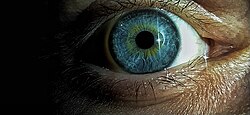
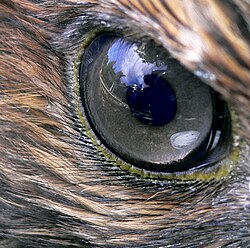
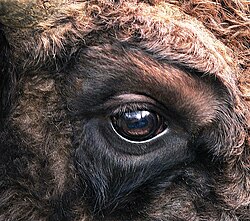
More advanced non-compound eyes, such as those found in vertebrates and some molluscs, function like a camera. Light enters the eye and is projected onto the retina, a light-sensitive layer of cells. Within the retina, cone cells handle color detection while rod cells manage low-light contrasts. These cells convert light into neural signals transmitted via the optic nerve.
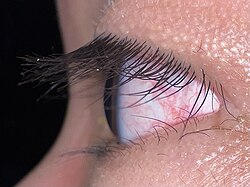
These eyes are generally spheroid and filled with vitreous humour (a transparent gel). They utilize a focusing lens and an iris. In humans, muscles adjust the pupil size to regulate light; however, many fish, amphibians, and snakes focus by telescoping the lens, similar to a camera lens.
Compound Eyes
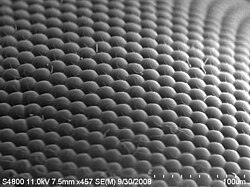
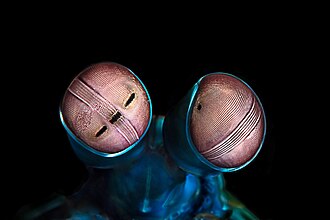
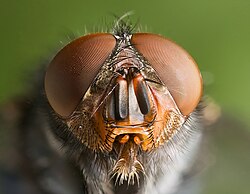
Arthropods utilize compound eyes, which consist of numerous simple facets. Each facet has its own lens and photosensitive cell. Depending on the species, these may produce a single pixelated image or multiple images that the brain fuses into a high-resolution picture.
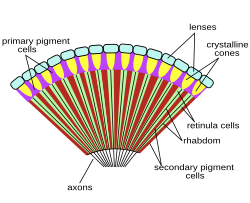
Compound eyes are exceptionally sensitive to motion. They are categorized into different types, including apposition eyes and superposition eyes (which are further divided into refracting, reflecting, and parabolic superposition types).
Physiology and Visual Performance
Visual Acuity
Visual acuity refers to the clarity or resolution of vision. There is a vast difference in acuity across species. For example, while a human with excellent vision can resolve 50 CPD, a rat can only resolve about 1 to 2 CPD. Interestingly, horses have higher acuity across most of their visual field than humans do, though they lack the extreme central clarity of the human fovea.
Color Perception and Light
Color vision is the ability to distinguish different spectral qualities of light. Most animals are limited to the 400-700 nm range. This limitation is believed to be a result of evolution in aquatic environments, where water filters out most of the electromagnetic spectrum, leaving only two small "windows" of light.
Comparative Eye Anatomy Summary
| Eye Type | Primary Organisms | Key Characteristic | Main Advantage |
|---|---|---|---|
| Pit Eye | Various Invertebrates | Eye-spot in a depression | Directional light sensing |
| Camera Eye | Vertebrates, Cephalopods | Single lens, retina | High resolution/acuity |
| Compound Eye | Arthropods (Insects, Crustaceans) | Multiple facets/ommatidia | Motion sensitivity, wide field of view |
To protect these delicate organs, mammals evolved unique features such as eyelids and eyelashes.

Frequently Asked Questions
What is the PAX6 gene?
The PAX6 gene is considered a key genetic factor in the evolution of eyes. It is a shared genetic feature across diverse species, supporting the theory that all modern eyes originated from a single type of proto-eye.
How do compound eyes differ from camera eyes?
Compound eyes consist of many individual lenses (facets) that detect motion and provide a wide field of view, whereas camera eyes use a single lens to project a high-resolution image onto a retina.
Why can't animals see the full electromagnetic spectrum?
Most animals are limited to wavelengths between 400 and 700 nm because the organ evolved in water, which blocks most of the spectrum. There was little evolutionary pressure for land animals to expand this range.
What is the difference between rods and cones?
In the retina, cone cells are responsible for detecting color, while rod cells are specialized for detecting contrasts in low-light environments.
How do fish and snakes focus their vision?
Unlike humans, who change the shape of the lens, most fish, amphibians, and snakes have fixed lens shapes and focus by moving the lens forward or backward, similar to a camera lens.