Anomalocaris: The Apex Predator of the Cambrian Seas
In the ancient oceans of the Cambrian period, one creature reigned supreme. Anomalocaris, a genus of prehistoric marine animals, represents one of the earliest examples of an apex predator—an organism at the top of the food chain with no natural predators of its own. With its formidable grasping appendages and sophisticated vision, it was a giant among its contemporaries, shaping the early evolution of marine ecosystems.
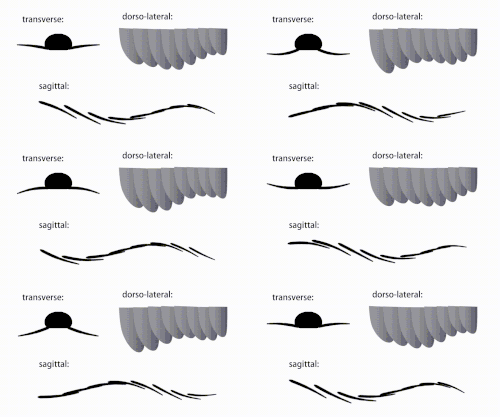
Belonging to the order Radiodonta (commonly known as radiodonts), Anomalocaris lived between 520 and 499 million years ago. These creatures are characterized by their unique anatomy, featuring swimming flaps along the body and a pair of segmented frontal appendages used to capture prey.
Key Facts
- Temporal Range: Early to Middle Cambrian (520–499 Ma).
- Classification: Stem-group Arthropoda, Order Radiodonta.
- Size: Estimated body lengths between 34.2 cm and 51.2 cm.
- Vision: Advanced compound eyes with up to 24,000 lenses per eye.
- Role: One of the first known apex predators in Earth's history.
Discovery and Scientific Identification
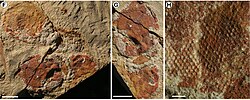
The journey to understanding Anomalocaris is a famous tale of paleontological misinterpretation. In 1966, Harry B. Whittington and his students, Simon Conway Morris and Derek Briggs, began revising the Burgess Shale fossil record. Initially, the different body parts of the animal were mistaken for entirely different species.
For years, the mouthparts were classified as a jellyfish-like creature called Peytoia, while the frontal appendages were thought to be the tails of shrimp-like animals. It wasn't until Whittington discovered a specimen where the appendages were unequivocally connected to the mouthparts that the scientific community realized these disparate fossils belonged to a single, enormous predator. While Peytoia was named first and is the technically correct name for the group, the name Anomalocaris was retained for the specific larger species of frontal appendages.
Anatomy and Physical Characteristics
Anomalocaris was massive compared to other Cambrian life. While early estimates suggested lengths up to 1 meter, modern analysis of the ratio between body parts suggests more modest but still impressive sizes.
Size and Species
The species A. canadensis typically reached body lengths of 34.2–37.8 cm (excluding the tail fan and appendages). However, A. daleyae, found in the Emu Bay Shale of Australia, was even larger, with estimated lengths ranging from 34.8 to 51.2 cm.
Vision and Sensory Capabilities
One of the most striking features of Anomalocaris was its stalked compound eyes. Analysis of fossils from the Emu Bay Shale reveals that these eyes were 30 times more powerful than those of trilobites. With over 24,000 ommatidia (individual lenses) in a single eye, its visual resolution rivaled that of a modern dragonfly. Furthermore, evidence suggests these predators may have possessed dichromatic color vision.
Feeding Mechanism
The animal utilized a pair of segmented frontal appendages to grasp its prey. These appendages were highly specialized for speed and capturing soft-bodied organisms.
Paleoecology and Hunting
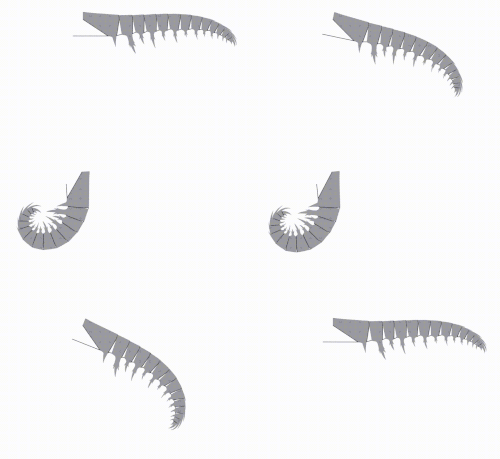
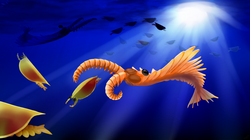
As a pelagic swimmer, Anomalocaris used its lateral body flaps to move efficiently through the water column. Its combination of high-resolution vision and raptorial appendages made it a lethal hunter of the Cambrian seas, targeting various organisms including Isoxys.
Summary of Anomalocaris Species and Classifications
| Species | Estimated Body Length | Key Feature | Primary Fossil Site |
|---|---|---|---|
| A. canadensis | 34.2–37.8 cm | Standard apex predator morphology | Burgess Shale |
| A. daleyae | 34.8–51.2 cm | Larger size; exceptional eye preservation | Emu Bay Shale |
Frequently Asked Questions
Was Anomalocaris a true arthropod?
Anomalocaris is classified as a stem-group arthropod. While it shares characteristics with modern arthropods, it belongs to the extinct order Radiodonta, representing an early evolutionary branch of the group.
How did scientists mistake its parts for different animals?
Because the fossils were often fragmented, the mouthparts looked like a separate organism (Peytoia) and the appendages looked like the abdomens of other crustaceans until a complete specimen linked them together.
How good was the vision of Anomalocaris?
Its vision was extraordinary for the time, featuring up to 24,000 lenses per eye, providing a resolution similar to that of a modern dragonfly and potentially allowing for color vision.
What did Anomalocaris eat?
It was an apex predator that used its frontal appendages to grasp prey. While once thought to crush hard shells, recent research suggests its appendages were better suited for speed and capturing soft-bodied prey.