Anomalocaris: The Giant Apex Predator of the Cambrian Seas
Long before the rise of dinosaurs, the oceans of the Cambrian period were ruled by a creature of staggering proportions and lethal efficiency. Anomalocaris, a member of the extinct order Radiodonta, represents one of the earliest examples of an apex predator—an animal at the top of the food chain with no natural predators of its own.
Characterized by its massive size relative to its contemporaries, Anomalocaris possessed a suite of specialized biological tools: swimming flaps for propulsion, highly advanced compound eyes, and a pair of formidable segmented appendages used to seize prey. These features allowed it to dominate the marine ecosystems between 520 and 499 million years ago.
Key Facts
- Temporal Range: Early to Middle Cambrian (520–499 Ma).
- Classification: Order Radiodonta, Class Dinocaridida.
- Maximum Size: Estimated up to 51.2 cm (approx. 20 inches) for A. daleyae.
- Vision: Compound eyes with up to 24,000 lenses per eye.
- Dietary Role: One of the first known apex predators in Earth's history.
The Puzzle of Discovery and Identification
The journey to understanding Anomalocaris is a famous case of paleontological misinterpretation. In the early 20th century, different parts of the animal were discovered and classified as entirely separate species. For years, researchers believed the mouthparts (assigned to Peytoia and Laggania) and the frontal appendages (assigned to Anomalocaris) belonged to different organisms.
It wasn't until a comprehensive revision of the Burgess Shale record in the 1960s and 70s, led by Harry B. Whittington, Simon Conway Morris, and Derek Briggs, that the pieces were fit together. The breakthrough occurred when Whittington discovered a specimen where the frontal appendage was unequivocally connected to a mouthpart similar to Peytoia. This revelation unified the fragments into a single, enormous creature, now categorized under the order Radiodonta (radiodonts).
Anatomy and Physical Description
Anomalocaris was a giant among its peers. While early estimates suggested lengths up to one meter, modern analysis of the ratio between body parts suggests more conservative figures. Anomalocaris canadensis is estimated to have reached 34.2–37.8 cm in body length, excluding its tail fan and appendages. A larger species, Anomalocaris daleyae, found in the Emu Bay Shale of Australia, is estimated to have reached between 34.8 and 51.2 cm.
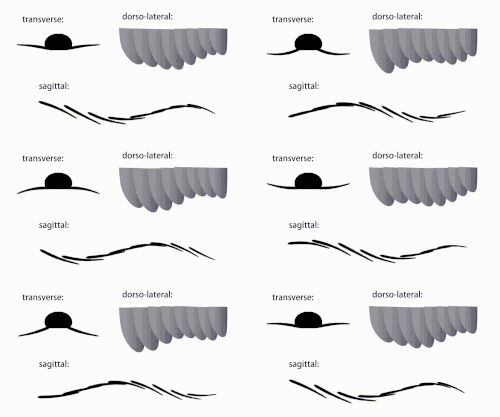
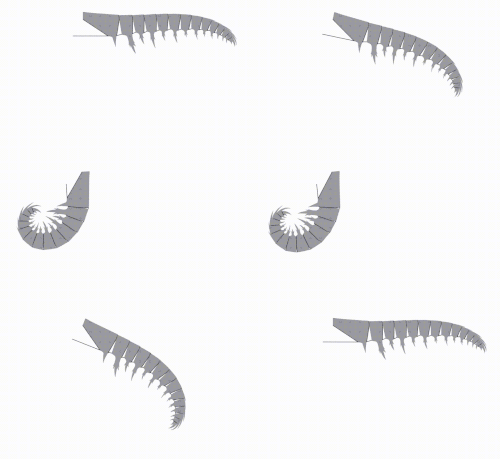
The creature's most striking features were its frontal appendages—segmented, grasping limbs used to capture prey. These were complemented by a specialized mouth and a series of swimming flaps that ran along the length of its body, allowing for efficient movement through the water column.
Advanced Visual Systems
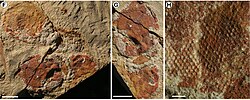
The visual capabilities of Anomalocaris were extraordinary. Fossilized compound eyes from A. daleyae reveal a level of sophistication that far surpassed the trilobites of the era. With one eye containing over 24,000 ommatidia (individual lens units), its resolution was comparable to that of a modern dragonfly. Furthermore, evidence suggests these predators may have possessed dichromatic color vision, providing a significant advantage when hunting in the Cambrian seas.
Paleobiology and Ecology
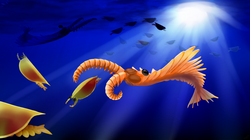
As a pelagic hunter, Anomalocaris occupied a critical niche in the early Paleozoic ecosystem. Its combination of speed, acute vision, and raptorial appendages made it a lethal hunter of soft-bodied organisms and potentially mineralized prey. Recent ecological reconstructions suggest a swimming posture with outstretched appendages, optimized for speed and precision during an attack.
Over time, the genus Anomalocaris has been refined. Many species originally assigned to it have been moved to other genera, such as Houcaris, Lenisicaris, Innovatiocaris, and Guanshancaris, as scientists better define the phylogenetic relationships within the Radiodonta order.
| Species | Estimated Body Length | Key Feature/Location | Visual Capability |
|---|---|---|---|
| A. canadensis | 34.2–37.8 cm | Burgess Shale; standard reference | High-resolution compound eyes |
| A. daleyae | 34.8–51.2 cm | Emu Bay Shale, Australia; larger size | ~24,000 lenses per eye |
Frequently Asked Questions
Was Anomalocaris the largest animal of the Cambrian?
It was one of the largest animals of its time, though not necessarily the absolute largest. Its size made it a dominant force, and it is widely considered one of the earliest apex predators.
How did scientists mistake it for multiple animals?
Because the fossils were often fragmented, the mouth, the body, and the appendages were found separately. Researchers initially thought the mouth was a jellyfish and the appendages were the legs of a different arthropod.
How good was the vision of Anomalocaris?
Its vision was incredibly acute, rivaling that of modern dragonflies. With tens of thousands of lenses per eye, it had a resolution 30 times more powerful than that of contemporary trilobites.
What did Anomalocaris eat?
It used its segmented frontal appendages to grasp prey. While it is known as an apex predator, research suggests its appendages were particularly well-suited for capturing soft-bodied prey and moving with speed.
Is Anomalocaris related to modern arthropods?
Yes, it is classified as a stem-group arthropod within the class Dinocaridida, representing an early evolutionary branch of the lineage that led to modern insects, spiders, and crustaceans.