Tabanidae: The Biology and Diversity of Horse Flies and Deer Flies
Often mistaken for common houseflies, members of the family Tabanidae are a distinct and fascinating group of true flies. Belonging to the order Diptera, these robust insects have a long evolutionary history, with a temporal range extending from the Berriasian period to the present day. With approximately 4,455 described species worldwide, the Tabanidae family represents a diverse group of insects that play complex roles in their various ecosystems.
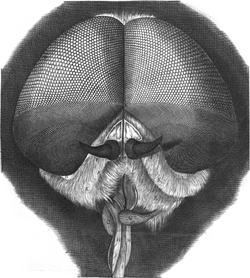
Key Facts
- Global Presence: Found worldwide except for polar regions and specific islands like Hawaii, Greenland, and Iceland.
- Size Range: Body lengths typically vary between 5 mm and 25 mm, with some wingspans reaching 60 mm.
- Diverse Genera: Includes Tabanus (horse flies), Chrysops (deer flies), and Diachlorus (yellow flies).
- Visual Sophistication: Possess advanced compound eyes capable of detecting light polarization.
- Larval Diet: Most species are carnivorous, consuming worms, insect larvae, and other arthropods.
Taxonomy and Classification
The Tabanidae are classified within the superfamily Tabanoidea and the infraorder Tabanomorpha. This superfamily also includes families such as Athericidae, Pelecorhynchidae, and Oreoleptidae. A notable characteristic shared by many tabanoid families is the presence of a venom canal in the mandibles of their larvae.
The family is divided into several subfamilies, including:
- Adersiinae
- Chrysopsinae
- Pangoniinae
- Scepsidinae
- Tabaninae
Physical Characteristics and Diversity
Tabanid species are generally medium to very large, robust insects. While they share a similar body plan, different genera exhibit distinct visual traits:
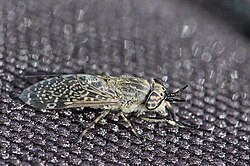
- Horse flies (Tabanus): These are the largest, reaching up to 25 mm in length. They are typically dark brown or black with dark eyes that often display a metallic sheen.
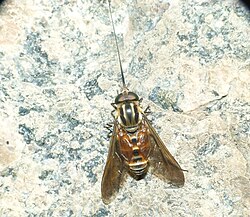
- Deer flies (Chrysops): Measuring up to 10 mm, these flies often have yellow to black bodies, striped abdomens, and membranous wings marked with dark patches.
- Yellow flies (Diachlorus): Similar in shape to deer flies, they are distinguished by their yellowish bodies and purplish-black eyes with a green sheen.
- Long-tongued flies (Subfamily Pangoniinae): Certain species, such as Philoliche sp., possess an exceptionally long, tubular mouthpart known as a proboscis, specialized for sucking nectar.
Anatomy of the Head
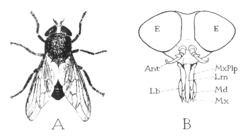
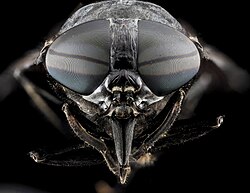
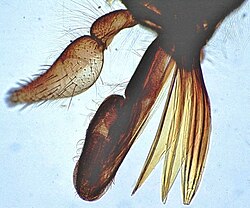
The head of a tabanid is dominated by its specialized feeding and sensory apparatus. In many species, the mouthparts are designed for efficient feeding, whether for nectar or blood. For example, the genus Tabanus features a complex arrangement of cutting and lapping structures.
Advanced Vision and Light Detection
One of the most remarkable features of the Tabanidae is their vision. Their compound eyes are composed of numerous optical units called ommatidia. These eyes are capable of detecting the polarization of light, a trait that is particularly important for females when targeting hosts.
The ommatidia in the suborder Brachycera contain eight photoreceptor cells, known as retinula cells (R). The outer cells (R1–R6) are primarily responsible for achromatic vision and motion detection. The central cells (R7 and R8) are specialized for detecting color and light polarity. There are two types of ommatidia—pale and yellow—which differ based on the wavelength sensitivity of the R8 cell. While they are highly sensitive to ultraviolet, blue, and green light, they cannot detect significant amounts of infrared or red light, meaning they cannot see the heat radiated by objects.
Life Cycle and Larval Development
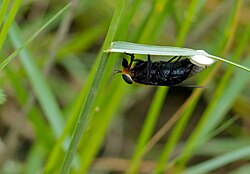
The life cycle of the Tabanidae begins when eggs are laid in clusters of up to 1,000 on vegetation or stones near water. These white eggs darken as they age and hatch after approximately six days. Upon hatching, the larvae use a specialized spike to exit the egg case and drop into moist ground or water.
Larval Characteristics
The larvae are legless, tapering grubs that typically possess 11 to 13 segments. They are largely carnivorous, often consuming worms and other arthropods, and can even exhibit cannibalistic behavior in captive environments. To breathe while submerged, they utilize a respiratory siphon located at their hind end. Depending on the species, larvae may be white, greenish, or brownish with dark bands.
While Chrysops species prefer very wet environments, Tabanus species are often found in drier locations. In temperate regions, larvae undergo a period of dormancy known as diapause during the winter, whereas tropical species may breed multiple times per year.
Pupation and Survival Adaptations
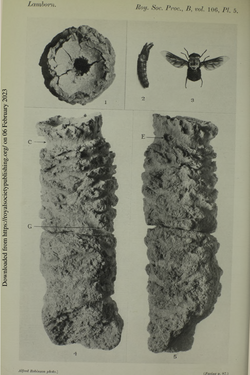
Once fully developed, the larvae move toward the soil surface to pupate. In certain environments, such as those found in Malawi, larvae have developed a unique survival strategy: they tunnel in a spiral motion through wet mud to create a partitioned cylinder. This structure protects the pupa from the physical stress of mudcracks that form as the ground dries.
Summary of Tabanidae Diversity
| Feature | Tabanus (Horse Fly) | Chrysops (Deer Fly) | Diachlorus (Yellow Fly) |
|---|---|---|---|
| Typical Length | Up to 25 mm | Up to 10 mm | Similar to Deer Fly |
| Body Color | Dark brown or black | Yellow to black | Yellowish |
| Eye Appearance | Dark, often metallic | Variable | Purplish-black with green sheen |
| Habitat Preference | Drier places | Very wet locations | Variable |
Predators and Ecosystem Interactions
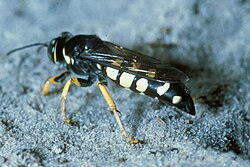
No insect exists in isolation. Tabanids are subject to predation by various species. For instance, the horse guard wasp (Stictia carolina) actively hunts horse flies to provide food for its brood within its nest.
Frequently Asked Questions
How do horse flies find their hosts?
Female horse flies use their advanced compound eyes to detect light polarization and specific visual cues, which helps them target suitable hosts.
Are all horse flies the same size?
No, they vary significantly. While many are between 5 and 25 mm, the specific size depends on the genus, with Tabanus being generally larger than Chrysops.
Where do horse flies lay their eggs?
Eggs are typically laid in large clusters of up to 1,000 on vegetation or stones located near water or moist soil.
Can horse flies see heat?
No. Their visual sensitivity is concentrated in the ultraviolet, blue, and green wavelengths. They lack the ability to detect significant infrared light, meaning they cannot see the heat radiated by objects.
What do horse fly larvae eat?
The larvae are carnivorous and feed on a variety of organisms, including worms, insect larvae, and other arthropods.