Understanding Arthropods: The World's Most Diverse Animal Phylum
From the depths of the ocean to the highest mountain peaks, arthropods are the most successful and diverse group of animals on Earth. With approximately 1,170,000 known species, this vast phylum includes everything from the tiny dust mite to the giant Japanese spider crab. Their ability to adapt to almost every environment is a testament to a biological design that has remained effective for hundreds of millions of years.
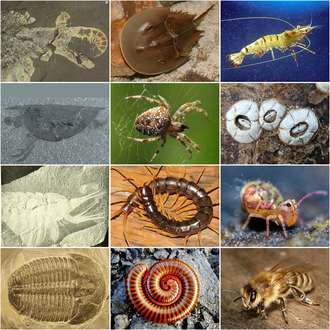
Key Facts
- Species Diversity: Roughly 1.17 million species identified.
- Temporal Range: They have existed from 538.8 million years ago to the present.
- Defining Traits: Characterized by a hard exoskeleton, segmented bodies, and jointed appendages.
- Major Groups: Includes insects, spiders, crustaceans, and myriapods (centipedes and millipedes).
- Evolutionary Link: Closely related to Onychophora, commonly known as velvet worms.
The Blueprint of an Arthropod
The success of arthropods lies in their unique body plan. Unlike vertebrates, which have an internal skeleton, arthropods possess an exoskeleton—a hard external covering that provides structural support and protection against predators and dehydration.
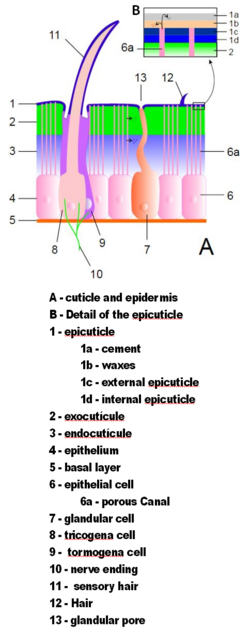
Their bodies are organized into somites (repeating segments), which are often fused into functional regions called tagmata. For example, many arthropods have a distinct head (cephalon) and a thorax or abdomen. This segmentation allows for specialized movement and the development of complex organs.
One of the most distinctive features of the phylum is their jointed appendages. Some species possess biramous appendages, meaning the limb branches into two parts, while others have uniramous (single-branched) limbs. These appendages are adapted for a variety of tasks, including walking, swimming, sensing the environment, and feeding.
![Structure of a biramous appendage.[21]](/images/da/e9/dae95a2b079b542c1677cc6a20186f1090a8a32f5d6b0d77dbce18010b12efee.png)
The Process of Moulting
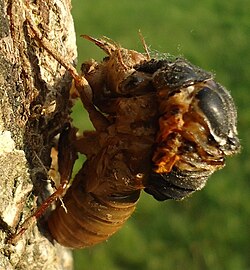
Because the exoskeleton is rigid, it cannot grow along with the animal. To increase in size, arthropods must undergo moulting (ecdysis). During this process, the animal sheds its old shell and grows a new, larger one. This is a vulnerable period in an arthropod's life, as they lack their protective armor until the new exoskeleton hardens.
Internal Systems and Senses
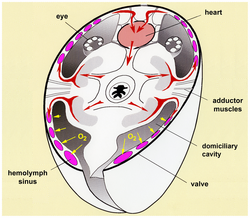
Arthropods have evolved efficient internal systems to support their active lifestyles. Their circulatory system is typically open, and respiration varies by species; some use gills, while others use specialized structures for gaseous diffusion.
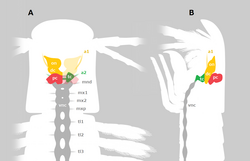
The nervous system consists of a central nervous system with a brain and a ventral nerve cord organized by segmented ganglia, which coordinate movement and responses across the body.
Sensory Perception
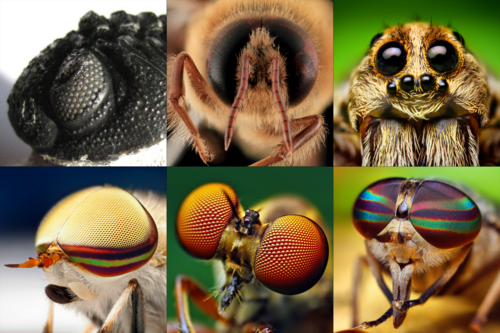
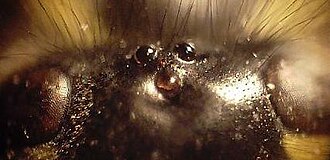
Arthropods are highly attuned to their surroundings. Their optical systems often include compound eyes, made of many individual lenses, and ocelli, which are simple eyes used to detect light intensity.
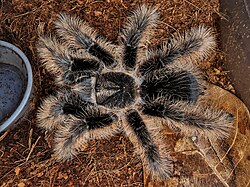
Beyond sight, they rely heavily on chemical and tactile senses. Many use antennae or setae (long, hair-like bristles) to detect vibrations, touch, and smells in their environment.
Classification and Diversity
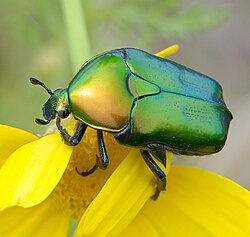
The phylum Arthropoda is broadly divided into several major groups based on their anatomy and evolutionary history. The most prominent living clades include the Chelicerata (spiders and horseshoe crabs) and the Mandibulata (which encompasses myriapods and pancrustaceans).
| Subphylum | Key Classes | Example Species |
|---|---|---|
| Chelicerata | Pycnogonida, Xiphosura, Arachnida | Platycryptus undatus (Spider) |
| Myriapoda | Symphyla, Pauropoda, Diplopoda, Chilopoda | Archispirostreptus gigas (Millipede) |
| Crustacea | Malacostraca, Branchiopoda, Copepoda | Ocypode ceratophthalma (Ghost Crab) |
| Hexapoda | Insecta, Entognatha | Saturnia pavonia (Moth) |
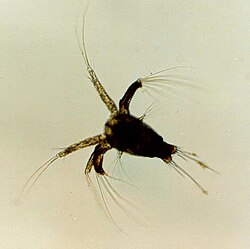
Development in arthropods can vary wildly. Some species undergo complex metamorphosis, while others, like certain shrimp, begin life as a nauplius larva, a specialized early developmental stage.
Evolutionary History
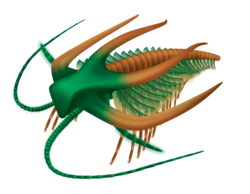
The fossil record reveals that arthropods appeared during the Cambrian period. Early transitional fossils, such as Kylinxia, provide clues on how stem-arthropods evolved into the "true" arthropods we see today.
![Kylinxia may be a key transitional fossil between stem-arthropods and true arthropods.[68]](/images/50/cf/50cf9bbebb42a8809e78dd17d659276b71f36563b6eb2c12da70c0dcb26936e3.png)
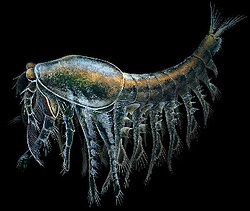
Other puzzling early forms, such as Marrella and Yicaris, highlight the experimental nature of early arthropod body plans. Research also indicates a close evolutionary relationship between arthropods and the velvet worm (Onychophora).
![The velvet worm (Onychophora) is closely related to arthropods[94]](/images/49/47/4947c926aed99063a08c519425ea3316891e561be1cb8e50694770e52a76de32.jpg)
Interaction with Humans
Arthropods have a complex relationship with humanity. In many cultures, they are a vital source of protein and are sold in food markets worldwide.
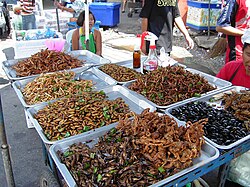
However, some arthropods are significant pests or vectors for dangerous diseases. Mosquitoes, in particular, are responsible for millions of cases of illness annually.
- Malaria: Transmitted by Anopheles mosquitoes (267 million cases/year; 1–2 million deaths).
- Dengue Fever: Transmitted by Aedes mosquitoes (5 million cases/year; 5,000 deaths).
- Yellow Fever: Transmitted by Aedes mosquitoes (4,432 cases/year; 1,177 deaths).
- Filariasis: Transmitted by Culex mosquitoes (250 million cases/year).
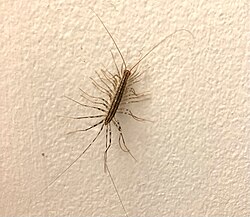
Beyond disease, many arthropods, such as the house centipede, coexist closely with humans in residential environments.
Frequently Asked Questions
What is the difference between an exoskeleton and an endoskeleton?
An exoskeleton is a hard outer shell located on the outside of the body, providing protection and support, whereas an endoskeleton (like that of humans) is an internal framework of bone or cartilage.
Why do arthropods have to moult?
Because their exoskeleton is rigid and does not grow, arthropods must shed their outer shell to allow their body to increase in size. This process is called moulting or ecdysis.
Which group of arthropods is the most diverse?
The Hexapoda, specifically the class Insecta, is the most diverse group, with beetles alone representing a massive portion of the phylum's total species count.
What are biramous appendages?
Biramous appendages are limbs that split into two branches. This is a common feature in many crustaceans and early arthropod fossils, allowing the limb to serve multiple functions, such as swimming and breathing.
How long have arthropods existed on Earth?
Arthropods have a temporal range starting from approximately 538.8 million years ago, making them one of the oldest and most resilient animal groups in the fossil record.