Enz River: A Journey from the Black Forest to the Neckar
The Enz is a significant river in the German state of Baden-Württemberg, carving a path from the rugged heights of the Northern Black Forest to its eventual confluence with the Neckar. Stretching approximately 106 kilometers in length, the Enz serves as a vital ecological artery and a historical economic lifeline for the region, passing through diverse landscapes ranging from steep wooded valleys to fertile wine-growing plains.
Key Facts
- Total Length: 105.6 km (including the Poppelbach).
- Source: Poppelbach in Besenfeld.
- Mouth: Neckar in Besigheim.
- Basin Size: 2,229 km².
- Major Cities: Pforzheim, Vaihingen, and Bietigheim-Bissingen.
- Key Tributaries: Nagold, Glems, and Metter.
Geography and River System
The Enz river system is characterized by a unique hydrographic quirk. While the river bears the name Enz, its right tributary, the Nagold, is nearly twice as long as the Enz's own headstream above their meeting point in Pforzheim. Furthermore, the Nagold carries double the volume of water at its mouth. Consequently, from a hydrological perspective, the Nagold is the main branch of the system, making the combined Enz-Nagold system the third longest tributary of the Neckar, following the Kocher and Jagst.
The Headstreams
The river begins with two primary headstreams: the Great Enz (Große Enz) and the Little Enz (Kleine Enz), which merge at the town of Calmbach. The Great Enz itself is formed by the union of the Poppelbach and the Kaltenbach at Gompelscheuer. While the Enz Spring (Enzbrunnen) is often marketed to tourists as the official source, the Poppelbach is the primary headstream in terms of water volume and catchment area.
Course Through the Black Forest
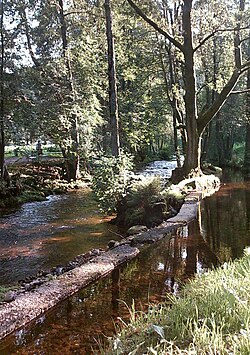
In its upper reaches, the Great Enz flows through narrow, wooded valleys shaped by glacial cirques from the last ice age. After passing through the Kegeltal at Sprollenhaus, the river cuts through bunter sandstone plateaux. The valley becomes more densely populated as it reaches the resort town of Bad Wildbad and continues through Neuenbürg, where the river forms a wide loop around the site of Neuenbürg Castle.
The Gäu and Neckar Basin
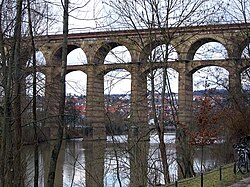
Upon leaving the Black Forest at Birkenfeld, the Enz enters the Gäu landscape—a region of South German Scarplands characterized by muschelkalk (shell limestone) beds. This lower course takes the river through the Kraichgau region and eventually into the Neckar Basin, passing through the industrial and administrative hubs of Vaihingen and Bietigheim-Bissingen before reaching its mouth.
Tributaries and Basin Overview
The Enz is fed by numerous streams that drain the Northern Black Forest and the surrounding basins. The most significant of these is the Nagold, but other notable contributors include the Glems and the Metter.
| Tributary | Side | Key Location/Feature |
|---|---|---|
| Little Enz | Right | Merges at Calmbach |
| Eyach | Left | Between Höfen and Neuenbürg |
| Nagold | Right | Major confluence at Pforzheim |
| Glems | Right | Joins near Unterriexingen |
| Metter | Left | Joins at Bietigheim |
Environment and Local Economy
Flora and Fauna
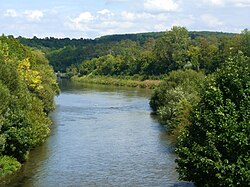
The lower Enz is a biodiversity hotspot, featuring water meadows, oxbow lakes, and riparian woodlands. Many of these areas are protected under the Natura 2000 network. The river supports a wide array of aquatic life, including mayflies, caddis flies, and fish species such as the barbel and bullhead. It is also a critical stop for migratory birds, including the kingfisher, goosander, and golden oriole.
Economic History and Industry
Historically, the Enz was central to the timber rafting industry, used to transport logs from the Black Forest. Evidence of this remains in the form of Schwallungen (storage ponds) like the Poppelsee. Today, the economy varies by region: the upper valley focuses on tourism and forestry, while the lower reaches are known for agriculture and viticulture on steep terraced slopes.
Industrial activity is concentrated in Pforzheim, world-renowned for its jewelry, watchmaking, and precious metals industries. Additionally, the region has a long history of iron ore mining dating back to the 5th century B.C., exemplified by the Frischglück Pit visitor mine.
Water Sports and Conservation
The upper Enz is a popular destination for white water canoeists, particularly the challenging Kurparkstrecke in Bad Wildbad. To protect the fragile ecosystem, authorities have implemented strict regulations in the Enzkreis and Ludwigsburg counties, including seasonal closures and designated entry points to protect pebble islands and spawning grounds.
Frequently Asked Questions
Which is the longest tributary of the Enz?
The Nagold is the longest tributary. In fact, it is nearly twice as long as the Enz's own headstream above their confluence in Pforzheim and carries significantly more water.
What was the historical economic importance of the Enz?
The river was vital for the timber rafting industry until the early 20th century, allowing for the efficient transport of logs from the Black Forest to other regions.
Is the Enz river protected for nature conservation?
Yes, several parts of the Enz valley, including the mouth of the Leudelsbach and the nature reserve near Vaihingen-Roßwag, are part of the Europe-wide Natura 2000 protected network.
What industries are prominent in the Enz region?
While forestry and tourism dominate the upper valley and viticulture is common in the lower reaches, Pforzheim is a major center for the jewelry, watch, and precious metals industries.
Can you go canoeing on the Enz?
Yes, white water canoeing is popular in the upper reaches, especially in Bad Wildbad. However, there are strict environmental regulations and seasonal closures in certain sections to protect the ecosystem.