Entente Cordiale: The Historic Rapprochement Between France and Britain
The Entente Cordiale (French for "cordial agreement") refers to a series of landmark agreements signed on April 8, 1904, between the United Kingdom and the French Republic. This diplomatic breakthrough marked a significant improvement in Anglo-French relations, effectively ending nearly a millennium of intermittent conflict and rivalry between the two nations.
While the term was first used in 1843 by British Foreign Secretary Lord Aberdeen to describe a "cordial, good understanding," it is most famously associated with the written, partly secret convention signed in London at the dawn of the 20th century.
Key Facts
- Signed Date: April 8, 1904.
- Primary Signatories: The United Kingdom of Great Britain and Ireland and the French Republic.
- Core Purpose: To resolve colonial disputes in Africa and Asia to avoid conflict and counter German influence.
- Key Figures: Théophile Delcassé (French Foreign Minister), Lord Lansdowne (British Foreign Secretary), and Paul Cambon (French Ambassador).
- Nature of Agreement: It was a diplomatic understanding, not a formal military alliance.
The Road to Cooperation
At the end of the 19th century, both nations found themselves in precarious positions. France felt isolated in Europe following the Napoleonic Wars and the defeat in the Franco-Prussian War (1870–71). German Chancellor Otto von Bismarck had actively worked to keep France estranged from potential allies to prevent it from seeking revenge for territorial losses in the Saar and Ruhr regions.
Simultaneously, Britain had pursued a policy of splendid isolation, avoiding permanent continental alliances and intervening only to protect its own interests. However, this changed after the Second Boer War, as Britain lost confidence in its strategic position and grew wary of Germany's rising power.
Despite these shared fears, the "Scramble for Africa" initially hindered cooperation. The 1898 Fashoda Incident, a colonial clash over the Upper Nile river basin in the Sudan, brought the two powers to the brink of war. France eventually backed down, suffering a diplomatic humiliation, but this realization of British superiority encouraged French Foreign Minister Théophile Delcassé to seek a friendship that could provide security against Germany.
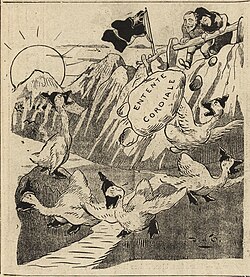
The Final Push for Agreement
The catalyst for the final agreement was the impending Russo-Japanese War. France was allied with Russia, and Britain had signed the Anglo-Japanese Alliance. To avoid being dragged into a conflict on opposing sides, the two powers decided to "shuck off their ancient rivalry" and resolve their global differences.
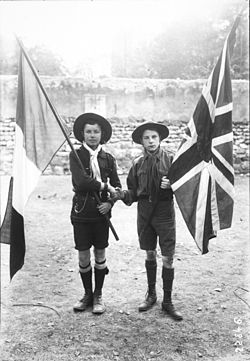
The Terms of the Agreement
The Entente Cordiale consisted of three primary documents focusing on colonial boundaries and spheres of influence rather than military cooperation.
Colonial Adjustments
- Africa: Britain recognized Morocco as being within the French sphere of influence, while France recognized Egypt as part of the British sphere. Britain also ceded the Los Islands to France and defined the Nigerian frontier in France's favor.
- North America: France renounced its exclusive rights to certain fisheries off the western coast of Newfoundland (the French Shore), though it retained the right to fish there.
- Asia and Pacific: In Siam (modern-day Thailand), the two nations established proposed zones of influence—French to the east of the Menam River basin and British to the west—though both eventually agreed not to annex Siamese territory. They also resolved jurisdictional disputes regarding the New Hebrides (Vanuatu).
The following table summarizes the primary territorial exchanges and recognitions:
| Region | British Recognition/Cession | French Recognition/Cession |
|---|---|---|
| North Africa | Recognized French influence in Morocco | Recognized British influence in Egypt |
| West Africa | Ceded Los Islands; adjusted Nigeria border | Gained Yarbutenda and Los Islands |
| North America | Regained control of Newfoundland coast | Renounced exclusive rights to French Shore |
| Asia (Siam) | Influence west of Menam River | Influence east of Menam River |
Long-Term Impact and Aftermath
Although not a formal military alliance, the Entente Cordiale paved the way for closer collaboration. When Germany attempted to disrupt the agreement during the First Moroccan Crisis (the Tangier Incident) in 1905, the move only served to strengthen the bond between London and Paris, leading to the initiation of military discussions between their general staffs.
Some officials in the British Foreign Office initially viewed the Entente as a mere "frame of mind" rather than a binding commitment. However, the partnership endured through the outbreak of World War I in 1914, eventually evolving into a formal military alliance.
Commemoration and Legacy
The legacy of the Entente Cordiale continues today through diplomatic events and educational initiatives. The 100th anniversary in 2004 featured state visits by Queen Elizabeth II and President Jacques Chirac, as well as the first-ever appearance of British troops in the Bastille Day parade.
Furthermore, the Entente Cordiale Scholarships, established in 1995 by John Major and Jacques Chirac, fund British and French students to study in each other's countries for one academic year, fostering mutual understanding among future leaders.
Frequently Asked Questions
Was the Entente Cordiale a military alliance?
No. It was a series of diplomatic agreements to resolve colonial disputes. While it created a friendly atmosphere that led to military cooperation, the formal Anglo-French military alliance was not established until the start of World War I in 1914.
What was the Fashoda Incident?
The Fashoda Incident was an 1898 colonial dispute in the Sudan where both Britain and France attempted to control the Upper Nile river basin. France's decision to back down from this confrontation helped pave the way for the Entente Cordiale.
How did Germany react to the agreement?
Germany viewed the Entente as a threat to its own system of alliances. In 1905, Germany attempted to break the agreement by intervening in Morocco (the Tangier Incident), but this action inadvertently strengthened the Anglo-French relationship.
What are the Entente Cordiale Scholarships?
Launched in 1995, these are selective scholarships that allow British and French students to spend one academic year studying in the other's country to promote cultural and intellectual exchange.
Why was the name "Waterloo" controversial in the context of the Entente?
Because the London terminus for the Eurostar was named Waterloo—the site of Napoleon's final defeat by a British-led alliance—some French politicians requested a name change. This issue was resolved when the service moved to St Pancras International in 2007.