Eastern Command of the Indian Army
The Eastern Command is a critical operational arm of the Indian Army, responsible for safeguarding the nation's eastern frontiers. Headquartered at Vijay Durg in Kolkata, West Bengal, this command manages a vast and geographically challenging terrain, ensuring stability and security across several northeastern states and bordering regions.
Key Facts
- Headquarters: Vijay Durg, Kolkata, West Bengal.
- Active Since: 1920 (with precursors dating back to 1904).
- Current Commander: Lt Gen V. M. Bhuvana Krishnan PVSM AVSM YSM.
- Major Engagements: World War II, Sino-Indian War, Indo-Pakistani War of 1971, and 2020 China–India skirmishes.
- Primary Components: III Corps, IV Corps, XVII Corps, and XXXIII Corps.
Historical Evolution
The origins of the Eastern Command trace back to the early 20th century. Between 1904 and 1908, the Bengal Command functioned as the precursor to the current structure. In 1908, under the recommendations of Lord Kitchener, the Commander-in-Chief of the Indian Army, the existing four commands were merged into two larger entities: the Northern Army and the Southern Army.
This consolidated system remained in place until 1920, when the military reverted to a four-command structure, officially re-establishing the Eastern Command alongside the Northern, Southern, and Western Commands.
Role in World War II
During the Second World War, the command played a pivotal role in regional defense. On April 21, 1942, it was re-designated as the Eastern Army, and its headquarters were moved to Barrackpore to better coordinate wartime operations. A notable achievement during this era was the raising of the Chindits in 1943 by the 77th Indian Infantry Brigade, a unit under the command's jurisdiction.
Post-War Transitions and the Sino-Indian War
Following the war, the Command Headquarters moved to Ranchi on March 23, 1947, and later to Lucknow in 1955. However, the aftermath of the Sino-Indian War necessitated a strategic reorganization. On May 1, 1963, the Central Command was re-raised with Lucknow as its base, while Kolkata was designated as the permanent headquarters for the Eastern Command.
The Indo-Pakistani War of 1971
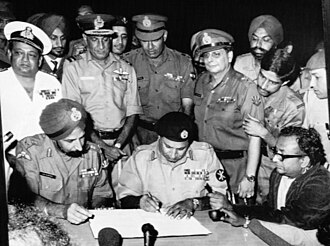
The Eastern Command was central to the victory in the 1971 conflict. The operation involved a massive mobilization of forces, including II Corps, IV Corps, and XXXIII Corps, coordinating complex maneuvers across East Bengal.
Key leadership during this period included Lieutenant General J. S. Aurora, head of the Indian Army's Eastern Command, who oversaw the final stages of the campaign.
Current Organizational Structure
Today, the Eastern Command maintains a sophisticated structure designed for mountain warfare and border security. It supervises several Corps and specialized areas to ensure comprehensive coverage of the eastern sector.
| Corps/Area | Headquarters | General Officer Commanding | Key Assigned Units |
|---|---|---|---|
| III Corps (Spear Corps) | Rangapahar, Nagaland | Lt Gen Abhijit S. Pendharkar | 2, 56, and 57 Mountain Divisions |
| IV Corps (Gajraj Corps) | Tezpur, Assam | Lt Gen Neeraj Shukla | 5, 21, and 71 Mountain Divisions |
| XVII Corps (Brahmastra Corps) | Panagarh, West Bengal | Lt Gen Yash Singh Ahlawat | 59 Mountain Division, 23rd Infantry Division |
| XXXIII Corps (Trishakti Corps) | Siliguri, West Bengal | Lt Gen Man Raj Singh Mann | 17, 20, and 27 Mountain Divisions |
| 101 Area | Shillong, Meghalaya | Lt Gen Mohit Wadhwa | Logistics and Communications |
| 111 Area | Bengdubi, West Bengal | Lt Gen Pawan Chadha | Regional Support |
Frequently Asked Questions
Where is the headquarters of the Eastern Command located?
The headquarters is located at Vijay Durg in Kolkata, West Bengal.
Who is the current commander of the Eastern Command?
The current commander is Lt Gen V. M. Bhuvana Krishnan PVSM AVSM YSM.
What were the Chindits?
The Chindits were specialized long-range penetration units raised in 1943 by the 77th Indian Infantry Brigade under the Eastern Command during World War II.
Which major wars has the Eastern Command been involved in?
The command has been active in World War II, the Sino-Indian War, the Indo-Pakistani War of 1971, and the 2020 China–India skirmishes.
What are the primary Corps under the Eastern Command?
The primary corps include the III Corps (Spear Corps), IV Corps (Gajraj Corps), XVII Corps (Brahmastra Corps), and XXXIII Corps (Trishakti Corps).