III Corps: A History of the British Army Field Corps
The III Corps was a significant field corps of the British Army, activated during both the First and Second World Wars. Serving as a critical intermediate command structure, it coordinated multiple divisions across some of the most pivotal theaters of 20th-century conflict, from the trenches of the Western Front to the evacuations of Dunkirk and the complexities of the Greek Civil War.
Key Facts
- Role: A field corps designed to provide command and control over multiple infantry divisions.
- Major Conflicts: Active during the First World War (1914–1918) and the Second World War (1939–1945).
- Key Engagements: Included the Battle of the Marne, the Battle of the Somme, the retreat to Dunkirk, and operations in Greece.
- Notable Commanders: Led by figures such as the Duke of Connaught, Sir William Pulteney, and Sir Ronald Adam.
- Evolution: Transitioned from a mobilization scheme in the 1870s to a fully operational combat headquarters in two global wars.
Early Origins and Pre-War Planning
Long before the global conflicts of the 20th century, the British Army experimented with the concept of the III Corps. In 1876, a mobilization scheme proposed eight army corps, with the 3rd Corps headquartered in Croydon and primarily composed of guards regiments. This specific structure was dropped by 1881, but the concept of corps-level organization persisted.
By 1891, the Stanhope Memorandum established a policy to mobilize three army corps for home defense. Later, in 1901, the army estimates introduced six regional corps. From October 1901, the Duke of Connaught held dual command as the Commander-in-Chief of Ireland and the General Officer Commanding-in-Chief (GOCinC) of III Corps. However, by 1907, the specific title of III Corps was removed, though the Irish Command continued to function as a corps comprising the 3rd Cavalry Brigade and the 5th and 6th Infantry Divisions.
III Corps in the First World War
When the British Expeditionary Force (BEF) was deployed in 1914, initial plans did not include intermediate headquarters between the General Headquarters (GHQ) and the infantry divisions. To align with the French army's two-division corps structure, the British improvised. III Corps HQ was officially formed in France on August 31, 1914, under the command of Sir William Pulteney.
The corps was immediately thrust into action, beginning with the First Battle of the Marne. It remained a fixture of the Western Front throughout the war, participating in grueling campaigns including the Battle of the Aisne, the Battle of Messines, and the Battle of Cambrai.
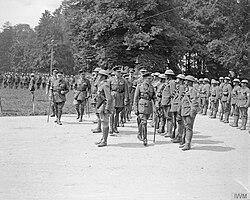
Composition and Evolution
The makeup of the III Corps shifted frequently to meet tactical needs. At its inception, it controlled the 4th and 6th Divisions. By the start of the Battle of the Somme in July 1916, its strength had evolved to include the 8th, 19th (Western), and 34th Divisions. During the final advance in Artois in October 1918, under Lieutenant-General Richard Butler, the corps commanded the 55th (West Lancashire) and 74th (Yeomanry) Divisions.
III Corps in the Second World War
The III Corps was reconstituted in France during the Second World War under Lieutenant-General Sir Ronald Forbes Adam. Its creation was a response to the expansion of the BEF, which had made the existing two-corps command structure too cumbersome to manage effectively.
The corps played a role in the desperate fighting of May 1940 and was eventually withdrawn during the evacuation from Dunkirk. Following this, the corps was based in the United Kingdom for a period, operating out of Whitchurch, Shropshire, where it was utilized for strategic deception purposes.
Global Deployment and Final Operations
The corps later moved to the Persia and Iraq Command as part of the British Tenth Army, where it commanded various formations, including the 5th Infantry Division. Its final major role began on October 16, 1944, when it became the headquarters for Lieutenant-General Ronald Scobie during the Greek Civil War. It managed forces including the 23rd Armoured Brigade before being redesignated as HQ Land Forces and Military Liaison (Greece) on December 17, 1944.
Summary of III Corps History
| Period | Primary Location | Key Commanders | Major Engagements/Roles |
|---|---|---|---|
| Pre-WWI (1901-1907) | Ireland / UK | Duke of Connaught | Home Defence / Irish Command |
| First World War | Western Front | Sir William Pulteney, Richard Butler | Marne, Somme, Artois, Cambrai |
| Second World War (Early) | France / UK | Sir Ronald Adam | Battle of France, Dunkirk |
| Second World War (Late) | Persia, Iraq, Greece | Ronald Scobie | Tenth Army, Greek Civil War |
Frequently Asked Questions
Why was III Corps created during the First World War?
It was created to match the organizational structure of the French Army, which used two-division army corps. This allowed for better coordination between the British Expeditionary Force and its French allies.
What was the role of III Corps during the retreat to Dunkirk?
III Corps served as a command element for the BEF in France, controlling the 42nd (East Lancashire) and 44th (Home Counties) Infantry Divisions, among other artillery and engineer units, before being evacuated.
Who were some of the most notable commanders of the III Corps?
Notable commanders include the Duke of Connaught, Lieutenant-General Sir William Pulteney, Lieutenant-General Richard Butler, and Lieutenant-General Sir Ronald Adam.
What happened to III Corps at the end of the Second World War?
After operating in Greece during the Greek Civil War, the corps was redesignated as HQ Land Forces and Military Liaison (Greece) in December 1944.
Which major battles did III Corps fight in during WWI?
The corps was involved in several major engagements, including the First Battle of the Marne, the Battle of the Somme (1916 and 1918), the Battle of Cambrai, and the final advance in Artois.