Indian Army (1895–1947)
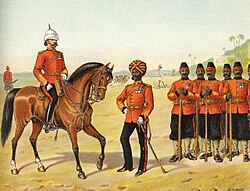
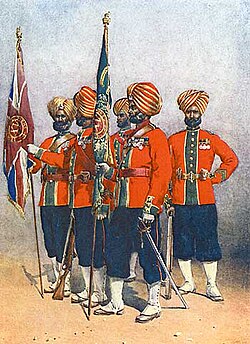
The Indian Army of the British Raj was a massive military force that served as a cornerstone of the British Empire's global power from the late 19th century until India's independence in 1947. Evolving from fragmented presidency forces into a unified professional army, it played a pivotal role in conflicts across Asia, Africa, and Europe.
Originally, military power in India was split between the Bengal, Madras, and Bombay armies under the East India Company. Following the Indian Rebellion of 1857, control shifted to the British Crown. By April 1, 1895, these separate entities were dissolved and unified into a single Indian Army, a structure that would eventually mobilize millions of soldiers during the two World Wars.
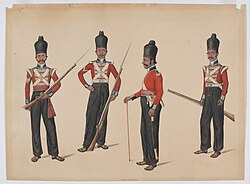
Key Facts
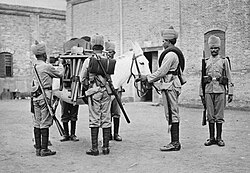
- Active Period: April 1, 1895 – August 15, 1947.
- Peak Strength: Approximately 1.5 million during WWI and 2.5 million during WWII.
- Allegiance: British Empire.
- Major Honors: 12 Victoria Crosses awarded in WWI and 31 in WWII.
- Core Structure: Transitioned from three Presidency armies to a unified command under GHQ India.
Evolution and Organizational Reforms
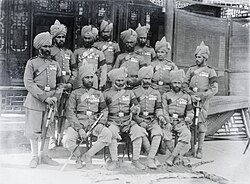
The transition to a unified army required significant structural changes. In 1879, the Presidency armies were integrated into four Commands with a central Commander-in-Chief. By 1903, the term "Indian Army" was officially adopted, and the Indian Staff Corps was abolished, meaning officers were now appointed directly to the army.
A General Staff was created to manage military policy, intelligence, and training. This was divided into the Adjutant-General (personnel and discipline) and the Quartermaster-General (supplies and communications). To professionalize leadership, the Indian Staff College was established in 1905, eventually basing its operations in Quetta in 1907.
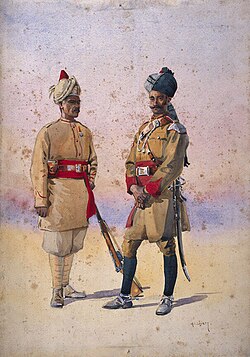
Regimental Changes and the Gurkhas
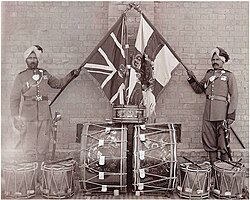
The Gurkha Regiments, known for their elite status, developed into their own line of rifle regiments starting in 1861. Over time, these expanded to include former Bengal Army units, eventually forming the 6th, 7th, and 8th Gurkha Rifles.
The First World War (1914–1918)
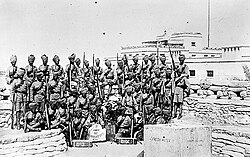
At the start of World War I, the British Indian Army consisted of 215,000 personnel. By November 1918, this number had surged to 573,000. Indian soldiers fought in diverse theaters, facing extreme conditions and high casualties.
The human cost was significant: 47,746 Indians were reported dead or missing, and 65,126 were wounded. Despite these losses, the bravery of the troops was recognized with 13,000 medals, including 12 Victoria Crosses, the highest award for gallantry in the face of the enemy.
Combat and Deployment
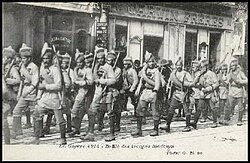
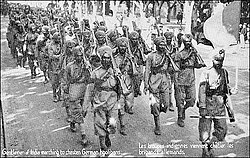
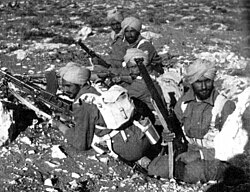
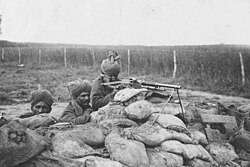
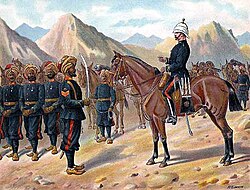
Indian troops were deployed to France, Mesopotamia, and other fronts. The 15th Sikh Regiment, for instance, arrived in Marseille to engage German forces, while the 2nd Rajput Light Infantry operated machine gun sections in the winter of 1914–15 in Flanders.
The Interwar Period and Indianisation
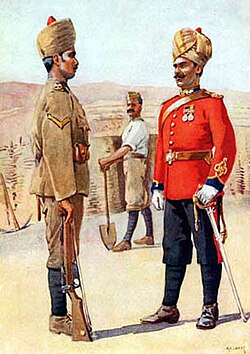
![Officer of the 15th Lancers (Cureton's Multanis), painted by Maj. A. C. Lovett. The regiment served in France during the 1914 Winter Operations.[45]](/images/c8/20/c8202a9d1229170ffb247d9e5bb0796b22f4b282dbd65226190fc672b46203af.jpg)
Between 1918 and 1939, the army focused on internal security and regional conflicts, such as the Third Anglo-Afghan War of 1919. This era saw the creation of the Indian Territorial Force (ITF) in 1920, a volunteer organization modeled after the British Territorial Army.
A critical social shift occurred through Indianisation—the process of promoting Indians to higher officer ranks. Indian cadets began studying at the Royal Military College, Sandhurst, becoming King's Commissioned Indian Officers (KCIOs). These officers held full authority over British troops, unlike the previous Viceroy's Commissioned Officers (VCOs). In 1932, the Indian Military Academy was established in Dehradun to provide local training for these officers.
The Second World War (1939–1945)
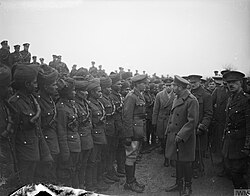
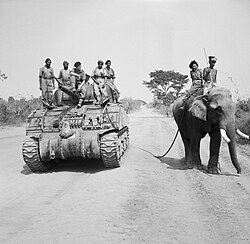
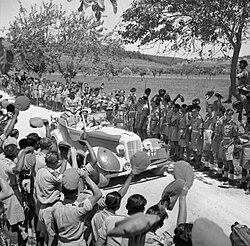
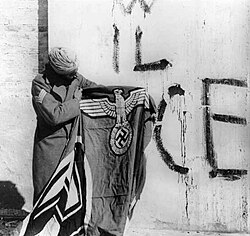
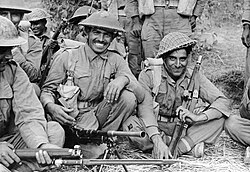
World War II saw the Indian Army reach its largest size, with roughly 2.5 million men serving. The force was instrumental in several global theaters, including the North African campaign (Operation Crusader), the Italian campaign (Battle of Monte Cassino), and the grueling Burma Campaign (Battles of Kohima and Imphal).
The cost of victory was high, with approximately 87,000 Indian soldiers killed. However, the army's contribution was highly decorated, with 31 Indians receiving the Victoria Cross. Some personnel faced darker fates; those captured in Malaya and Singapore were often subjected to forced labor in Japanese-occupied New Guinea.
Victory and Transition
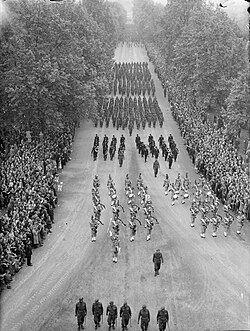
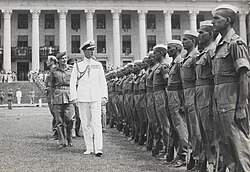
Following the war, the army participated in victory parades in Delhi (1946) and London (1946), marking the end of the conflict before the army was partitioned following India's independence in 1947.
Summary of the British Indian Army
| Feature | World War I | World War II |
|---|---|---|
| Approximate Size | 1,500,000 (Total serving) | 2,500,000 (Total serving) |
| Fatalities | 47,746 dead or missing | ~87,000 killed |
| Victoria Crosses | 12 | 31 |
| Key Theaters | France, Mesopotamia | North Africa, Italy, Burma |
Frequently Asked Questions
![Indian Army soldiers pass the saluting base in the Delhi Victory Week Parade, 7 March 1946.[65]](/images/5a/20/5a206ab578576586eb5f7694676a79c40fdfea55520aedb98eb7062382a5c7af.jpg)
What was the process of Indianisation?
Indianisation was the gradual promotion of Indian soldiers into higher officer ranks. This included sending cadets to Sandhurst in Great Britain and later establishing the Indian Military Academy in Dehradun in 1932, allowing Indians to hold full commissions as King's Commissioned Indian Officers.
How did the army transition from the East India Company to the Crown?
Following the Indian Rebellion of 1857, the British Crown took direct rule of India from the East India Company in 1858. All company troops were transferred to the Crown, eventually leading to the unification of the separate Presidency armies into a single Indian Army by 1895.
What role did the Gurkhas play in the Indian Army?
The Gurkhas were elite rifle regiments that developed their own distinct line starting in 1861. They were highly valued for their combat skills and expanded over time to include several regiments, such as the 6th, 7th, and 8th Gurkha Rifles.
Which major campaigns did the Indian Army fight in during WWII?
The army fought in numerous critical campaigns, including the East African and North African campaigns (such as Operation Compass and Operation Crusader), the Italian campaign (including the Battle of Monte Cassino), and the Burma Campaign (specifically the Battles of Kohima and Imphal).
What happened to the Indian Army after 1947?
With the independence and partition of India in 1947, the British Indian Army ceased to exist in its colonial form. Its administration and units were divided between the newly formed sovereign nations of India and Pakistan.